Introduction
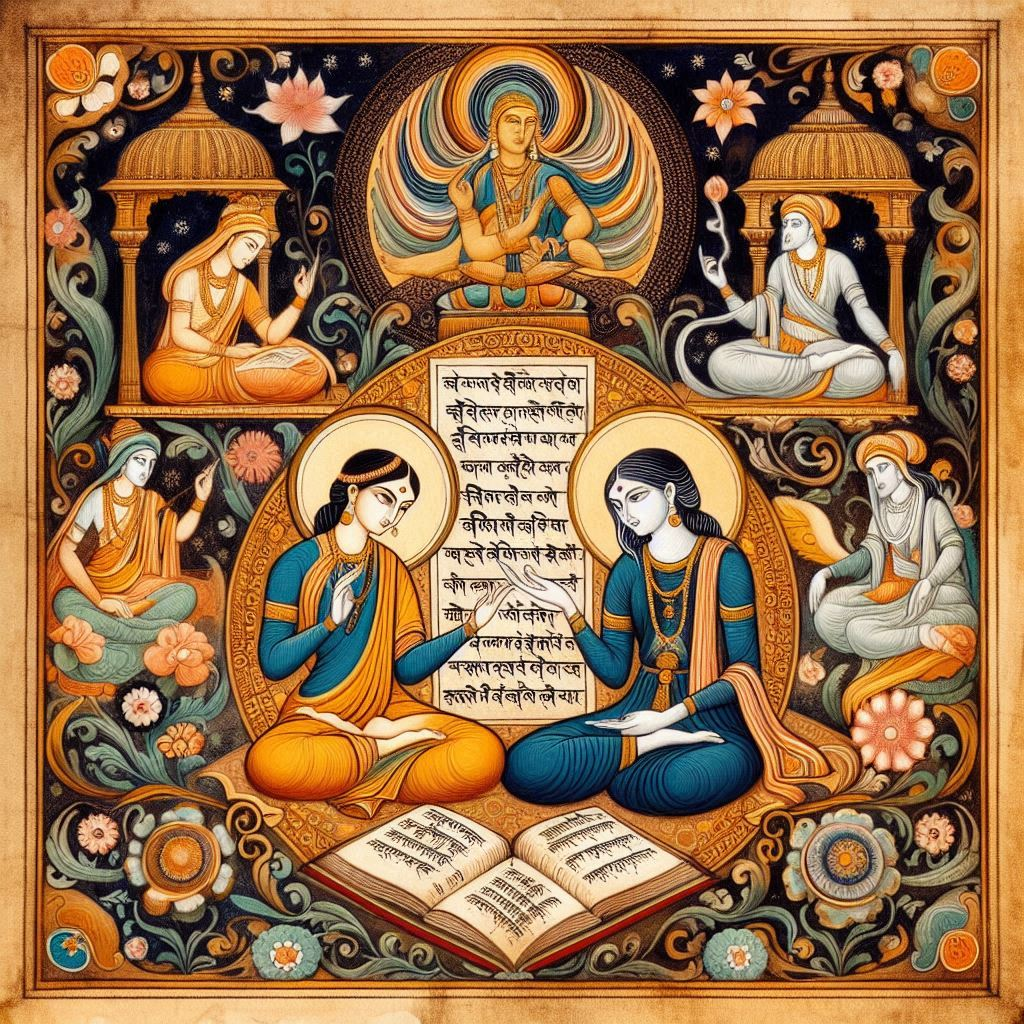
The following 75 verses constitute the entire First Canto (प्रथमः सर्गः) of Mahākavi Māgha’s Śiśupālavadha, detailing the dialogue between Lord Krishna and Sage Narada (कृष्णनारदसंभाषणम्). These verses directly precede Verse 2.1:
यियक्षमाणेनाहूतः पार्थेनाथ द्विषन्मुरम् ।
चैद्यं प्रति प्रतिष्ठासुरासीत् कार्यद्वयाकुलः ॥ १ ॥
Below, for each of the 75 ślokas, the original Sanskrit text, word-by-word meaning / key concepts (अन्वयार्थः), and an English translation are provided.
श्लोकः १ (Verse 1)
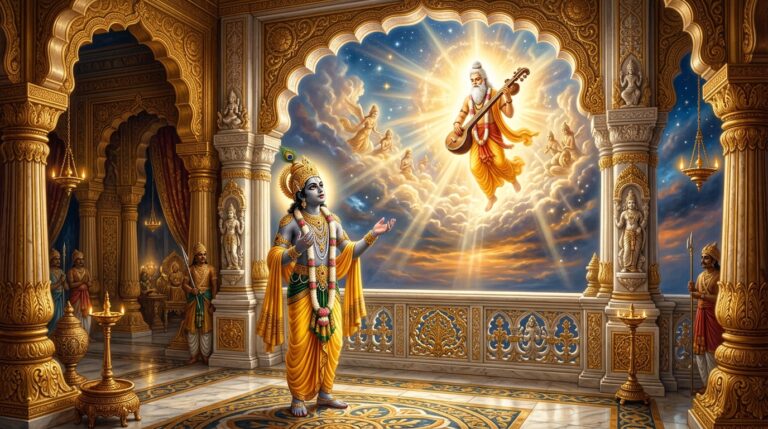
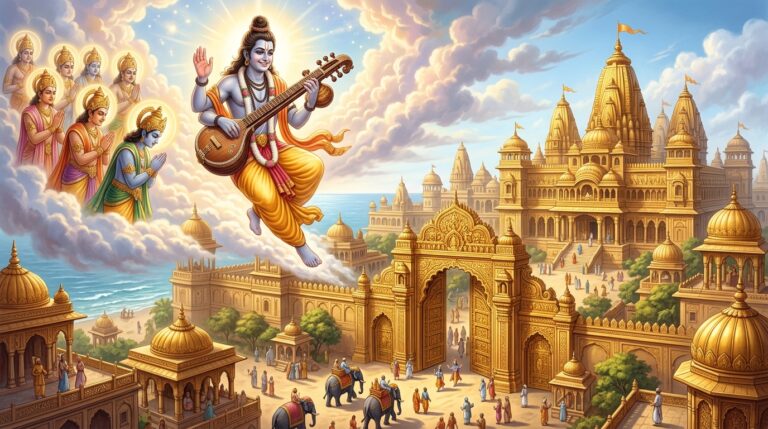
श्रियः पतिः श्रीमति शासितुं जगज्जगन्निवासो वसुदेवसद्मनि ।
वसन ददर्शावतरन्तमम्बराद् हिरण्यगर्भाङ्गभुवं मुनिं हरिः ॥ १ ॥
Meaning (अन्वयार्थः):
श्रियः पतिः (the lord/consort of Lakshmi), जगन्निवासः (the abode/dwelling of all the worlds), हरिः (Lord Krishna), जगत् शासितुम् (in order to govern and protect the world), श्रीमति वसुदेवसद्मनि वसन् (residing in the opulent palace of Vasudeva), अम्बरात् अवतरन्तम् (descending from the sky/firmament), हिरण्यगर्भाङ्गभुवं मुनिम् (the sage born of the mind/body of Brahma, i.e., Sage Narada), ददर्श (beheld/saw).
English Translation:
While residing in the splendid mansion of Vasudeva to protect and govern the universe, Lord Hari (Krishna)—the consort of Lakshmi and the supreme abode in whom all worlds dwell—beheld the sage Narada, the son born of Brahma, descending from the firmament.
श्लोकः २ (Verse 2)
गतं तिरश्चीनमनूरुसारथेः प्रसिद्धमूर्ध्वं ज्वलनं हविर्भुजः ।
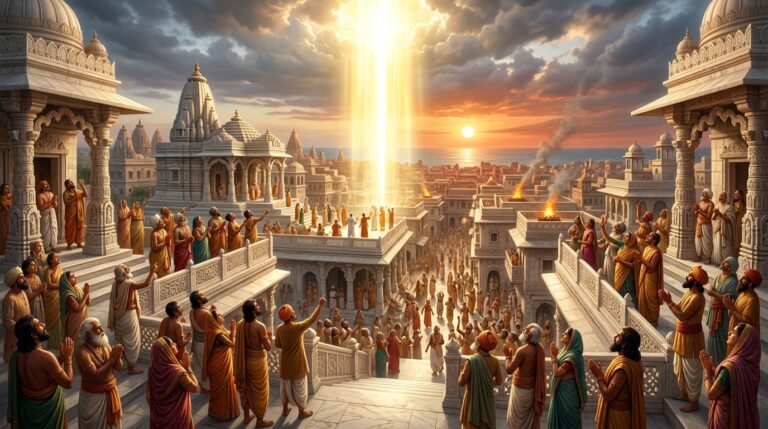
पतत्यधो धाम विसारि सर्वतः किमेतदित्याकुलमीक्षितं जनैः ॥ २ ॥
Meaning (अन्वयार्थः):
अनूरुसारथेः गतं तिरश्चीनं प्रसिद्धम् (the movement of the Sun, whose charioteer is Aruna, is well known to be transverse/oblique across the sky); हविर्भुजः ज्वलनम् ऊर्ध्वं प्रसिद्धम् (the flaming of Fire, consumer of oblations, is known to rise upwards); सर्वतः विसारि धाम अधः पतति (here, a mass of luster spreading in all directions is falling downwards); किम् एतत् इति (what can this be?) जनैः आकुलम् ईक्षितम् (thus was it watched in utter bewilderment by the people).
English Translation:
The path of the Sun (charioted by Aruna) is renowned for moving obliquely, and the blaze of Fire is known to soar upwards; yet this brilliance, radiating everywhere, was descending directly downwards. Gazing upon it, the onlookers wondered in deep astonishment: ‘What can this marvel be?’
श्लोकः ३ (Verse 3)
चयस्त्विषामित्यवधारितं पुरस्ततः शरीरीति विभाविताकृतिम् ।
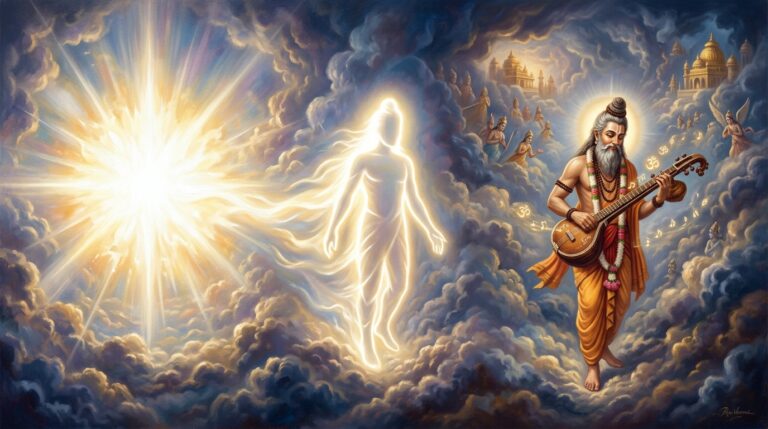
विभुर्विभक्तावयवं पुमानिति क्रमादमुं नारद इत्यबोधि सः ॥ ३ ॥
Meaning (अन्वयार्थः):
पुरः त्विषां चयः इति अवधारितम् (at first, it was discerned merely as an assemblage of radiant light); ततः शरीरी इति विभाविताकृतिम् (then, as a contour emerged, as an embodied living being); पुमान् इति विभक्तावयवम् (subsequently, as distinct limbs became visible, as a male human form); क्रमात् अमुं नारदः इति सः विभुः अबोधि (gradually, the all-pervading Lord Krishna recognized him specifically as Sage Narada).
English Translation:
At first, it was perceived merely as a dazzling mass of light; then, as its outline materialized, as an embodied entity; next, as distinct limbs took shape, as a man; and gradually, the omnipresent Lord discerned him with certainty: ‘This is Narada!’
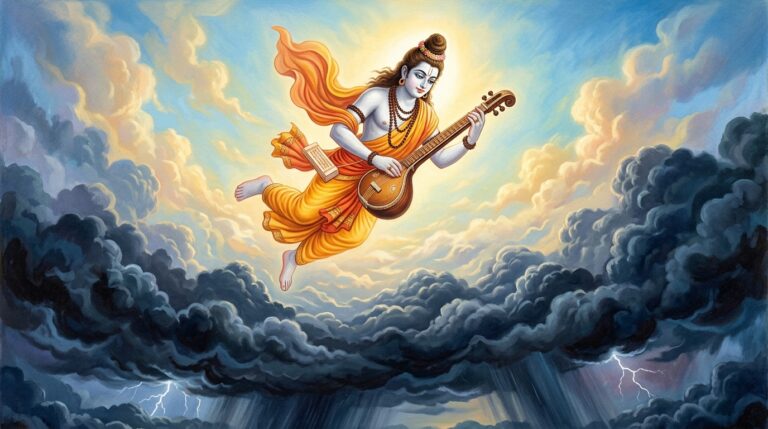
श्लोकः ४ (Verse 4)
नवानधोधो बृहतः पयोधरान् समूढकर्पूरपरागपाण्डुरम् ।
क्षणं क्षणोत्क्षिप्तगजेन्द्रकृत्तिना स्फुटोपमं भूतिसितेन शम्भुना ॥ ४ ॥
Meaning (अन्वयार्थः):
समूढकर्पूरपरागपाण्डुरम् (radiantly white like an accumulated mound of camphor powder); नवान् बृहतः पयोधरान् अधोधः [कुर्वन्तम्] (surpassing and leaving far below the vast, newly formed dark rainclouds); क्षणोत्क्षिप्तगजेन्द्रकृत्तिना (who for an instant flings up the dark hide of the slain elephant-demon); भूतिसितेन शम्भुना (white with smeared sacred ashes, Lord Sambhu/Shiva); क्षणं स्फुटोपमम् (bearing for a moment an unmistakable resemblance to Lord Shiva).
English Translation:
Gleaming brilliantly white like an accumulated heap of camphor dust as he left the vast, newly gathered dark rainclouds far below him, the sage appeared for a moment in vivid resemblance to Lord Shiva, who, white with sacred ashes, tosses the dark hide of the elephant-demon above his shoulders.

श्लोकः ५ (Verse 5)
दधानमम्भोरुहकेसरद्युतीर्जटाः शरच्चन्द्रमरीचिरोचिषम् ।
विपाकपिङ्गास्तुहिनस्थलीरुहो धराधरेन्द्रं व्रततीततीरिव ॥ ५ ॥
Meaning (अन्वयार्थः):
अम्भोरुहकेसरद्युतीः जटाः दधानम् (bearing matted locks that possessed the golden-yellow luster of lotus filaments); शरच्चन्द्रमरीचिरोचिषम् (possessing a body shining with the pure white radiance of autumn moonbeams); विपाकपिङ्गाः तुहिनस्थलीरुहः व्रततीततीः [दधानम्] धराधरेन्द्रम् इव (resembling the king of mountains, Himalaya, covered in snowy expanses and bearing clusters of creepers grown ripe and golden-yellow with maturity).
English Translation:
Bearing matted coils of hair radiant with the tawny hue of lotus filaments upon a body shining like the rays of the autumn moon, the sage looked like the monarch of mountains (Himalaya) clad in pure snow and crowned with ripe, golden-yellow climbing creepers.
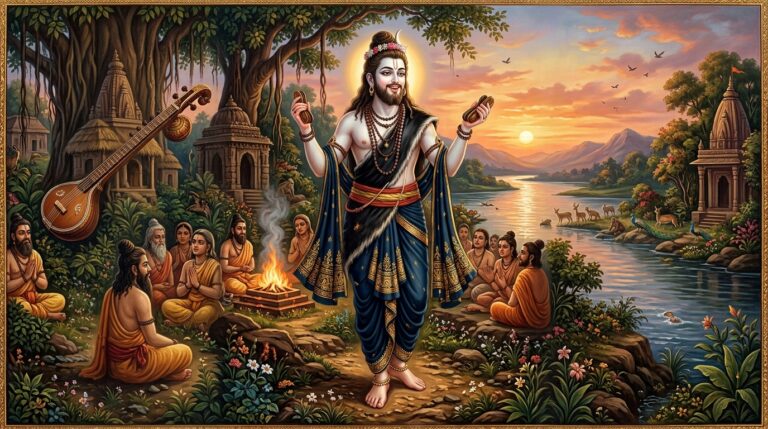
श्लोकः ६ (Verse 6)
पिशङ्गमौञ्जीयुजमर्जुनच्छविं वसानमेणाजिनमञ्जनद्युति ।
सुवर्णसूत्राकलिताधराम्बरां विडम्बयन्तं शितिवाससस्तनुम् ॥ ६ ॥
Meaning (अन्वयार्थः):
पिशङ्गमौञ्जीयुजम् (bound by a reddish-yellow girdle of Munja grass); अर्जुनच्छविम् (having a fair/white radiant complexion); अञ्जनद्युति एणाजिनं वसानम् (wearing a black antelope skin possessing the deep luster of dark collyrium); सुवर्णसूत्राकलिताधराम्बराम् (having dark-blue lower garments encircled by a golden cord/waistband); शितिवाससः तनुं विडम्बयन्तम् (emulating and mirroring the majestic form of Balarama, the blue-clad Lord).
English Translation:
Possessing a fair, glowing complexion, encircled by a reddish-yellow girdle of Munja grass, and draped in a black deer-skin dark as collyrium, he closely mirrored the form of Balarama (the blue-robed Lord), whose dark-blue attire is fastened with a girdle of golden cord.
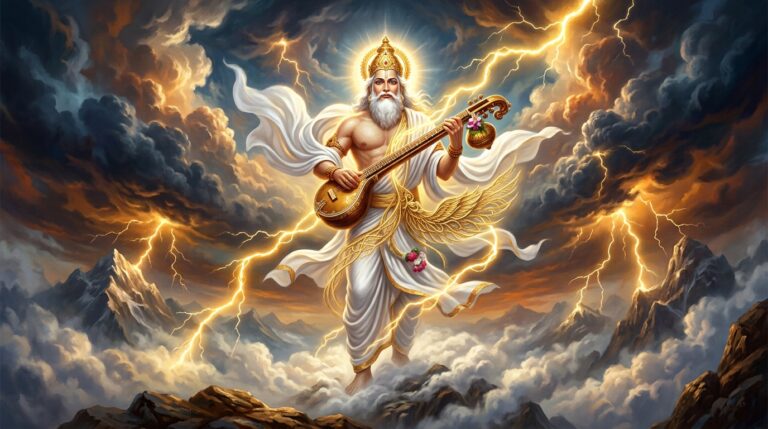
श्लोकः ७ (Verse 7)
विहङ्गराजाङ्गरुहैरिवाततैर्हिरण्यमयोर्वीरुहवल्लितन्तुभिः ।
कृतोपवीतं हिमशुभ्रमुच्चकैर्घनं घनान्ते तडितां गुणैरिव ॥ ७ ॥
Meaning (अन्वयार्थः):
हिरण्यमयोर्वीरुहवल्लितन्तुभिः (made from the golden fibers of celestial creepers of the Kalpavriksha); विहङ्गराजाङ्गरुहैः आततैः इव (resembling the spread-out golden feathers of Garuda, king of birds); कृतोपवीतम् (wearing a sacred thread); घनान्ते तडितां गुणैः [उपवीतं] हिमशुभ्रम् उच्चकैः घनम् इव (resembling a lofty cloud, white as snow at the close of the monsoon, encircled by luminous streaks of lightning).
English Translation:
Adorned with a sacred thread fashioned from the golden fibers of heavenly creepers—resembling the extended radiant feathers of Garuda—the sage, dazzling white as snow, looked like a lofty autumn cloud girdled by brilliant flashes of lightning.
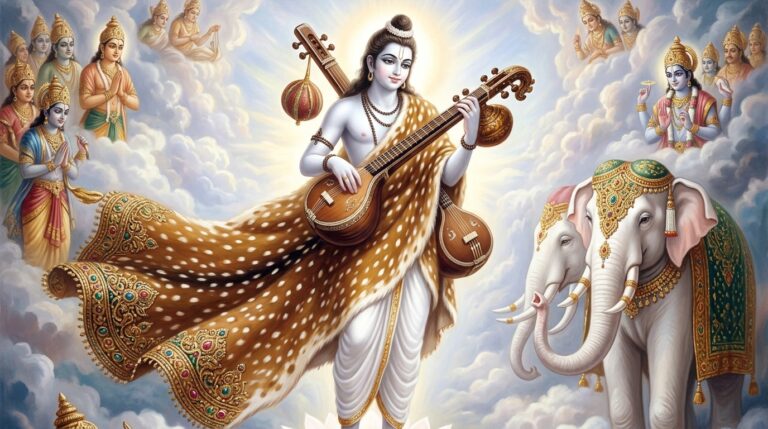
श्लोकः ८ (Verse 8)
निसर्गचित्रोज्वलसूक्ष्मपक्ष्म्णा लसद्बिसच्छेदसिताङ्गसङ्गिना ।
चकासतं चारुचमूरुचर्मणा कुथेन नागेन्द्रमिवेन्द्रवाहनम् ॥ ८ ॥
Meaning (अन्वयार्थः):
निसर्गचित्रोज्वलसूक्ष्मपक्ष्म्णा (naturally variegated with spots, bright, and having delicate fine hairs); लसद्बिसच्छेदसिताङ्गसङ्गिना (clinging to his fair body that gleamed white like freshly severed lotus stalk fibers); चारुचमूरुचर्मणा चकासतम् (shining resplendently with a beautiful Camuru antelope skin); कुथेन नागेन्द्रम् इन्द्रवाहनम् इव (resembling Airavata, the royal elephant and vehicle of Indra, covered with a colorful embroidered decorative housing blanket).
English Translation:
Shining with a graceful Camuru deer hide—naturally dappled, bright, and fine-haired—which draped his body that was as white as freshly cut lotus fibers, he appeared like Airavata, the celestial king of elephants ridden by Indra, draped in a splendidly painted decorative blanket.

श्लोकः ९ (Verse 9)
अजस्रमास्फालितवल्लकीगुणक्षतोज्ज्वलाङ्गुष्ठनखांशुभिन्नया ।
पुरः प्रवालैरिव पूरितार्द्धया विभान्तमच्छस्फटिकाक्षमालया ॥ ९ ॥
Meaning (अन्वयार्थः):
अजस्रम् आस्फालितवल्लकीगुणक्षत-उज्ज्वल-अङ्गुष्ठनखांशु-भिन्नया (intermingled and tinted by the crimson-red rays of his right thumb’s nail, slightly bruised and glowing from constantly striking the strings of his lute); पुरः प्रवालैः पूरितार्द्धया इव (appearing as if its front half were strung with red corals); अच्छस्फटिकाक्षमालया विभान्तम् (shining with a rosary of flawless, clear crystal beads).
English Translation:
He shone with a rosary of spotless crystal beads whose front half appeared as though studded with red coral, being tinted by the radiant pink rays reflecting from his thumb’s nail, which was slightly reddened and chafed from unceasingly plucking the strings of his divine lute.

श्लोकः १० (Verse 10)
रणद्भिराधट्टनया नभस्वतः पृथग्विभिन्नाश्रुतिमण्डलैः स्वरैः ।
स्फुटीभवद्ग्रामविशेषमूर्च्छना मवेक्षमाणं महतीं मुहुर्मुहुः ॥ १० ॥
Meaning (अन्वयार्थः):
नभस्वतः आघट्टनया रणद्भिः (resounding by the gentle friction of the passing wind); पृथक् विभिन्नाश्रुतिमण्डलैः स्वरैः (producing distinct musical notes arranged into their proper cycles of microtonal intervals / śrutis); स्फुटीभवद्ग्रामविशेषमूर्च्छनाम् (vividly manifesting the distinct scales/grāmas and melodic modulations/mūrcchanās); महतीं मुहुर्मुहुः अवेक्षमाणम् (fondly and repeatedly looking down upon his celebrated lute, Mahatī).
English Translation:
He was gazing repeatedly with affection upon his magnificent lute, Mahatī, whose strings, gently vibrating under the touch of the celestial breeze, produced melodious notes that clearly unfolded the precise microtonal intervals (śrutis), parental musical scales (grāmas), and rhythmic modulations (mūrcchanās).
श्लोकः ११ (Verse 11)
निवर्त्य सोऽनुव्रजतः कृतानतीनतीन्द्रियज्ञाननिधिर्नभःसदः ।
समासदत् सादितदैत्यसम्पदः पदं महेन्द्रालयचारु चक्रिणः ॥ ११ ॥
Meaning (अन्वयार्थः):
अतीन्द्रियज्ञाननिधिः सः (that sage Narada, a veritable treasure-house of transcendental knowledge beyond the senses); अनुव्रजतः कृतानतीन् नभःसदः निवर्त्य (graciously dismissing the celestials/gods who had followed him and offered their prostrations); सादितदैत्यसम्पदः चक्रिणः (of Lord Krishna, bearer of the discus, who had crushed the power and prosperity of demons); महेन्द्रालयचारु पदं समासदत् (reached the royal abode of the Lord, delightful and grand as Indra’s paradise).
English Translation:
Having graciously bid farewell to the celestial deities who had escorted him on his path and bowed in homage, that sage—a supreme repository of supersensory wisdom—arrived at the magnificent palace of Lord Krishna (the wielder of the Sudarshana discus), which rivaled Indra’s heaven in splendor and stood where demonic power had been completely vanquished.

श्लोकः १२ (Verse 12)
पतन् पतङ्गप्रतिमस्तपोनिधिः पुरोऽस्य यावन्न भुवि व्यलीयत ।
गिरेस्तडित्वानिव तावदुच्चकैर्जवेन पीठादुदतिष्ठदच्युतः ॥ १२ ॥
Meaning (अन्वयार्थः):
पतङ्गप्रतिमः सः तपोनिधिः (that repository of ascetic penance, dazzling like the sun); अस्य पुरः भुवि यावत् न व्यलीयत (before he could even alight upon the ground in front of Him); तावत् अच्युतः (even within that fleeting moment, Lord Achyuta/Krishna); गिरेः तडित्वान् इव (like a lightning-laden raincloud rising from a mountain summit); पीठात् उच्चकैः जवेन उदतिष्ठत् (swiftly and respectfully arose from his elevated throne).
English Translation:
Even before that radiant sun-like treasure of asceticism could alight upon the earth before Him, Lord Achyuta (Krishna) sprang up with swift reverence from his lofty throne, like a majestic, lightning-charged cloud rising from a mountain peak.

श्लोकः १३ (Verse 13)
अथ प्रयत्नोन्नमितानमत्फणैर्धृते कथञ्चित्फणिनां गणैरधः ।
न्यधायिषातामभिदेवकीसुतं सुतेन धातुश्चरणौ भुवस्तले ॥ १३ ॥
Meaning (अन्वयार्थः):
अथ (then); अधः प्रयत्नोन्नमितानमत्फणैः फणिनां गणैः कथञ्चित् धृते (upon the surface of the earth, which was somehow upheld from below with immense effort by the serpent hosts of Shesha, straining their bending hoods to raise them); धातुः सुतेन (by Narada, the son of Brahma the Creator); देवकीसुतम् अभि (facing Lord Krishna, the son of Devaki); चरणौ भुवस्तले न्यधायिषाताम् (both feet were gently placed upon the ground).
English Translation:
Then the son of Brahma set his two feet upon the earth directly before the son of Devaki—upon that earth which was maintained in equilibrium only with great exertion by the subterranean serpents (headed by Adishesha), who strained to push up their bowed hoods beneath its weight.
श्लोकः १४ (Verse 14)
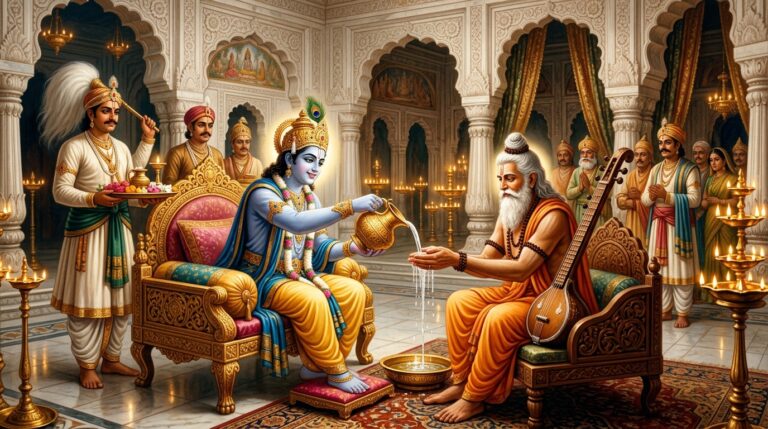
तमर्घ्यमर्घ्यादिकयादिपूरुषः सपर्यया साधु स पर्यपूपुजत् ।
गृहानुपैतुं प्रणयादभीप्सवो भवन्ति नापुण्यकृतां मनीषिणः ॥ १४ ॥
Meaning (अन्वयार्थः):
आदिपूरुषः सः (that Primordial Being, Lord Krishna); तम् अर्घ्यम् (that venerable sage, worthy of the highest guest-worship); अर्घ्यादिकया सपर्यया साधु पर्यपूपुजत् (duly and perfectly honored with the offering of the ceremonial arghya, water, and traditional hospitality); हि (for indeed); मनीषिणः (wise and enlightened sages); अपुण्यकृतां गृहान् (the houses of those who lack spiritual merit); प्रणयात् उपैतुम् अभीप्सवः न भवन्ति (never desire to visit out of affection or goodwill).
English Translation:
The Primordial Being (Lord Krishna) devoutly worshiped that venerable guest with the traditional offerings of arghya and hospitable rites; for indeed, spiritually enlightened sages never deign to enter the abodes of those who are devoid of sacred merit.
श्लोकः १५ (Verse 15)
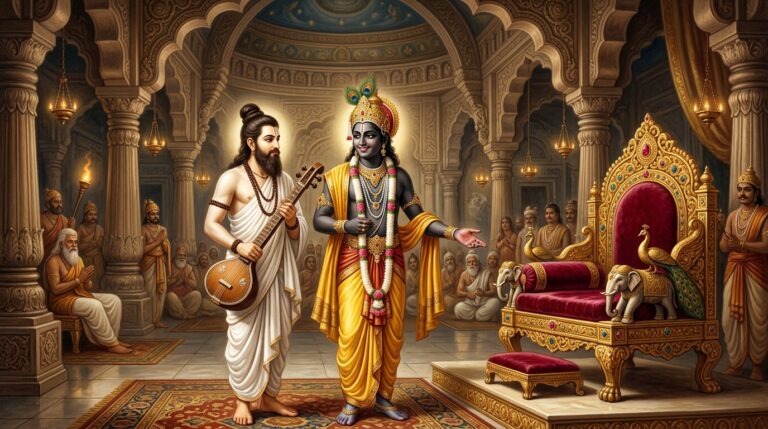
न यावदेतावुदपश्यदुत्थितौ जनस्तुषारासाराञ्जनपर्वताविव ।
स्वहस्तदत्ते मुनिमासने मुनिश्चिरन्तनस्तावदभिन्यवीविशत् ॥ १५ ॥
Meaning (अन्वयार्थः):
जनः एतौ तुषारासाराञ्जनपर्वतौ इव (the assembled people, looking upon the two standing together, resembling a mountain of snow and a mountain of black collyrium); यावत् उदपश्यत् (while they were still gazing upon them in awe); चिरन्तनः मुनिः तावत् (the ancient primordial sage, Lord Narayana/Krishna, in the meantime); स्वहस्तदत्ते आसने मुनिम् अभिन्यवीविशत् (cordially seated the sage Narada upon a luxurious throne presented by His own hands).
English Translation:
While the onlookers were still beholding the magnificent sight of the two standing together—resembling a mountain of snow beside a mountain of dark collyrium—the Eternal Sage (Lord Krishna) graciously seated Sage Narada upon a throne offered with His own hands.
श्लोकः १६ (Verse 16)
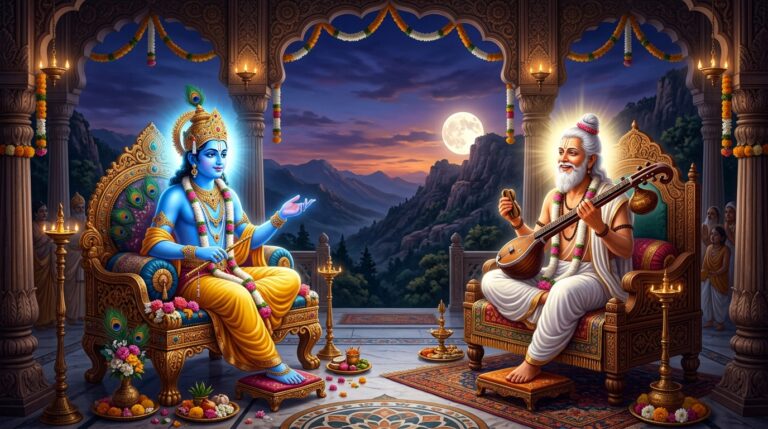
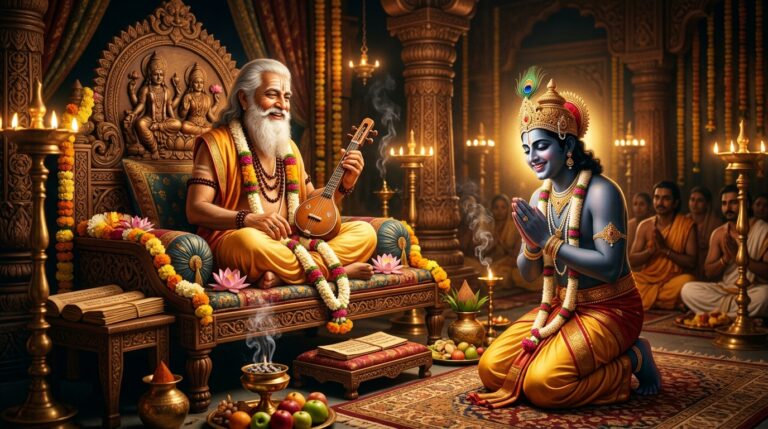
महामहानीलशिलारुचः पुरो निषेदिवान् कंसकृषः स विष्टरे ।
श्रितोदयाद्रेरभिसायमुच्चकैरचूचुरच्चन्द्रमसोऽभिरामताम् ॥ १६ ॥
Meaning (अन्वयार्थः):
महामहानीलशिलारुचः कंसकृषः पुरः (before Lord Krishna, the destroyer of Kamsa, who gleamed with the luster of a massive sapphire gemstone); विष्टरे निषेदिवान् सः (seated upon his high seat, that sage Narada); अभिसायम् उदयाद्रिं श्रितः (resting atop the eastern mountain at the arrival of evening twilight); चन्द्रमसः अभिरामताम् उच्चकैः अचूचुरत् (thoroughly stole and outshone the celestial loveliness of the rising full moon).
English Translation:
Seated upon the splendid throne opposite Lord Krishna (the slayer of Kamsa), whose hue was that of a colossal polished sapphire, the sage completely eclipsed the serene beauty of the full moon rising atop the eastern mountain against the darkening evening sky.
श्लोकः १७ (Verse 17)
विधाय तस्यापचितिं प्रसेदुषः प्रकाममप्रीयत यज्वनां प्रियः ।
ग्रहीतुमार्यान् परिचर्यया मुहुर्महानुभावा हि नितान्तमर्थिनः ॥ १७ ॥
Meaning (अन्वयार्थः):
यज्वनां प्रियः (Lord Krishna, beloved of the performers of sacred sacrifices); प्रसेदुषः तस्य अपचितिं विधाय (having rendered worship to the delightfully pleased sage); प्रकामम् अप्रीयत (rejoiced with utmost contentment); हि (for); महानुभावाः (exalted and noble souls); परिचर्यया आर्यान् ग्रहीतुम् (to win over virtuous, venerable persons through devoted service); मुहुः नितान्तम् अर्थिनः [भवन्ति] (are ever intensely desirous).
English Translation:
Having reverently worshipped the benevolent sage, Lord Krishna—the beloved patron of sacred sacrificers—felt supreme delight; for truly, high-minded souls are ever eager to win the hearts of the virtuous through humble, dedicated service.

श्लोकः १८ (Verse 18)
अशेषतीर्थोपहृताः कमण्डलोर्निधाय पाणावृषिणाभ्युदीरिताः ।
अघौघविध्वंसविधौ पटीयसीर्नतेन मूर्ध्ना हरिरग्रहीदपः ॥ १८ ॥
Meaning (अन्वयार्थः):
अशेषतीर्थोपहृताः (collected from all the sacred pilgrimage waters/tirthas); अघौघविध्वंसविधौ पटीयसीः (supremely efficacious in obliterating all masses of sins); कमण्डलोः पाणाव् निधाय ऋषिणा अभ्युदीरिताः अपः (the waters poured from the kamandalu into his hand by the sage with consecrated chants); हरिः नतेन मूर्ध्ना अग्रहीत् (Lord Hari received upon His deeply bowed head).
English Translation:
With a deeply inclined head, Lord Hari accepted the consecrated waters that the sage poured from his holy water-pot into His palm—waters gathered from all the sacred tirthas across the universe, supremely capable of washing away every trace of sin.

श्लोकः १९ (Verse 19)
स काञ्चने यत्र मुनेरनुज्ञया नवाम्बुदश्यामवपुर्न्यविक्षत ।
जिगाय जम्बूजनितशriyः श्रियं सुमेरुशृङ्गस्य तदा तदासनम् ॥ १९ ॥
Meaning (अन्वयार्थः):
यत्र मुनेः अनुज्ञया (upon which golden throne, with the permission of the sage); नवाम्बुदश्यामवपुः सः न्यविक्षत (He whose body had the dark hue of a fresh raincloud, Lord Krishna, seated Himself); तदा तत् काञ्चनम् आसनम् (then that golden seat); जम्बूजनितश्रियः सुमेरुशृङ्गस्य श्रियं जिगाय (surpassed the splendor of the peak of Mount Sumeru, enriched by the golden fruits and sap of the celestial Jambu tree).
English Translation:
When Lord Krishna, whose divine form possessed the dark luster of a newly formed monsoon cloud, took His seat upon the golden throne with the sage’s blessing, that throne outshone the radiant peak of Mount Sumeru beautified by the golden waters of the heavenly Jambu tree.
श्लोकः २० (Verse 20)
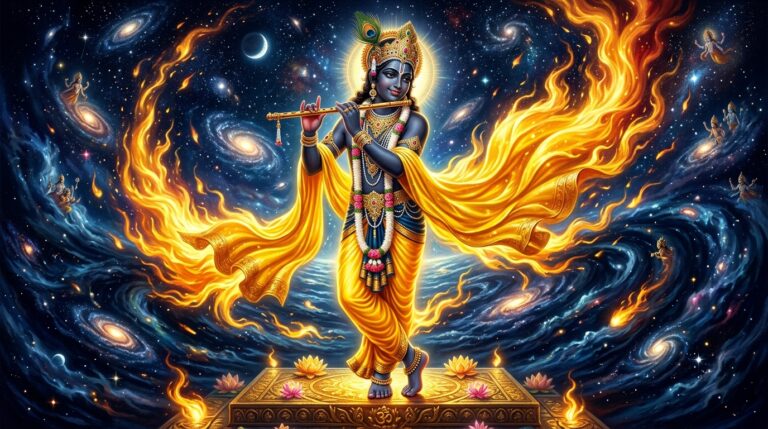
स तप्तकार्तस्वरभास्वराम्बरः कठोरताराधिपलाञ्छनच्छविः ।
विदोद्युते वाडवजातवेदसः शिखाभिराश्लिष्ट इवाम्भसां निधिः ॥ २० ॥
Meaning (अन्वयार्थः):
तप्तकार्तस्वरभास्वराम्बरः (adorned in yellow silken garments brilliant as refined, molten gold); कठोरताराधिपलाञ्छनच्छविः (possessing a deep dark complexion like the hare-mark on a mature full moon); सः (that Lord Krishna); विदोद्युते वाडवजातवेदसः शिखाभिः आश्लिष्टः (embraced by the flashing, darting crests of the submarine fire); अम्भसां निधिः इव [विरेजे] (shone like the vast ocean).
English Translation:
Draped in yellow silk resplendent like molten gold and possessing a body dark as the shadowy hare upon the full moon, Lord Krishna looked like the majestic ocean encompassed by the blazing, golden tongues of the submarine fire.

श्लोकः २१ (Verse 21)
रथाङ्गपाणेः पटलेन रोचिषामृषित्विषः संवलिता विरेजिरे ।
चलत्पलाशान्तरगोचरास्तरोस्तुषारमूर्तेरिव नक्तमंशवः ॥ २१ ॥
Meaning (अन्वयार्थः):
रथाङ्गपाणेः रोचिषां पटलेन संवलिताः (intermingling with the dense mass of dark radiance emanating from Lord Krishna, the bearer of the discus); ऋषित्विषः (the dazzling white bodily rays of the sage Narada); नक्तं तरोः चलत्पलाशान्तरगोचराः तुषारमूर्तेः अंशवः इव विरेजिरे (shone like the luminous white rays of the moon penetrating at night through the trembling green foliage of a tree).
English Translation:
The brilliant white rays radiating from Sage Narada, as they blended with the dense blue-black splendor of the discus-bearing Lord, shone like beams of cool moonlight filtering through the rustling, dark leaves of a forest tree at night.
Lorem ipsum dolor sit amet, consectetur adipiscing elit. Ut elit tellus, luctus nec ullamcorper mattis, pulvinar dapibus leo.
श्लोकः २२ (Verse 22)
प्रफुल्लतापिच्छनिभैरभीशुभिः शुभैश्च सप्तच्छदपांसुपाण्डुभिः ।
परस्परेण च्छुरितामलच्छवी तदैकवर्णाविव तौ बभूवतुः ॥ २२ ॥
Meaning (अन्वयार्थः):
प्रफुल्लतापिच्छनिभैः (resembling blossoming dark Tapiccha / Tamala blossoms, Krishna’s rays); सप्तच्छदपांसुपाण्डुभिः शुभैः च अभीशुभिः (and with auspicious white rays pale like the pollen of Saptacchada / seven-leaf tree flowers, Narada’s rays); परस्परेण च्छुरितामलच्छवी (their spotless natural radiances overlaying and suffusing one another); तौ तदा एकवर्णाव् इव बभूवतुः (the two divine personages appeared then as though merged into a single harmonious color).
English Translation:
With rays dark as blossoming Tamala flowers (from Krishna) and pure white like the pollen of Saptacchada blossoms (from Narada) intermingling and mutually enhancing their spotless complexions, the two divine beings seemed to coalesce into a single, wondrous hue.
श्लोकः २३ (Verse 23)
युगान्तकालप्रतिसंहृतात्मनो जगन्ति यस्यां सविकासमासत ।
तनौ ममुस्तत्र न कैटभद्विषस्तपोधनाभ्यागमसम्भवा मुदः ॥ २३ ॥
Meaning (अन्वयार्थः):
युगान्तकालप्रतिसंहृतात्मनः (who had withdrawn the cosmos into Himself at the time of universal dissolution / pralaya); यस्यां तनौ जगन्ति सविकासम् आसत (in whose divine body all the universes rested comfortably with ample space); तत्र कैटभद्विषः तनौ (in that very body of Lord Krishna, the foe of Kaitabha); तपोधनाभ्यागमसम्भवाः मुदः न ममुः (the surging ecstasies born of the arrival of the great ascetic Narada could not be contained!).
English Translation:
In whose divine form, when He withdraws the cosmos at the dissolution of the universe, all the worlds reside expansively without crowding—in that very body of Krishna (the destroyer of Kaitabha), the immense joy surging from the arrival of the holy sage could not find enough room to be contained!
श्लोकः २४ (Verse 24)
निदाघधामानमिवाधिदीधितिं मुदा विकासं यतिमभ्युपेयुषी ।
विलोचने बिभ्रदधिश्रितश्रियौ स पुण्डरीकाक्ष इति स्फुटोऽभवत् ॥ २४ ॥
Meaning (अन्वयार्थः):
मुदा विकासम् उपेयुषी (blooming wide with overflowing spiritual ecstasy); अधिदीधितिं यतिं निदाघधामानम् इव अभ्युपेयुषी (facing the sage, who radiated intense brilliance like the midday summer sun); अधिश्रितश्रियौ विलोचने बिभ्रत् (bearing two eyes that attained supreme aesthetic charm); सः पुण्डरीकाक्षः इति स्फुटः अभवत् (He made His celebrated epithet ‘Pundarikaksha’—the Lotus-Eyed—wonderfully manifest and true).
English Translation:
Expanding wide with joy as they turned toward the ascetic who radiated dazzling luster like the summer sun, Lord Krishna’s eyes attained such peerless beauty that His eternal name, ‘Pundarikaksha’ (the Lotus-Eyed Lord), became gloriously verified and evident to all.
श्लोकः २५ (Verse 25)
सितं सितिम्ना सुतरां मुनेर्वपुर्विसारिभिः सौधमिवाथ लम्भयन् ।
द्विजावलिव्याजनिशाकरांशुभिः शुचिस्मितां वाचमवोचदच्युतः ॥ २५ ॥
Meaning (अन्वयार्थः):
द्विजावलिव्याजनिशाकरांशुभिः (by the moonbeams disguised as the pearly rows of His gleaming teeth); विसारिभिः सितिम्ना (with their spreading white radiance); मुनेः सितं वपुः सुतरां सौधम् इव लम्भयन् (causing the sage’s fair white body to shine even brighter, like coating a white palace with fresh lime); अच्युतः शुचिस्मितां वाचम् अवोचत् (Lord Achyuta uttered words accompanied by a pure, luminous smile:).
English Translation:
Further brightening the naturally fair form of the sage—as though applying a fresh coat of gleaming white to an ivory palace—with the spreading moonbeams that were His pearly teeth, Lord Achyuta addressed him with a pure, radiant smile:
श्लोकः २६ (Verse 26)
हरत्ययं सम्प्रति हेतुरेष्यतः शुभस्य पूर्वाचरितैः कृतं शुभैः ।
शरीरभाजां भवदीयदर्शनं व्यनक्ति कालत्रितयेऽपि योग्यताम् ॥ २६ ॥
Meaning (अन्वयार्थः):
भवदीयदर्शनं (the holy vision / darśana of your revered self); सम्प्रति अयं [अघम्] हरति (at present, this dispels sins and brings immediate purification); एष्यतः शुभस्य हेतुः (it is the generative cause of future prosperity and auspiciousness); पूर्वाचरितैः शुभैः कृतम् (it has been achieved through righteous, virtuous deeds performed in the past); [इति] शरीरभाजां कालत्रितये अपि योग्यतां व्यनक्ति (thus, it proves and demonstrates the spiritual worthiness of embodied souls across all three dimensions of time—past, present, and future).
English Translation:
The vision of your revered self at present obliterates all sins; it acts as the cause of future auspiciousness; and it is attained through virtuous deeds performed in the past. Thus, beholding you manifests the spiritual merit of embodied beings across all three divisions of time.
श्लोकः २७ (Verse 27)
जगत्यपर्याप्तसहस्रभानुना न यन्नियन्तुं समभावि भानुना ।
प्रसह्य तेजोभिरसङ्ख्यतां गतैरदस्त्वया नुत्तमनुत्तमं तमः ॥ २७ ॥
Meaning (अन्वयार्थः):
जगति अपर्याप्तसहस्रभानुना भानुना (by the thousand-rayed sun, whose powers were insufficient in this world); यत् नियन्तुं न समभावि (that which could not be restrained or dispelled); अदः अनुत्तमं तमः (this unsurpassed, impenetrable inner darkness of spiritual ignorance); असङ्ख्यतां गतैः तेजोभिः (by your boundless, innumerable rays of spiritual light); त्वया प्रसह्य नुत्तम् (has been powerfully and forcibly driven away by you).
English Translation:
That unsurpassed darkness of worldly ignorance, which the thousand-rayed sun himself was powerless to conquer, has been forcibly vanquished by you through the innumerable and boundless rays of your spiritual radiance.
श्लोकः २८ (Verse 28)
कृतः प्रजाक्षेमकृता प्रजासृजा सुपात्रनिक्षेपनिराकुलात्मना ।
सदोपयोगेऽपि गुरुस्त्वमक्षतिर्निधिः श्रुतीनां धनसम्पदामिव ॥ २८ ॥
Meaning (अन्वयार्थः):
प्रजाक्षेमकृता (by the creator who desires the ultimate welfare of all living beings); सुपात्रनिक्षेपनिराकुलात्मना (whose mind is completely at peace having deposited his supreme treasure with an ideal recipient); प्रजासृजा (by Brahma, the creator of creatures); त्वं श्रुतीनां निधिः कृतः (you have been made the living treasury of the eternal Vedas); सदोपयोगे अपि (even when constantly used and drawn upon); अक्षतिः (undiminished, intact); धनसम्पदाम् इव (like an inexhaustible storehouse of vast riches); गुरुः [असि] (you are weighty and venerable).
English Translation:
By the Creator (Brahma)—who ever seeks the welfare of His subjects and whose heart is at rest having entrusted His wealth to the most worthy vessel—you have been established as the repository of the sacred Vedas; and like an inexhaustible treasury of riches, your wisdom remains wholly undiminished despite constant expenditure.
श्लोकः २९ (Verse 29)
विलोकनेनैव तवामुना मुने कृतः कृतार्थोऽस्मि निबर्हितांहसा ।
तथापि शुश्रूषुरहं गरीयसीर्गिरोऽथवा श्रेयसि केन तृप्यते ॥ २९ ॥
Meaning (अन्वयार्थः):
मुने (O holy Sage!); निबर्हितांहसा अमुना तव विलोकनेन एव (by this mere sight of you, which destroys every mass of sin); कृतः कृतार्थः अस्मि (I have already been made completely fulfilled); तथापि अहं गरीयसीः गिरः शुश्रूषुः (nevertheless, I am eager to listen to your weightier and sublime words); अथवा (or rather); श्रेयसि केन तृप्यते (who can ever feel satisfied or satiated with what is good and auspicious?).
English Translation:
O Sage! By this mere sight of you, which purges all sins, I have already attained the highest fulfillment. Yet, I yearn to hear your profound words—for indeed, who has ever felt satiated when partaking of the good and auspicious?
श्लोकः ३० (Verse 30)
गतस्पृहोऽप्यागमनप्रयोजनं वदेति वक्तुं व्यवसीयते यया ।
तनोति नस्तामुदितात्मगौरवो गुरुस्तवैवागम एष धृष्टताम् ॥ ३० ॥
Meaning (अन्वयार्थः):
गतस्पृहः अपि (though you are an ascetic sage entirely devoid of selfish desires); आगमनप्रयोजनं वद इति वक्तुं (to say: ‘Please declare the purpose of your arrival’); यया व्यवसीयते (the boldness with which I endeavor to ask); उदितात्मगौरवः तव एषः गुरुः आगमः एव (this weighty arrival of yours, which greatly elevates our prestige and dignity); नः तां धृष्टतां तनोति (alone inspires in us this presumption).
English Translation:
Though you are wholly desireless, the boldness that prompts me to ask, ‘Pray, reveal the reason for your visit,’ is inspired solely by this august arrival of yours, which exalts our honor and emboldens our inquiry.
श्लोकः ३१ (Verse 31)
इति ब्रुवन्तं तमुवाच स व्रती न वाच्यमित्थं पुरुषोत्तम त्वया ।
त्वमेव साक्षात्करणीय इत्यतः किमस्ति कार्यं गुरु योगिनामपि ॥ ३१ ॥
Meaning (अन्वयार्थः):
इति ब्रुवन्तं तं (to Lord Krishna who was speaking thus); सः व्रती उवाच (that ascetic sage Narada replied); पुरुषोत्तम (O Supreme Being, Purushottama!); त्वया इत्थं न वाच्यम् (it does not become You to speak in this manner); त्वम् एव साक्षात्करणीयः (You alone are the supreme reality to be directly beheld in realization); इतः योगिनाम् अपि गुरु कार्यं किम् अस्ति (other than this, what higher or weightier task can there possibly be even for the most accomplished yogis?).
English Translation:
To the Lord speaking thus, the ascetic sage replied: ‘O Purushottama! It does not befit You to speak in this modest way. To realize and behold You directly in person—what higher purpose than this could ever exist, even for the greatest of yogis?’
श्लोकः ३२ (Verse 32)
उदीर्णरागप्रतिरोधकं जनैरभीक्ष्णमक्षुण्णतयातिदुर्गमम् ।
उपेयुषो मोक्षपथं मनस्विनस्त्वमग्रभूमिर्निरपायसंश्रया ॥ ३२ ॥
Meaning (अन्वयार्थः):
उदीर्णरागप्रतिरोधकम् (blocked by the formidable obstacles of mounting worldly passions and attachments); जनैः अभीक्ष्णम् अक्षुण्णतया (owing to its rarely being trodden or cultivated by ordinary people); अतिदुर्गमम् (exceedingly impassable and difficult to traverse); मोक्षपथम् उपेयुषः (who have set out upon the path of spiritual liberation); मनस्विनः (for such self-controlled, resolute seekers); त्वं निरपायसंश्रया अग्रभूमिः (You are the ultimate destination, the immutable and safe haven of eternal refuge).
English Translation:
For resolute seekers who traverse the path to final liberation—a path obstructed by rising attachments and impassable because it is untrodden by the common multitude—You are the supreme, ultimate destination, the unfailing sanctuary of eternal refuge.
श्लोकः ३३ (Verse 33)
उदासितारं निगृहीतमानसैर्गृहीतमध्यात्मदृशा कथञ्चन ।
बहिर्विकारं प्रकृतेः पृथग्विदुः पुरातनं त्वां पुरुषं पुराविदः ॥ ३३ ॥
Meaning (अन्वयार्थः):
पुराविदः (those deeply versed in the ancient scriptures, the Upanishads and Puranas); निगृहीतमानसैः (by those whose minds are restrained in contemplation); अध्यात्मदृशा कथञ्चन गृहीतम् (barely perceived with difficulty through the subtle eye of spiritual intuition); प्रकृतेः बहिर्विकारं पृथक् (transcending the modifications of material Nature / Prakriti, separate and detached); उदासितारम् (the indifferent witness); त्वां पुरातनं पुरुषं विदुः (recognize You as the eternal, primordial Cosmic Person / Purusha).
English Translation:
The knowers of ancient truth know You to be the Primordial Purusha—the detached Witness, untainted by and transcending all transformations of Prakriti, whom sages with disciplined minds can barely perceive through the eye of spiritual meditation.
श्लोकः ३४ (Verse 34)
निवेशयामासिथ हेलयोद्धतं फणाभृतां छाद्म निवेशनैकभूः ।
जगत्त्रयैकस्थपतिस्त्वमुच्चकैरहीश्वरस्तम्भशिरःसु भूतलम् ॥ ३४ ॥
Meaning (अन्वयार्थः):
जगत्त्रयैकस्थपतिः (the supreme, sole architect of the three worlds); फणाभृतां निवेशनैकभूः (the primary founder and protector of the abodes of the hooded serpents); त्वम् (You); हेलया उद्धतं भूतलं (the earth, lifted with effortless ease during Your Boar incarnation); अहि-ईश्वर-स्तम्भ-शिरःसु (upon the summits of the lofty pillars that are the hoods of Adishesha, king of serpents); उच्चकैः छाद्म निवेशयामासिथ (did erect high up like a celestial pavilion roof).
English Translation:
As the supreme architect of the three worlds and the singular shelter of the hooded serpents, You effortlessly lifted the earth from the cosmic waters and set it aloft upon the pillar-like hoods of Adishesha, the king of serpents, as though constructing a celestial canopy.
श्लोकः ३५ (Verse 35)
अनन्यगुर्व्यास्तव केन केवलः पुराणमूर्तेर्महिमावगम्यते ।
मनुष्यजन्मापि सुरासुरान् गुणैर्भवान् भवच्छेदकरैः करोत्यधः ॥ ३५ ॥
Meaning (अन्वयार्थः):
पुराणमूर्तेः तव (of You, whose divine form is eternal and beginningless); केवलः अनन्यगुर्व्याः महिमा (the absolute, peerless majesty); केन अवगम्यते (by whom can it ever be fully comprehended?); मनुष्यजन्मा अपि भवान् (even though You have now taken a human birth); भवच्छेदकरैः गुणैः (by Your divine attributes that destroy the bondage of worldly rebirth); सुरासुरान् अधः करोति (You surpass and eclipse both the gods and the demons).
English Translation:
O Eternal Being! Who can truly grasp Your peerless, self-existent majesty? Even having assumed a mortal human birth, You eclipse both gods and demons by Your transcendent virtues that sever the bonds of worldly transmigration.
श्लोकः ३६ (Verse 36)
लघूकरिष्यन्नतिभारभङ्गुराममूं किल त्वं त्रिदिवादवातरः ।
उदूढलोकत्रितयेन साम्प्रतं गुरुर्धरित्री क्रियतेतरां त्वया ॥ ३६ ॥
Meaning (अन्वयार्थः):
अतिभारभङ्गुराम् अमूं [धरित्रीम्] लघूकरिष्यन् (wishing to lighten the burden of this earth, which was breaking under excessive oppression); किल त्वं त्रिदिवात् अवातरः (it is said that You descended from heaven); साम्प्रतं त्वया उदूढलोकत्रितयेन (yet now, by You, who carry within Yourself all three worlds); धरित्री गुरुः क्रियतेतराम् (the earth is made infinitely heavier!).
English Translation:
It is said that You descended from heaven to lighten the load of this earth, which was bending under excessive weight; yet now, by harboring all the three worlds within Your form, You have made the earth immeasurably heavier!
श्लोकः ३७ (Verse 37)
निजौजसोज्जासयितुं जगद्द्रुहामुपाजिहीथा न महीतलं यदि ।
समाहितैरप्यनिरूपितस्ततः पदं दृशः स्याः कथमीश मादृशाम् ॥ ३७ ॥
Meaning (अन्वयार्थः):
ईश (O Supreme Lord!); निजौजसा जगद्द्रुहाम् उज्जासयितुं (in order to destroy the enemies of the universe by Your own prowess); महीतलं न उपाजिहीथाः यदि (if You had not descended to the surface of the earth); ततः समाहितैः अपि अनिरूपितः [त्वम्] (then, You who cannot be perceived even by sages in deep meditation); मादृशां दृशः पदं कथं स्याः (how could You ever have become an object of direct sight to humble beings like us?).
English Translation:
O Lord! If You had not descended to this mortal earth to vanquish the tormentors of the universe with Your divine power, how could You—whom even the most accomplished ascetics cannot perceive in deepest meditation—ever have become visible to the eyes of beings like us?
श्लोकः ३८ (Verse 38)
उपप्लुतं पातुमदो मदोद्धतैस्त्वमेव विश्वम्भर विश्वमीशिषे ।
ऋते रवेः क्षालयितुं क्षमेत कः क्षपातमस्काण्डमलीमसं नभः ॥ ३८ ॥
Meaning (अन्वयार्थः):
विश्वम्भर (O Sustainer of the Cosmos!); मदोद्धतैः उपप्लुतम् अदः विश्वं पातुम् (to protect this universe afflicted and tormented by arrogant tyrants); त्वम् एव ईशिषे (You alone are sovereignly capable); रवेः ऋते (except for the radiant Sun); क्षपातमस्काण्डमलीमसं नभः (the vast sky soiled and blackened by the dense darkness of night); क्षालयितुं कः क्षमेत (who else has the strength to cleanse and brighten?).
English Translation:
O All-Sustaining Lord! You alone have the power to protect this universe when it is overwhelmed by insolent tyrants. Who, other than the radiant sun, possesses the power to cleanse the vast firmament stained by the thick gloom of night?
श्लोकः ३९ (Verse 39)
करोति कंसादिमहीभृतां वधाज्जनो मृगाणामिव यत्तव स्तवम् ।
हरेर्हिरण्याक्षपुरःसरासुरद्विपद्विषः प्रत्युत सा तिरस्क्रिया ॥ ३९ ॥
Meaning (अन्वयार्थः):
कंसादिमहीभृतां वधात् (on account of the slaying of earth-ruling tyrants such as Kamsa); जनः तव यत् स्तवं करोति (that people offer You praise); तत् मृगाणां [वधात्] हरेः [इव] (that is like praising a mighty lion for killing mere deer); हिरण्याक्षपुरःसरासुरद्विपद्विषः [तव] (to You, who are the celestial lion that tore apart the colossal elephant-like demons headed by Hiranyaksha); सा प्रत्युत तिरस्क्रिया (such praise is rather an understatement and belittlement of Your true might!).
English Translation:
When people extol You for slaying kings like Kamsa, it is like praising a lion for killing timid deer; to You, the divine lion who shattered elephantine demons like Hiranyaksha and Hiranyakashipu, such comparison is rather a depreciation of Your true majesty!
श्लोकः ४० (Verse 40)
प्रवृत्त एव स्वयमुज्झितश्रमः क्रमेण पेष्टुं भुवनद्विषामसि ।
तथापि वाचालतया युनक्ति मां मिथस्त्वदाभाषणलोलुपं मनः ॥ ४० ॥
Meaning (अन्वयार्थः):
भुवनद्विषां क्रमेण पेष्टुं (to crush the enemies of the worlds in due order); स्वयम् एव उज्झितश्रमः प्रवृत्तः असि (You are already engaged of Your own accord, without the slightest fatigue); तथापि मिथः त्वदाभाषणलोलुपं मनः (nevertheless, my heart, eagerly coveting private conversation with You); मां वाचालतया युनक्ति (compels me to speak with such garrulousness).
English Translation:
Of Your own accord and without weariness, You are already actively engaged in crushing the foes of the universe in due course. Nevertheless, my heart, yearning to converse with You in intimate communion, impels me to speak at such length.
श्लोकः ४१ (Verse 41)
तदिन्द्रसन्दिष्टमुपेन्द्र यद्वचः क्षणं मया विश्वजनीनमुच्यते ।
समस्तकार्येषु गतेन धुर्यतामहिद्विषस्तद्भवता निशम्यताम् ॥ ४१ ॥
Meaning (अन्वयार्थः):
उपेन्द्र (O Upendra, Younger Brother of Indra / Krishna!); तत् अहिद्विषः समस्तकार्येषु धुर्यतां गतेन मया (therefore, by me, who bears the foremost responsibility in all missions of Indra, the foe of Vritra); विश्वजनीनं यत् इन्द्रसन्दिष्टं वचः (the message sent by Indra, which promotes the welfare of all living beings); क्षणं मया उच्यते (is now being delivered by me for a moment); भवता तत् निशम्यताम् (may that be graciously heard by You).
English Translation:
Therefore, O Upendra! As one who shoulders the foremost duties in all affairs of Indra (the slayer of Vritra), I now deliver this message charged with universal welfare; may it please You to lend it Your ear.
श्लोकः ४२ (Verse 42)
अभूदभूमिः प्रतिपक्षजन्मनां भियां तनूजस्तपनद्युतिर्दितेः ।
यमिन्द्रशब्दार्थनिसूदनं हरेर्हिरण्यपूर्वं कशिपुं प्रचक्षते ॥ ४२ ॥
Meaning (अन्वयार्थः):
दितेः तनूजः (the son of Diti); तपनद्युतिः (blazing with the radiance of the sun); प्रतिपक्षजन्मनां भियां अभूमिः (who knew no fear whatsoever arising from any adversary); हरेः इन्द्रशब्दार्थनिसूदनं (the destroyer of the very meaning of the title ‘Indra’, the sovereign ruler); यं हिरण्यपूर्वं कशिपुं प्रचक्षते (whom the wise call by the name Hiranyakashipu); [सः] अभूत् (arose in the ancient era).
English Translation:
There once lived a son of Diti named Hiranyakashipu, brilliant as the scorching sun, utterly devoid of fear from any adversary, who stripped Indra of the very meaning of his royal title as supreme ruler of the gods.
श्लोकः ४३ (Verse 43)
समत्सरेणासुर इत्युपेयुषा चिराय नाम्नः प्रथमाभिधेयताम् ।
भवस्य पूर्वावतारस्तरस्विना मनःसु येन द्युसदां व्यधीयत ॥ ४३ ॥
Meaning (अन्वयार्थः):
समत्सरेण (by him who was consumed by bitter envy); असुरः इति नाम्नः प्रथमाभिधेयताम् उपेयुषा (who earned the title of being the foremost among all beings called ‘Asuras’); तरस्विना (by that violently powerful demon); येन चिराय (by whom, for an enduring age); द्युसदां मनःसु (in the hearts of the gods residing in heaven); भवस्य पूर्वावतारः व्यधीयत (a dread of worldly rebirth and constant fear was implanted).
English Translation:
By that violently mighty demon, who through burning malice became the foremost exemplar of the name ‘Asura’, constant terror—a foretaste of the miseries of mundane birth—was inflicted for ages upon the minds of the celestial gods.
श्लोकः ४४ (Verse 44)
दिशामधीशांश्चतुरो यतः सुरानपास्य तं रागहृताः सिषेविरे ।
अवापुरारभ्य ततश्चला इति प्रवादमुच्चैरयशस्करं श्रियः ॥ ४४ ॥
Meaning (अन्वयार्थः):
चतुरः दिशाम् अधीशान् सुरान् अपास्य (abandoning the four sovereign guardian deities of the cardinal quarters, the Lokapalas); यतः रागहृताः श्रियः तं सिषेविरे (since the goddesses of royal fortune, captivated by passion for his might, attended upon him alone); ततः आरभ्य (from that time onward); श्रियः ‘चलाः’ इति उच्चैः अयशस्करं प्रवादम् अवापुः (royal fortunes gained the widely proclaimed and disgraceful reputation of being ‘fickle and unsteady’).
English Translation:
Because the goddesses of royal prosperity abandoned the four guardian deities of the quarters and, captivated by his prowess, submitted themselves to him alone, they earned from that day forth the enduring and shameful reputation of being ‘fickle’.
श्लोकः ४५ (Verse 45)
पुराणि दुर्गाणि निशातमायुधं बलानि शूराणि घनाश्च कञ्चुकाः ।
स्वरूपशोभैकगुणानि नाकिनां गणैस्तमाशङ्क्य तदादि चक्रिरे ॥ ४५ ॥
Meaning (अन्वयार्थः):
नाकिनां गणैः (by the hosts of celestial gods); तम् आशङ्क्य (dreading his invincible fury); तदादि (from that time forward); दुर्गाणि पुराणि (fortified citadels); निशातम् आयुधम् (sharpened weapons); शूराणि बलानि (valiant armies); घनाः कञ्चुकाः च (and heavy suits of armor); स्वरूपशोभैकगुणानि चक्रिरे (were maintained solely for ornamental display and vanity, rendered utterly useless for defense).
English Translation:
Dreading his irresistible power, the hosts of heaven thereafter maintained their fortified citadels, razor-sharp weapons, heroic armies, and dense coats of armor solely for decorative pomp and vain display.
श्लोकः ४६ (Verse 46)
स सञ्चरिष्णुर्भुवनान्तराणि यां यदृच्छयाशिश्रियदाश्रयः श्रियः ।
अकारि तस्यै मुकुटोपलस्खलत्करैस्त्रिसन्ध्यं त्रिदशैर्दिशे नमः ॥ ४६ ॥
Meaning (अन्वयार्थः):
सञ्चरिष्णुः सः (that roaming conqueror); भुवनान्तराणि (across the different worlds); यां दिशं यदृच्छया आशिश्रियत् (whichever cardinal direction he chose to visit of his own whimsical pleasure); श्रियः आश्रयः (he, the sole master of all opulence); तस्यै दिशे (toward that very direction); मुकुटोपलस्खलत्करैः त्रिदशैः (by the gods, rays radiating from their prostrating jeweled crowns); त्रिसन्ध्यं नमः अकारि (homage was offered three times every single day).
English Translation:
Whichever direction that master of fortune arbitrarily chose to visit as he wandered through the worlds, the gods bowed down toward that quarter at the three junctures of every day, their prostrating crowns flashing with jewels.
श्लोकः ४७ (Verse 47)
सटच्छटाभिन्नघनेन बिभ्रता नृसिंह सैंहीमतनुं तनुं त्वया ।
स मुग्धकान्तास्तनसङ्गभङ्गुरैरुरोविदारं प्रतिचस्करे नखैः ॥ ४७ ॥
Meaning (अन्वयार्थः):
नृसिंह (O Lord Narasimha!); सटच्छटाभिन्नघनेन (with the spreading mass of Your mane ripping through the dense clouds); अतनुं सैंहीम् तनुं बिभ्रता त्वया (bearing a colossal leonine form); सः (that Hiranyakashipu); मुग्धकान्तास्तनसङ्गभङ्गुरैः नखैः (with Your sharp claws, which had previously been turned blunt only against the firm breasts of his bewitching consorts); उरोविदारं प्रतिचस्करे (had his chest brutally torn open and was slain).
English Translation:
O Lord Narasimha! Assuming a colossal half-man, half-lion body whose towering mane tore through the rainclouds, You ripped open his chest with Your sharp claws—claws that had hitherto been turned blunt only against the firm breasts of his swooning beloveds!
श्लोकः ४८ (Verse 48)
विनोदमिच्छन्नथ दर्पजन्मनो रणेन कण्ड्वास्त्रिदशैः समं पुनः ।
स रावणो नाम निकामभीषणं बभूव रक्षः क्षतरक्षणं दिवः ॥ ४८ ॥
Meaning (अन्वयार्थः):
अथ दर्पजन्मनः कण्ड्वाः (then, of the unbearable itch born of intoxicated martial arrogance); त्रिदशैः समं रणेन विनोदम् इच्छन् (seeking amusement through bloody warfare against the celestial gods); पुनः सः (he, reincarnating once more); दिवः क्षतरक्षणं (destroying all protective order in heaven); निकामभीषणं रावणः नाम रक्षः बभूव (became the Rakshasa named Ravana, exceedingly terrifying to all).
English Translation:
Then, seeking to satisfy the restless itch born of overweening martial pride through endless war with the gods, he was born again as the dread Rakshasa named Ravana, who stripped heaven of all protection and filled the worlds with terror.
श्लोकः ४९ (Verse 49)
प्रभुर्बुभूषुर्भुवनत्रयस्य यः शिरोऽतिरागाद्दशमं चिकर्तिषुः ।
अतर्कयद्विघ्नमिवेष्टसाहसः प्रसादमिच्छासदृशं पिनाकिनः ॥ ४९ ॥
Meaning (अन्वयार्थः):
भुवनत्रयस्य प्रभुः बुभूषुः यः (who, desiring to become the undisputed sovereign master of the three worlds); अतिरागात् दशमं शिरः चिकर्तिषुः (eager to sever his own tenth head in supreme sacrifice out of ardent devotion); इष्टसाहसः [सन्] (being passionately attached to audacious feats of valor); पिनाकिनः इच्छासदृशं प्रसादम् (Lord Shiva’s benevolent grace, appearing in accordance with his wishes); विघ्नम् इव अतर्कयत् (regarded as an unwelcome obstacle to completing his supreme sacrifice!).
English Translation:
Desiring to become the sovereign ruler of the three worlds and eager to sever his tenth head out of ferocious devotion, he, rejoicing in reckless feats of audacity, regarded even Lord Shiva’s gracious boon as an unwelcome interruption to his sacrifice!
श्लोकः ५० (Verse 50)
समुत्क्षिपन् यः पृथिवीभृतां वरं वरप्रदानस्य चकार शूलिनः ।
त्रसत्तुषाराद्रिसुताससम्भ्रमस्वयंग्रहाश्लेषमुखेन निष्क्रयम् ॥ ५० ॥
Meaning (अन्वयार्थः):
पृथिवीभृतां वरं [कैलासं] समुत्क्षिपन् यः (who, uprooting Kailasa, the foremost among mountains); त्रसत्-तुषाराद्रिसुता-ससम्भ्रम-स्वयंग्रह-आश्लेष-मुखेन (by occasioning the spontaneous, trembling, passionate embrace of Parvati, the terrified daughter of the Himalaya); शूलिनः वरप्रदानस्य निष्क्रयं चकार (paid off the purchase-price/ransom for the lavish boons bestowed by Lord Shiva).
English Translation:
By lifting Mount Kailasa, he caused the terrified daughter of the snowy mountain (Parvati) to clasp Lord Shiva in a spontaneous, trembling embrace—thereby paying the full purchase-price for the boons the trident-bearing Lord had bestowed upon him.
श्लोकः ५१ (Verse 51)
पुरीमवस्कन्द लुनीहि नन्दनं मुषाण रत्नानि हरामराङ्गनाः ।
विगृह्य चक्रे नमुचिद्विषा वशी य इत्थमस्वास्थ्यमहर्दिवं दिवः ॥ ५१ ॥
Meaning (अन्वयार्थः):
पुरीम् अवस्कन्द (storm and sack the celestial city, Amaravati!); नन्दनं लुनीहि (hew down the sacred trees of Indra’s Nandana pleasure-grove!); रत्नानि मुषाण (plunder the divine jewels!); अमराङ्गनाः हराम (let us abduct the celestial maidens!); वशी यः (he, who subjugated all); नमुचिद्विषा विगृह्य (waging bitter war against Indra, slayer of Namuchi); दिवः इत्थम् अहर्दिवम् अस्वास्थ्यं चक्रे (thus inflicted perpetual torment and turmoil upon heaven day and night).
English Translation:
‘Storm the divine city! Cut down the celestial grove of Nandana! Plunder the heavenly gems! Abduct the nymphs!’—waging relentless war against Indra, that tyrant subjected heaven to ceaseless havoc and affliction day and night.
श्लोकः ५२ (Verse 52)
सलीलयातानि न भर्तुरभ्रमोर्न चित्रमुच्चैःश्रवसः पदक्रमम् ।
अनुद्रुतः संयति येन केवलं बलस्य शत्रुः प्रशशंस शीघ्रताम् ॥ ५२ ॥
Meaning (अन्वयार्थः):
येन संयति अनुद्रुतः (pursued by whom in the thick of battle); बलस्य शत्रुः [इन्द्रः] (Indra, the archenemy of demon Bala); भर्तुः अभ्रमोः सलीलयातानि न (neither the stately, playful strides of Airavata, the lord of cow-elephants); उच्चैःश्रवसः चित्रं पदक्रमं न (nor the wondrous trotting paces of the steed Uccaihsravas); केवलं शीघ्रतां प्रशशंस (praised solely pure, unvarnished speed to escape alive!).
English Translation:
Hotly pursued by him in battle, Indra praised neither the majestic, undulating gait of his royal mount Airavata nor the wondrous strides of his divine horse Uccaihsravas, but valued solely sheer, headlong speed to escape with his life.
श्लोकः ५३ (Verse 53)
अशक्नुवन् सोढुमधीरलोचनः सहस्ररश्मेरिव यस्य दर्शनम् ।
प्रविश्य हेमाद्रिगुहागृहान्तरं निनाय बिभ्यद्दिवसानि कौशिकः ॥ ५३ ॥
Meaning (अन्वयार्थः):
यस्य दर्शनं सहस्ररश्मेः इव सोढुम् अशक्नुवन् (unable to endure the blazing sight of Ravana, just as an owl cannot endure the dazzling rays of the thousand-beamed sun); अधीरलोचनः कौशिकः (the trembling-eyed Indra / like an owl); बिभ्यत् हेमाद्रिगुहागृहान्तरं प्रविश्य (quaking in terror and hiding within the inner cavern-chambers of Mount Meru); दिवसानि निनाय (spent his days in fearful seclusion).
English Translation:
Unable to endure the sight of him—as an owl is blinded by the thousand-rayed sun—the trembling-eyed Indra hid himself in terror within the deep caverns of Mount Meru and passed his days in anxious dread.
श्लोकः ५४ (Verse 54)
बृहच्छिलानिष्ठुरकण्ठघट्टनाविकीर्णलोलाग्निकणं सुरद्विषः ।
जगत्प्रभोरप्रसहिष्णु वैष्णवं न चक्रमस्याक्रमताधिकन्धरम् ॥ ५४ ॥
Meaning (अन्वयार्थः):
बृहच्छिलानिष्ठुरकण्ठघट्टनाविकीर्णलोलाग्निकणं (scattering showering sparks of fire upon striking the demon’s throat, which was as unyielding as a massive granite boulder); जगत्प्रभोः वैष्णवं चक्रम् (the mighty Vaishnava discus of Lord Vishnu, Sovereign of the Cosmos); सुरद्विषः अस्य अधिकन्धरं न अक्रमत (could not penetrate or slice through the neck of this adversary of the gods); अप्रसहिष्णु [बभूव] (and proved unable to prevail).
English Translation:
Even the celestial discus of Vishnu, the Lord of the Universe, could not penetrate the neck of that demon; striking against his throat, which was as unyielding as solid rock, it merely scattered flickering sparks of fire and was repulsed.
श्लोकः ५५ (Verse 55)
विभिन्नशङ्खः कलुषीभवन्मुहुर्मदेन दन्तीव मनुष्यधर्मणः ।
निरस्तगाम्भीर्यमपास्तपुष्पकः प्रकम्पयामास न मानसं न सः ॥ ५५ ॥
Meaning (अन्वयार्थः):
मदेन कलुषीभवन् दन्तीव (like a wild tusker growing maddened and agitated by rut-fluid); विभिन्नशङ्खः (who shattered the treasure-conches of Kubera / split the temples of the elephant); अपास्तपुष्पकः (who snatched away the celestial aerial car Pushpaka / broke through lotus clusters); निरस्तगाम्भीर्यम् (shattering all serene composure and depth); मनुष्यधर्मणः मानसं सः न प्रकम्पयामास न (did he fail to shake and violently agitate the mind of Kubera? He indeed shook it thoroughly!).
English Translation:
Like a wild elephant in rut who breaks the conches and tramples the lotuses of Lake Manasa, robbing it of its serene depth, he shattered the treasures and seized the Pushpaka chariot of Kubera, throwing his tranquility into violent turmoil.
श्लोकः ५६ (Verse 56)
रणेषु तस्य प्रहिताः प्रचेतसा सरोषहुङ्कारपराङ्मुखीकृताः ।
प्रहर्तुरेवोरगराजरज्जवो जवेन कण्ठं सभयं प्रपेदिरे ॥ ५६ ॥
Meaning (अन्वयार्थः):
रणेषु प्रचेतसा तस्य प्रहिताः (hurled against him in battles by Varuna, the lord of waters); उरगराजरज्जवः (the deadly lassoes made of kingly venomous serpents); सरोषहुङ्कारपराङ्मुखीकृताः (turned back in retreat by his enraged, roaring grunt ‘Hum!’); जवेन प्रहर्तुः एव कण्ठं सभयं प्रपेदिरे (fled in terror and swiftly coiled themselves around the throat of the striker, Varuna, himself!).
English Translation:
The deadly serpent-nooses hurled at him in battle by Varuna were so terrified by his furious roar of ‘Hum!’ that they recoiled in panic and coiled tightly around the throat of Varuna himself!
श्लोकः ५७ (Verse 57)
परेतभर्तुर्महिषोऽमुना धनुर्विधातुमुत्खातविषाणमण्डलः ।
हृतेऽपि भारे महतस्त्रपाभरादुवाह दुःखेन भृशानतं शिरः ॥ ५७ ॥
Meaning (अन्वयार्थः):
अमुना धनुः विधातुं समुत्खातविषाणमण्डलः (whose majestic curved horns had been violently uprooted by this demon to fashion a battle-bow); परेतभर्तुः महिषः (the buffalo-steed of Yama, the monarch of the dead); भारे हृते अपि (even though its physical burden had been removed); महतः त्रपाभरात् (out of an overwhelming weight of shame and humiliation); भृशानतं शिरः दुःखेन उवाह (bore its deeply bowed head with agonizing grief).
English Translation:
The buffalo-steed of Yama, whose horns had been forcibly torn out by Ravana to make a bow, carried its deeply lowered head with agonizing pain—not from any physical load, but under the intolerable weight of humiliation, even though its burden had been removed.
श्लोकः ५८ (Verse 58)
स्पृशन् सशङ्कः समये शुचावपि स्थितः कराग्रैरसमग्रपातिभिः ।
अधर्मघर्मोदकबिन्दुमौक्तिकैरलञ्चकारास्य वधूरहस्करः ॥ ५८ ॥
Meaning (अन्वयार्थः):
शुचौ समये अपि (even during the sweltering heat of the summer season); सशङ्कः स्पृशन् (touching him with timorous, hesitant rays); असमग्रपातिभिः कराग्रैः स्थितः (remaining with partial, subdued beams so as not to cause him discomfort); अहस्करः (the Sun); अस्य वधूः (Ravana’s beloved women); अधर्मघर्मोदकबिन्दुमौक्तिकैः अलञ्चकार (adorned with pearl-like droplets of perspiration born of forbidden, illicit passion).
English Translation:
Even in the height of summer, the Sun touched him timidly with softened, attenuated rays lest he offend him, and gently adorned the demon’s consorts with pearl-like beads of perspiration born of their forbidden amorous play.
श्लोकः ५९ (Verse 59)
कलासमग्रेण गृहानमुञ्चता मनस्विनीरुत्कयितुं पटीयसा ।
विलासिनस्तस्य वितन्वता रतिं न नर्मसचिव्यमकारि नेन्दुना ॥ ५९ ॥
Meaning (अन्वयार्थः):
कलासमग्रेण (with his sixteen digits fully intact, remaining ever a full moon); गृहान् अमुञ्चता (never departing from Ravana’s palace courts); मनस्विनीः उत्कयितुं पटीयसा (expert in awakening passionate longing in the hearts of haughty damsels); विलासिनः तस्य रतिं वितन्वता (heightening the amorous delight of that voluptuous demon); इन्दुना नर्मसचिव्यं न अकारि न (did the Moon not serve as his devoted jester and companion in pleasure? He assuredly did!).
English Translation:
Remaining permanently full in all his sixteen digits and never leaving his palace, the Moon—expert in exciting passionate yearning in proud women—faithfully served as the attendant companion to the pleasures of that luxurious monarch.
श्लोकः ६० (Verse 60)
विदग्धलीलोचितदन्तपत्रिकाचिकीर्षया नूनमनेन मानिना ।
न जातु वैनायकमेकमुद्धृतं विषाणमद्यापि पुनः प्ररोहति ॥ ६० ॥
Meaning (अन्वयार्थः):
अनेन मानिना (by this proud, insolent demon); विदग्धलीलोचितदन्तपत्रिकाचिकीर्षया नूनम् (undoubtedly out of a desire to carve fashionable ivory ear-ornaments for his clever courtesans); वैनायकम् उद्धृतम् एकं विषाणं (the single tusk of Ganesha, son of Vinayaka, which was uprooted); अद्य अपि जातु पुनः न प्ररोहति (has never grown back to this day!).
English Translation:
Surely it was out of a whim to fashion exquisite ivory ear-ornaments for his sophisticated courtesans that this haughty demon ripped out one of Ganesha’s tusks, which to this very day has never grown back!
श्लोकः ६१ (Verse 61)
निशान्तनारीपरिधानधूननस्फुटागसाप्यूरुषु लोलचक्षुषः ।
प्रियेण तस्यानपराधबाधिताः प्रकम्पनेनानुचकम्पिरे सुराः ॥ ६१ ॥
Meaning (अन्वयार्थः):
प्रियेण प्रकम्पनेन (by his dear servant, the Wind-god Vayu); निशान्तनारीपरिधानधूननस्फुटागसा अपि (who committed the clear offense of blowing aside the silken skirts of his sleeping palace women); ऊरुषु लोलचक्षुषः तस्य (to reveal their shapely thighs to Ravana’s wandering, lustful gaze); अनपराधबाधिताः सुराः अनुचकम्पिरे (the innocent, guiltless gods were made to tremble with sympathetic terror).
English Translation:
When the Wind-god (Vayu), seeking to please his master, committed the impudent fault of blowing aside the garments of the sleeping palace women to expose their thighs to Ravana’s lustful gaze, the innocent gods trembled in dread of the tyrant’s wrath.
श्लोकः ६२ (Verse 62)
तिरस्कृतस्तस्य जनाभिभाविना मुहुर्महिम्ना महसां महीयसाम् ।
बभार बाष्पैर्द्विगुणीकृतं तनुस्तनूनपाद्धूमवितानमाधिजैः ॥ ६२ ॥
Meaning (अन्वयार्थः):
जनाभिभाविना महसां महीयसाम् तस्य महिम्ना (by his overwhelming majesty, which eclipsed even the mightiest and most radiant luminaries); मुहुः तिरस्कृतः (repeatedly humbled and overshadowed); तनूनपात् (the Fire-god, Agni); आधिजैः बाष्पैः द्विगुणीकृतं तनुः (with his smoke-bodied form doubled by tears of burning mental anguish); धूमवितानं बभार (bore a dense canopy of smoky tears).
English Translation:
Repeatedly outshone and humiliated by the demon’s overpowering splendor, which eclipsed the brightest deities, the Fire-god (Agni) had his dark mantle of smoke doubled by the bitter tears of his private grief.
श्लोकः ६३ (Verse 63)
तदीयमातङ्गघटाविघट्टितैः कपोलभित्तिप्रोषितदानवारिभिः ।
गृहीतदिक्कैरपुनर्निवर्तिभिश्चिरस्य याथार्थ्यमलम्भि दिग्गजैः ॥ ६३ ॥
Meaning (अन्वयार्थः):
तदीयमातङ्गघटाविघट्टितैः (violently collided with and battered by Ravana’s battalions of war-elephants); कपोलभित्तिप्रोषितदानवारिभिः (having the ichor / rut-fluid permanently dried up from their broad temples); गृहीतदिक्कैः अपुनर्निवर्तिभिः (who fled to the farthest corners of the quarters never to return); दिग्गजैः चिरस्य याथार्थ्यम् अलम्भि (the guardian elephants of the quarters finally realized the true literal meaning of their name: ‘elephants stuck in the directions’).
English Translation:
Shattered by the charge of his elephant divisions and their temple rut-juice completely dried up in fear, the guardian elephants of the quarters fled to the ends of the horizons never to return, thus finally fulfilling the literal meaning of their name, Diggajas (‘elephants bound to the directions’).
श्लोकः ६४ (Verse 64)
परस्य मर्माविधमुज्झतां निजं द्विजिह्वतादोषमजिह्मगामिभिः ।
तमिद्धमाराधयितुं सकर्णकैः कुलैर्न भेजे फणिनां भुजङ्गता ॥ ६४ ॥
Meaning (अन्वयार्थः):
परस्य मर्माविधम् (stinging the vital, vulnerable spots of adversaries); निजं द्विजिह्वतादोषम् उज्झताम् (abandoning their innate wickedness of bearing forked tongues / deceitfulness); अजिह्मगामिभिः (moving straightforwardly without deceit); सकर्णकैः (possessing ears / listening attentively); फणिनां कुलैः (by the serpent clans); तम् इद्धम् आराधयितुं (in order to propitiate that blazing sovereign); भुजङ्गता न भेजे (the crooked, vicious nature of snakes was discarded, serving only as his adornments).
English Translation:
To appease that blazing monarch, even the venomous serpent tribes abandoned their deceitful, double-tongued malice and crooked gait, serving him uprightly as submissive, ear-adorned attendants.
श्लोकः ६५ (Verse 65)
तपेन वर्षाः शरदा हिमागमो वसन्तलक्ष्म्या शिशिरः समेत्य च ।
प्रसूनक्लृप्तं ददतः सदर्तवः पुरेऽस्य वास्तव्यकुटुम्बितां दधुः ॥ ६५ ॥
Meaning (अन्वयार्थः):
तपेन वर्षाः (the Rainy season combining with Summer); शरदा हिमागमो (the Autumn uniting with the Dewy season); वसन्तलक्ष्म्या शिशिरः च समेत्य (and the Cold season merging with the radiant beauty of Spring); प्रसूनक्लृप्तं सदर्तवः ददतः (all the six seasons simultaneously offering their floral tributes); अस्य पुरे वास्तव्यकुटुम्बितां दधुः (took up permanent household residence in his royal capital, Lanka).
English Translation:
Summer coalescing with the Rains, Autumn joining with the Dewy season, and the Cold season uniting with Spring—all six seasons together took up permanent residence as householders in his capital, offering their floral tributes simultaneously all year round.
श्लोकः ६६ (Verse 66)
अभीक्ष्णमुष्णैरपि तस्य सोष्मणः सुरेन्द्रवन्दीश्वसितानिलैर्यथा ।
सचन्दनाम्भःकणकोमलैस्तथा वपुर्जलार्द्रापवनैर्न निर्ववौ ॥ ६६ ॥
Meaning (अन्वयार्थः):
सोष्मणः तस्य वपुः (the body of that demon, burning hot with feverish arrogance); सुरेन्द्रवन्दीश्वसितानिलैः अभीक्ष्णम् उष्णैः अपि (by the hot sighs continually breathed forth by his captive celestial women); यथा निर्ववौ (found such exquisite soothing relief); सचन्दनाम्भःकणकोमलैः जलार्द्रापवनैः तथा न [निर्ववौ] (as it never did from the cool breezes laden with fragrant sandalwood water!).
English Translation:
The body of that tyrant, inflamed with arrogant lust, was soothed more by the burning sighs of his captive celestial women than it ever was by gentle breezes cooled with drops of sandalwood water.
श्लोकः ६७ (Verse 67)
अमानवं जातमजं कुले मनोः प्रभाविनं भाविनमन्तमात्मनः ।
मुमोच जानन्नपि जानकीं न यः सदाभिमानैकधना हि मानिनः ॥ ६७ ॥
Meaning (अन्वयार्थः):
मनोः कुले जातम् (born in the solar dynasty of Manu); अमानवं प्रभाविनम् अजम् (the superhuman, glorious, unborn Lord Vishnu); आत्मनः भाविनम् अन्तम् (the destined cause of his own imminent destruction); जानन् अपि (even though fully aware of this truth); यः जानकीं न मुमोच (he never surrendered Sita, daughter of Janaka); हि (for); मानिनः सदा अभिमानैकधनाः (proud and high-minded men prize their supreme pride as their sole wealth!).
English Translation:
Knowing well that the unborn, divine Lord had incarnated in the solar line of Manu to bring about his destined destruction, he nevertheless refused to surrender Sita; for proud souls count their unyielding honor as their only true treasure.
श्लोकः ६८ (Verse 68)
स्मरस्यदो दाशरथिर्भवन् भवानमुं वनान्ताद्वनितापहारिणम् ।
पयोधिमाविद्धचलज्जलाविलं विलङ्घ्य लङ्कां निकषा हनिष्यति ॥ ६८ ॥
Meaning (अन्वयार्थः):
भवान् दाशरथिः भवन् (You, incarnating as the illustrious Rama, son of Dasharatha); वनान्तात् वनितापहारिणम् अमुम् (who abducted Your beloved consort Sita from the hermitage in the forest); आविद्धचलज्जलाविलं पयोधिं विलङ्घ्य (bridging and crossing the ocean churning with restless, turbulent waves); लङ्कां निकषा हनिष्यति [इति] अदः स्मरसि (slew him in battle outside the gates of Lanka—surely You recall this heroic deed of Yours!).
English Translation:
Incarnating as the son of Dasharatha (Rama), You bridged the surging, turbulent ocean and slew this ravisher of Your consort just outside the citadel of Lanka—surely You remember that glorious triumph!
श्लोकः ६९ (Verse 69)
अथोपपत्तिं छलनापरो परामवाप्य शैलूष इवैष भूमिकाम् ।
तिरोहितात्मा शिशुपालसंज्ञया प्रतीयते सम्प्रति सोऽप्यसः परैः ॥ ६९ ॥
Meaning (अन्वयार्थः):
अथ छलनापरः एषः (now, this very same master of deceit); शैलूषः भूमिकाम् इव (like an actor assuming a new disguise and dramatic costume); परां उपपत्तिम् अवाप्य (having obtained a third birth and reincarnation); तिरोहितात्मा (his former identity concealed); शिशुपालसंज्ञया (under the name of Sisupala); सम्प्रति परैः असः अपि सः प्रतीयते (is now regarded by ordinary mortals as a different person, though he is none other than that ancient fiend).
English Translation:
Now, that master of deception, having assumed a new incarnation like an actor putting on another costume, conceals his true self under the name of Sisupala, and ordinary men fail to recognize that he is that very same ancient demon.
श्लोकः ७० (Verse 70)
स बाल आसीद्वपुषा चतुर्भुजो मुखेन पूर्णेन्दुरुचिस्त्रिलोचनः ।
युवा कराक्रान्तमहीभृदुच्चकैरसंशयं सम्प्रति तेजसा रविः ॥ ७० ॥
Meaning (अन्वयार्थः):
सः बालः वपुषा चतुर्भुजः (as a newborn infant, he possessed four arms like Vishnu); पूर्णेन्दुरुचिः मुखेन त्रिलोचनः आसीत् (with a face radiant as the full moon, he had a third eye in his forehead like Shiva); सम्प्रति युवा तेजसा रविः उच्चकैः कराक्रान्तमहीभृत् (now grown into a youth, he is undoubtedly like the radiant Sun, subjugating kings by his armies / covering the mountains with his scorching rays); असंशयम् (beyond any shadow of a doubt).
English Translation:
At birth, he appeared with four arms and a third eye in his forehead; now, grown to youth, he is like the blazing sun, subjugating earthly kings with his oppressive forces as the sun envelopes mountain summits with its scorching rays.
श्लोकः ७१ (Verse 71)
स्वयं विधाता सुरदैत्यरक्षसामनुग्रहापग्रहयोर्दृच्छया ।
दशाननादीनभिराद्धदेवतावितीर्णवीर्यातिशयान् हसत्यसौ ॥ ७१ ॥
Meaning (अन्वयार्थः):
सुरदैत्यरक्षसाम् अनुग्रहापग्रहयोः (in bestowing boons and curses upon gods, demons, and Rakshasas); स्वयं यदृच्छया विधाता (acting on his own sovereign impulse, as if he were the Creator Brahma himself); अभिराद्धदेवतावितीर्णवीर्यातिशयान् (whose superior prowess was merely granted by propitiated deities); दशाननादीन् असौ हसति (this Sisupala laughs in scorn at Ravana and other ancient demons).
English Translation:
Arbitrarily distributing favors and penalties among gods, demons, and men as if he were the Creator Himself, he laughs in contempt at Ravana and other past demons, whose prowess was merely a gift derived from worshipping gods.
श्लोकः ७२ (Verse 72)
बलावलेपादधुनापि पूर्ववत् प्रबाध्यते तेन जगज्जिगीषुणा ।
सतीव योषित् प्रकृतिः सुनिश्चिता पुमांसमन्वेति भवान्तरेष्वपि ॥ ७२ ॥
Meaning (अन्वयार्थः):
जगज्जिगीषुणा तेन (by him, who aggressively lusts to conquer the entire world); बलावलेपात् अधुना अपि पूर्ववत् प्रबाध्यते (the universe is being severely tormented today, just as in his former births, through sheer arrogance of brute strength); सुनिश्चिता प्रकृतिः (an ingrained, deep-rooted innate nature); सती योषित् इव (like a chaste and faithful wife); भवान्तरेषु अपि पुमांसम् अन्वेति (follows a man faithfully across successive reincarnations).
English Translation:
Driven by the lust for universal conquest, he torments the worlds today out of sheer insolence of strength, exactly as in his past lives; for an ingrained nature, like a devoted wife, follows a man through successive reincarnations.
श्लोकः ७३ (Verse 73)
तदेनमुल्लङ्घितशासनं विधेर्विधेहि कीनाशनिवेशनातिथिम् ।
शुभेतराचारविपक्रिमापदो विपादनीया हि सतामसाधवः ॥ ७३ ॥
Meaning (अन्वयार्थः):
तत् विधेः शासनम् उल्लङ्घितम् एनं (therefore, this violator of the divine ordinances of moral cosmic law); कीनाशनिवेशनातिथिं विधेहि (send him as a guest to the gloomy palace of Yama, the God of Death); हि (for); शुभेतराचारविपक्रिमापदो (whose evil deeds have ripened into destructive calamities for the world); असाधवः सतां विपादनीयाः (such wicked villains must be extinguished without hesitation by the righteous).
English Translation:
Therefore, dispatch this transgressor of cosmic law as a guest to the halls of Yama (Death); for the wicked, whose vices ripen into universal calamity, must be completely eliminated by the righteous.
श्लोकः ७४ (Verse 74)
हृदयमरिवधोदयादुपोढद्रढिम दधातु पुनः पुरन्दरस्य ।
घनपुलकपुलोमजाकुचाग्रद्रुतपरिरम्भनिपीडनक्षमत्वम् ॥ ७४ ॥
Meaning (अन्वयार्थः):
पुरन्दरस्य हृदयम् (may the heart of Indra, king of heaven); अरिवधोदयात् उपोढद्रढिम (recovering its former firmness and valor upon the news of his enemy Sisupala’s destruction); घनपुलकपुलोमजाकुचाग्रद्रुतपरिरम्भनिपीडनक्षमत्वं (the capacity to endure the passionate, tight embrace of Sachi, the daughter of Puloman, whose breasts bristle with thrilling ecstasy); पुनः दधातु (once again regain!).
English Translation:
May Indra’s heart, regaining its former strength upon the slaughter of his foe, once again be fit to withstand the tight, ecstatic embrace of Sachi, whose breasts bristle with thrilling delight!
श्लोकः ७५ (Verse 75)
ओमित्युक्तवतोऽथ शार्ङ्गिण इति व्याहृत्य वाचं नभ-
स्तस्मिन्नुत्पतितं पुरः सुरमुनाविन्दोः श्रियं बिभ्रति ।
शत्रूणामनिशं विनाशपिशुनः क्रुद्धस्य चैद्यं प्रति
व्योम्नीव भृकुटिच्छलेन वदने केतुश्चकारास्पदम् ॥ ७५ ॥
Meaning (अन्वयार्थः):
अथ शार्ङ्गिणः ‘ओम्’ इति उक्तवतः (then, as Lord Krishna, wielder of the bow Sarnga, uttered ‘Om’ in solemn assent); सुरमुनौ इति वाचं व्याहृत्य (and as the divine sage Narada, having spoken these words); इन्दोः श्रियं बिभ्रति नभः पुरः उत्पतितं [सति] (bearing the serene luster of the moon, leaped into the heavens before Him); चैद्यं प्रति क्रुद्धस्य (of the Lord enraged against the king of Chedi, Sisupala); शत्रूणाम् अनिशं विनाशपिशुनः (ominously portending the relentless annihilation of His foes); वदने भृकुटिच्छलेन (upon His divine brow, under the guise of a knitted eyebrow); व्योम्नि केतुः इव आस्पदं चकार (like a dread comet appearing in the sky, His wrath took firm residence).
English Translation:
When the wielder of the Sarnga bow uttered ‘Om’ in solemn assent and the divine sage, radiant as the moon, vaulted into the celestial heavens, a stern furrow knitted upon the brow of the Lord who was burning with wrath against the King of Chedi—resembling an ominous comet rising in the firmament, relentlessly portending the total destruction of His enemies.
इति माघभट्टविरचिते शिशुपालवधमहाकाव्ये कृष्णनारदसंभाषणं नाम प्रथमः सर्गः समाप्तः ॥