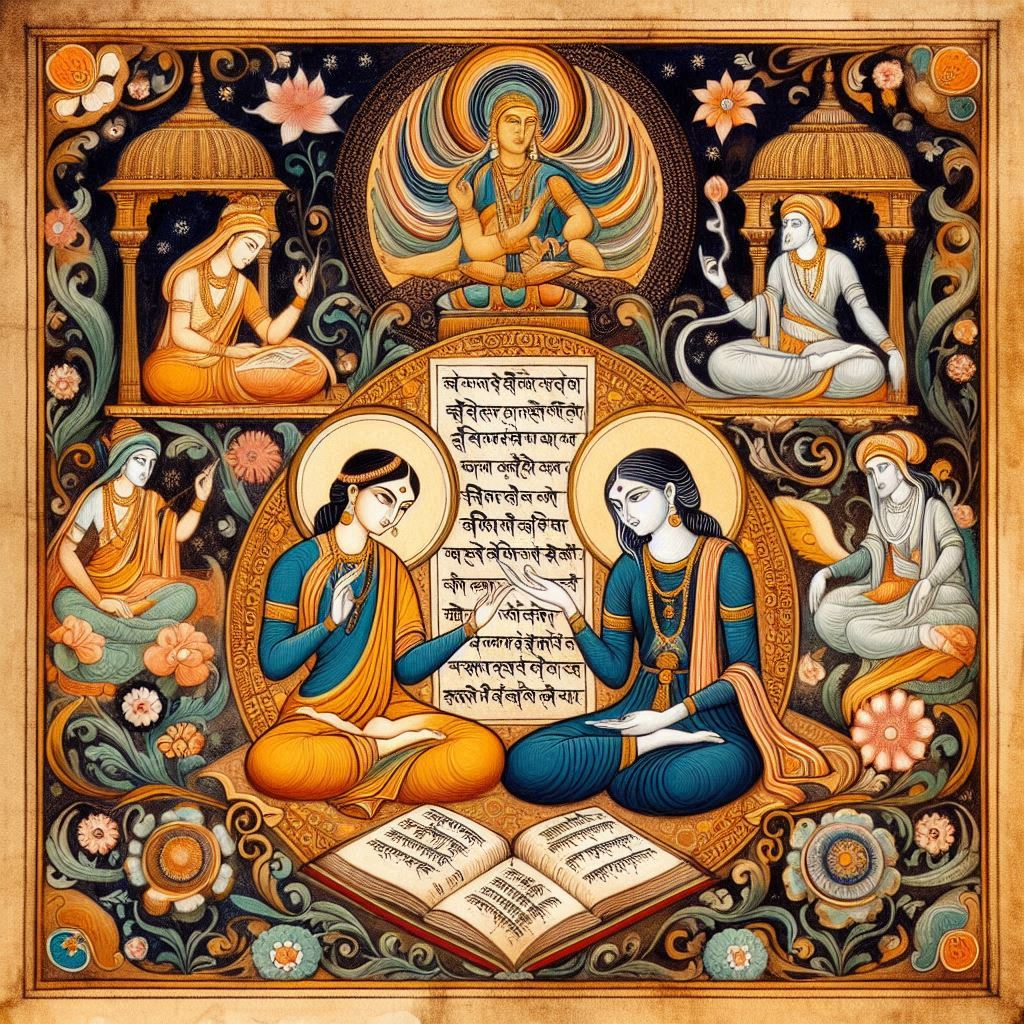
नाटकम्
(नान्द्यन्ते ततः प्रविशति सूत्रधारः।)
Word-by-Word Meaning:
- नान्द्यन्ते = At the end of Nandhi.
- ततः = then
- प्रविशति = enters
- सूत्रधारः = stage manager/director
भावार्थः (Meaning of the verse):
“Then, the stage manager enters, At the end of Nandhi.”
Verse#1
सूत्रधारः- नारायणस्त्रिभुवनैकपरायणो वः
पायादुपायशतयुक्तिकरः सुराणाम्।
लोकत्रयाविरतनाटकतन्त्रवस्तु-
प्रस्तावनप्रतिसमापनसूत्रधारः ।। 1 ।।
Split of the Sloka by its meaning and actual words:
नारायणः त्रिभुवन+एक+परायणः वः
पायात् उपाय+शत+युक्ति+करः सुराणाम्।
लोक+त्रय+अविरत+नाटक+तन्त्र+वस्तु-
प्रस्तावन+प्रतिसमापन+सूत्रधारः ।। 1 ।।
Further division into words:
- नारायणः = Narayana (Lord Vishnu)
- त्रिभुवन = three worlds (heaven, earth, and the underworld)
- एक = one
- परायणः = refuge, protector
- वः = your
- पायात् = may protect
- उपाय = means, methods
- शत = hundred
- युक्ति = strategies, techniques
- करः = maker, doer
- सुराणाम् = of the gods
- लोक = world
- त्रय = three
- अविरत = continuous, unceasing
- नाटक = drama, play
- तन्त्र = system, framework
- वस्तु = essence, substance
- प्रस्तावन = introduction
- प्रतिसमापन = conclusion
- सूत्रधारः = stage manager, director
Word-Meaning:
- नारायणः = Narayana (Lord Vishnu)
- त्रिभुवन = three worlds (heaven, earth, and the underworld)
- एक = one
- परायणः = refuge, protector
- वः = your
- पायात् = may protect
- उपाय = means, methods
- शत = hundred
- युक्ति = strategies, techniques
- करः = maker, doer
- सुराणाम् = of the gods
- लोक = world
- त्रय = three
- अविरत = continuous, unceasing
- नाटक = drama, play
- तन्त्र = system, framework
- वस्तु = essence, substance
- प्रस्तावन = introduction
- प्रतिसमापन = conclusion
- सूत्रधारः = stage manager, director
भावार्थः (Meaning of the verse):
“May Narayana, the sole refuge of the three worlds, protect you. He who devises hundreds of strategies for the gods, who is the unceasing director of the drama of the three worlds, from introduction to conclusion.”
This sloka praises Lord Narayana (Vishnu) as the protector and director of the cosmic play, ensuring the well-being of the gods and the harmony of the three worlds.
Behind the scenes after Verse#1
Sloka:
(परिक्रम्य) एवमार्यमिश्रान्विज्ञापय़ामि।
अये किं नु खलु मयि विज्ञापनव्यग्रे शब्द इव श्रूयते।
अङ्ग पश्यामि।
(नेपथ्ये)
भो भो निवेद्यतां निवेद्यतां तावत्।
Split of the Sloka by its meaning and actual words:
(परिक्रम्य) एवम् आर्य+मिश्रान् विज्ञापयामि।
अये किं नु खलु मयि विज्ञापन+व्यग्रे शब्द इव श्रूयते।
अङ्ग पश्यामि।
(नेपथ्ये)
भो भो निवेद्यतां निवेद्यतां तावत्।
Word-Meaning:
- परिक्रम्य = having circumambulated
- एवम् = thus
- आर्य = noble
- मिश्रान् = mixed, various
- विज्ञापयामि = I inform
- अये = oh!
- किं = what
- नु = indeed
- खलु = surely
- मयि = in me
- विज्ञापन = announcement
- व्यग्रे = engrossed
- शब्द = sound
- इव = like
- श्रूयते = is heard
- अङ्ग = oh dear
- पश्यामि = I see
(नेपथ्ये)
- भो भो = oh! oh!
- निवेद्यतां = let it be informed
- तावत् = meanwhile
भावार्थः (Meaning of the verse):
“Having circumambulated, I inform the noble ones thus: Oh! What is this sound that I hear, while I am engrossed in making the announcement? Oh dear, I see.”
(From behind the scenes)
“Oh! Oh! Let it be informed, let it be informed meanwhile.”
This sloka is typically used in the context of classical Sanskrit drama, where the stage manager or an actor is making an announcement or reacting to a sound heard while making an announcement. The phrase “भो भो निवेद्यतां निवेद्यतां तावत्” indicates an urgent call to inform something immediately.
Verse#2
Actual Sloka:
सूत्रधारः- भवतु विज्ञातम्। एष खलु संशप्तकानीकनिवाहिते जनार्दनसहाये धनञ्जये तदनन्तरमुपगतभीष्मवधामर्षितैर्धार्तराष्ट्रैः परिवार्य निपातितः
कुमारोऽभिमन्युः। तथाहि
यान्त्यर्जुनप्रत्यभियानभीता
यतोऽर्जुनस्तां दिशमीक्षमाणाः।
नराधिपाः स्वानि निवेशनानि
सौभद्रबाणाङ्कितनष्टसंज्ञाः ।। 2 ।।
Split of the Sloka by its meaning and actual words:
सूत्रधारः- भवतु विज्ञातम्। एष खलु संशप्तक+आनीक+निवाहिते जनार्दन+सहाये धनञ्जये तद+अनन्तरम् उपगत+भीष्म+वध+अमर्षितैः धार्तराष्ट्रैः परिवार्य निपातितः
कुमारः अभिमन्युः। तथाहि
यान्ति अर्जुन+प्रत्य+अभियान+भीता
यतः अर्जुनः ताम् दिशम् ईक्षमाणाः।
नर+अधिपाः स्वानि निवेशनानि
सौभद्र+बाण+अङ्कित+नष्ट+संज्ञाः ।। 2 ।।
Word-Meaning:
- सूत्रधारः = stage manager
- भवतु = let it be
- विज्ञातम् = known
- एष = this
- खलु = indeed
- संशप्तक = sworn warriors
- आनीक = army
- निवाहिते = stationed
- जनार्दन = Krishna
- सहाये = assisting
- धनञ्जये = Arjuna
- तद = then
- अनन्तरम् = afterwards
- उपगत = approached
- भीष्म = Bhishma
- वध = killing
- अमर्षितैः = enraged
- धार्तराष्ट्रैः = by the sons of Dhritarashtra
- परिवार्य = surrounding
- निपातितः = felled
- कुमारः = prince
- अभिमन्युः = Abhimanyu
- तथाहि = thus indeed
- यान्ति = go
- अर्जुन = Arjuna
- प्रत्य = towards
- अभियान = attack
- भीता = fearful
- यतः = because
- अर्जुनः = Arjuna
- ताम् = that
- दिशम् = direction
- ईक्षमाणाः = looking
- नर = men
- अधिपाः = kings
- स्वानि = their
- निवेशनानि = abodes
- सौभद्र = son of Subhadra (Abhimanyu)
- बाण = arrows
- अङ्कित = marked
- नष्ट = lost
- संज्ञाः = consciousness
भावार्थः (Meaning of the verse):
“The stage manager says: Let it be known. This indeed is the prince Abhimanyu, who, after the fall of Bhishma, was surrounded and felled by the enraged sons of Dhritarashtra in the army of the sworn warriors, with Janardana (Krishna) assisting Arjuna. Thus indeed, the kings, fearful of Arjuna’s counter-attack, seeing him in that direction, go back to their abodes, marked by the arrows of Subhadra’s son, having lost consciousness.”
This sloka describes the tragic fall of Abhimanyu, the son of Arjuna and Subhadra, during the Kurukshetra war, and the fear it instilled in the opposing kings.
Verse#3
Sloka:
(ततः प्रविशति भटः ।)
भटः- भो भोः! निवेद्यतां तावत्पुत्रशतश्लाघ्यबान्धवाय विज्ञानविस्तारितविनयाचारदीर्घचक्षुषे महाराजाय धृतराष्ट्राय। एष खलु
योधस्यन्दनवाजिवारणवधैर्विक्षोभ्य राज्ञां बलं
बालेनार्जुनकर्म येन समरे लीलायता दर्शितम्।
सौभद्रः स रणे नराधिपशतैर्वेगागतैः सर्वशः
खे शक्रस्य पितामहस्य सहसैवोत्सङ्गमारोपितः ।। 3 ।।
Split of the Sloka by its meaning and actual words:
(ततः प्रविशति भटः ।)
भटः- भो भोः! निवेद्यतां तावत् पुत्र+शत+श्लाघ्य+बान्धवाय विज्ञान+विस्तारित+विनय+आचार+दीर्घ+चक्षुषे महाराजाय धृतराष्ट्राय। एष खलु
योध+स्यन्दन+वाजि+वारण+वधैः विक्षोभ्य राज्ञां बलं
बाल+एन+अर्जुन+कर्म येन समरे लीलायता दर्शितम्।
सौभद्रः स रणे नर+अधिप+शतैः वेग+आगतैः सर्वशः
खे शक्रस्य पितामहस्य सहसा एव उत्सङ्गम् आरोपितः ।। 3 ।।
Word-Meaning:
- ततः = then
- प्रविशति = enters
- भटः = soldier
- भो भोः = oh! oh!
- निवेद्यतां = let it be informed
- तावत् = meanwhile
- पुत्र = son
- शत = hundred
- श्लाघ्य = praiseworthy
- बान्धवाय = relative
- विज्ञान = knowledge
- विस्तारित = expanded
- विनय = humility
- आचार = conduct
- दीर्घ = long
- चक्षुषे = vision
- महाराजाय = to the great king
- धृतराष्ट्राय = to Dhritarashtra
- एष = this
- खलु = indeed
- योध = warrior
- स्यन्दन = chariot
- वाजि = horse
- वारण = elephant
- वधैः = by the killing
- विक्षोभ्य = shaking
- राज्ञां = of kings
- बलं = army
- बाल = boy
- एन = this
- अर्जुन = Arjuna
- कर्म = deed
- येन = by whom
- समरे = in battle
- लीलायता = playfully
- दर्शितम् = shown
- सौभद्रः = son of Subhadra (Abhimanyu)
- स = he
- रणे = in battle
- नर = men
- अधिप = kings
- शतैः = by hundreds
- वेग = speed
- आगतैः = coming
- सर्वशः = from all sides
- खे = in the sky
- शक्रस्य = of Indra
- पितामहस्य = of the grandsire (Brahma)
- सहसा = suddenly
- एव = indeed
- उत्सङ्गम् = lap
- आरोपितः = placed
भावार्थः (Meaning of the verse):
“The soldier enters and says: Oh! Oh! Let it be informed meanwhile to the great king Dhritarashtra, who is praiseworthy among relatives, with expanded knowledge, humility, and long vision. This indeed is the son of Subhadra (Abhimanyu), who, by his deeds in battle, playfully shook the army of kings by killing warriors, chariots, horses, and elephants. He, in battle, was surrounded by hundreds of kings coming from all sides with speed, and suddenly, he was placed in the lap of Indra and Brahma in the sky.”
This sloka describes the valor and tragic end of Abhimanyu, the son of Arjuna and Subhadra, during the Kurukshetra war, highlighting his heroic deeds and the overwhelming odds he faced.
Verse#4
Sloka:
(ततः प्रविशति धृतराष्ट्रो गान्धारी दुःशला प्रतिहारी च।)
धृतराष्ट्रः- कथं नु भोः!
केनैतच्छ्रतिपथदूषणं कृतं मे
कोऽयं मे प्रियमिति विप्रियं ब्रवीति।
कोऽस्माकं शिशुवधपातकाङ्कितानां
वंशस्य क्षयमवघोषयत्यभीतः ।। 4 ।।
Split of the Sloka:
ततः प्रविशति धृतराष्ट्रः गान्धारी दुःशला प्रतिहारी च |
धृतराष्ट्रः- कथं नु भोः!
केन एतत् श्रतिपथदूषणं कृतं मे
कः अयम् मे प्रियम् इति विप्रियं ब्रवीति |
कः अस्माकं शिशुवधपातकाङ्कितानां
वंशस्य क्षयम् अवघोषयति अभीतः || 4 ||
Word-by-Word Meaning:
ततः = Then
प्रविशति = Enters
धृतराष्ट्रः = Dhritarashtra
गान्धारी = Gandhari
दुःशला = Dushala
प्रतिहारी = Attendant
च = And
धृतराष्ट्रः = Dhritarashtra
कथं = How
नु = Indeed
भोः = Oh!
केन = By whom
एतत् = This
श्रतिपथदूषणं = Defilement of the path of hearing (i.e., bad news)
कृतं = Done
मे = To me
कः = Who
अयम् = This
मे = To me
प्रियम् = Dear
इति = Thus
विप्रियं = Unpleasant
ब्रवीति = Says
कः = Who
अस्माकं = Our
शिशुवधपातकाङ्कितानां = Marked by the sin of killing children
वंशस्य = Of the lineage
क्षयम् = Destruction
अवघोषयति = Proclaims
अभीतः = Fearlessly
भावार्थः (Meaning of the verse):
“Then enters Dhritarashtra, Gandhari, Dushala, and the attendant.
Dhritarashtra says:
‘How indeed, oh! By whom has this defilement of the path of hearing been done to me?
Who is this that says something dear to me is unpleasant?
Who fearlessly proclaims the destruction of our lineage, marked by the sin of killing a child?’”
Verse#5
Sloka:
गान्धारी- महाराअ! अत्थि उण जाणीअदि केवलं पुत्तसंखअकारओ कुळविग्गहो भविस्सिदि त्ति। (महाराज! अस्ति पुनर्ज्ञायते केवलं पुत्रसंक्षयकारकः कुलविग्रहो भविष्यतीति।)
धृतराष्ट्रः- गान्धारि! ज्ञायते।
गान्धारी- महाराअ कदा णु खु । (महाराज कदा नु खलु।)
धृतराष्ट्रः- गान्धारि! श्रृणु
अद्याभिमन्युनिधनाज्जनितप्रकोपः
सामर्षकृष्णधृतरश्मिगुणप्रतोदः।
पार्थः करिष्यति तदुग्रधनुःसहायः
शान्तिं गमिष्यति विनाशमवाप्य लोकः ।। 5 ।।
Split of the Sloka:
गान्धारी- महाराअ! अत्थि उण जाणीअदि केवलं पुत्तसंखअकारओ कुळविग्गहो भविस्सिदि त्ति। (महाराज! अस्ति पुनर्ज्ञायते केवलं पुत्रसंक्षयकारकः कुलविग्रहो भविष्यतीति।)
धृतराष्ट्रः- गान्धारि! ज्ञायते।
गान्धारी- महाराअ कदा णु खु । (महाराज कदा नु खलु।)
धृतराष्ट्रः- गान्धारि! श्रृणु
अद्य-अभिमन्यु-निधनात्-जनित-प्रकोपः
सामर्ष-कृष्ण-धृत-रश्मि-गुण-प्रतोदः।
पार्थः करिष्यति तत्-उग्र-धनुः-सहायः
शान्तिं गमिष्यति विनाशम्-अवाप्य लोकः ।। 5 ।।
Word-by-Word Meaning:
गान्धारी = Gandhari
महाराअ = Maharaja (O King)
अत्थि = Exists
उण = Again
जाणीअदि = Is known
केवलं = Only
पुत्तसंखअकारओ = Destruction of sons
कुळविग्गहो = Family conflict
भविस्सिदि = Will happen
त्ति = Thus
धृतराष्ट्रः = Dhritarashtra
गान्धारि = Gandhari
ज्ञायते = Is known
गान्धारी = Gandhari
महाराअ = Maharaja (O King)
कदा = When
णु = Indeed
खु = Surely
धृतराष्ट्रः = Dhritarashtra
गान्धारि = Gandhari
श्रृणु = Listen
अद्य = Today
अभिमन्यु = Abhimanyu
निधनात् = From the death
जनित = Generated
प्रकोपः = Anger
सामर्ष = With anger
कृष्ण = Krishna
धृत = Held
रश्मि = Reins
गुण = Virtue
प्रतोदः = Whip
पार्थः = Arjuna
करिष्यति = Will do
तत् = That
उग्र = Fierce
धनुः = Bow
सहायः = With the help
शान्तिं = Peace
गमिष्यति = Will go
विनाशम् = Destruction
अवाप्य = Having obtained
लोकः = World
भावार्थः (Meaning of the verse):
“Gandhari: O King! It is known again that only the destruction of sons and family conflict will happen.
Dhritarashtra: Gandhari! It is known.
Gandhari: O King, when indeed?
Dhritarashtra: Gandhari! Listen.
Today, from the death of Abhimanyu, generated anger, with the whip of Krishna’s held reins, Arjuna, with the help of his fierce bow, will bring peace by obtaining the destruction of the world.”
Verse#6
Sloka:
गान्धारी- हावच्छ अभिमञ्ञो! ईदिसे वि णाम पुरुसखअकारए कुळविग्गहे वत्तमाणे वाळभावणिभज्जणं अम्हाणं भग्गाकमेण करअंतो कहिं दाणिं
पोत्तअ! गदोसि। (हा वत्स अभिमन्यो! ईदृशेऽपि नाम पुरुषक्षयकारके कुलविग्रहे वर्तमाने बालभावनिमज्जनमस्माकं भाग्यक्रमेण कुर्वन् कुत्रेदानीं पौत्रक! गतोऽसि।)
दुःशला- जेण दाणि उत्तराए वेधव्वं दाइदं, तेण अत्तणो जुवदिजणस्स वेधव्वमादिट्ठं। (येनेदानीं वध्वै उत्तरायै वैधव्यं दत्तं तेनात्मनो युवतिजनाय वैधव्यमादिष्टम्।)
धृतराष्ट्रः- अथ केनैष व्यसनार्णवस्य सेतुबन्धः कृतः ।
भटः- महाराज! मया।
धृतराष्ट्रः- को भवान्।
भटः- महाराज! ननु जयत्रातोऽस्मि।
धृतराष्ट्रः- जयत्रात!
केनाभिमन्युर्निहतः कस्य जीवितमप्रियम्।
पञ्चानां पाण्डवाग्नीनां आत्मा केनेन्धनीकृतः ।। 6 ।।
Split of the Sloka:
गान्धारी- हावच्छ अभिमञ्ञो! ईदिसे वि णाम पुरुसखअकारए कुळविग्गहे वत्तमाणे वाळभावणिभज्जणं अम्हाणं भग्गाकमेण करअंतो कहिं दाणिं
पोत्तअ! गदोसि। (हा वत्स अभिमन्यो! ईदृशेऽपि नाम पुरुषक्षयकारके कुलविग्रहे वर्तमाने बालभावनिमज्जनमस्माकं भाग्यक्रमेण कुर्वन् कुत्रेदानीं पौत्रक! गतोऽसि।)
दुःशला- जेण दाणि उत्तराए वेधव्वं दाइदं, तेण अत्तणो जुवदिजणस्स वेधव्वमादिट्ठं। (येनेदानीं वध्वै उत्तरायै वैधव्यं दत्तं तेनात्मनो युवतिजनाय वैधव्यमादिष्टम्।)
धृतराष्ट्रः- अथ केन एष व्यसनार्णवस्य सेतुबन्धः कृतः ।
भटः- महाराज! मया।
धृतराष्ट्रः- कः भवान्।
भटः- महाराज! ननु जयत्रातः अस्मि।
धृतराष्ट्रः- जयत्रात!
केन अभिमन्युः निहतः कस्य जीवितम् अप्रियम्।
पञ्चानां पाण्डव-अग्नीनां आत्मा केन इन्धनीकृतः ।। 6 ।।
Word-by-Word Meaning:
गान्धारी = Gandhari
हावच्छ = Alas
अभिमञ्ञो = Abhimanyu
ईदिसे = Such
वि = Even
णाम = Indeed
पुरुसखअकारए = Destruction of men
कुळविग्गहे = Family conflict
वत्तमाणे = Happening
वाळभावणिभज्जणं = Breaking of childhood
अम्हाणं = Our
भग्गाकमेण = By fate
करअंतो = Doing
कहिं = Where
दाणिं = Now
पोत्तअ = Grandson
गदोसि = Gone
धृतराष्ट्रः = Dhritarashtra
अथ = Then
केन = By whom
एष = This
व्यसनार्णवस्य = Of the ocean of calamities
सेतुबन्धः = Bridge
कृतः = Made
भटः = Soldier
महाराज = O King
मया = By me
धृतराष्ट्रः = Dhritarashtra
कः = Who
भवान् = You
भटः = Soldier
महाराज = O King
ननु = Indeed
जयत्रातः = Jayatrata
अस्मि = Am
धृतराष्ट्रः = Dhritarashtra
जयत्रात = Jayatrata
केन = By whom
अभिमन्युः = Abhimanyu
निहतः = Killed
कस्य = Whose
जीवितम् = Life
अप्रियम् = Unpleasant
पञ्चानां = Of the five
पाण्डव = Pandavas
अग्नीनां = Fires
आत्मा = Soul
केन = By whom
इन्धनीकृतः = Made fuel
भावार्थः (Meaning of the verse):
“Gandhari: Alas, Abhimanyu! Even in such a situation of family conflict causing the destruction of men, where are you now, my grandson, who was doing the breaking of childhood by fate?
Dushala: By whom now has widowhood been given to Uttara, by the same has widowhood been assigned to his own young women.
Dhritarashtra: Then by whom has this bridge over the ocean of calamities been made?
Soldier: O King, by me.
Dhritarashtra: Who are you?
Soldier: O King, I am Jayatrata.
Dhritarashtra: Jayatrata! By whom was Abhimanyu killed? Whose life has become unpleasant? By whom has the soul of the five Pandavas been made fuel?”
Verse#7
Sloka:
भटः- महाराज! बहुभिः किल पार्थिवैः समागतैर्निहतः कुमारोऽभिमन्युः। स्यात्तु जयद्रथो निमित्तभूतः।
धृतराष्ट्रः- हन्त जयद्रथो निमित्तभूतः।
भटः- महाराज अथ किम्।
धृतराष्ट्रः- हन्त जयद्रथो निहतः।
(तच्छुत्वा दुःशला रोदिति।)
धृतराष्ट्रः- कैषा रोदिति।
प्रतीहारी- महाराअ! भट्टिदारिआ दुश्शळा। (महाराज! भर्तृदारिका दुःशला।)
धृतराष्ट्रः- वत्से अलमलं रुदितेन। पश्य,
भर्तुस्ते नूनमत्यन्तमवैधव्यं न रोचते।
येन गाण्डीविबाणानामात्मा लक्षीकृतः स्वयम् ।। 7 ।।
Split of the Sloka:
भटः- महाराज! बहुभिः किल पार्थिवैः समागतैः निहतः कुमारः अभिमन्युः। स्यात् तु जयद्रथः निमित्तभूतः।
धृतराष्ट्रः- हन्त जयद्रथः निमित्तभूतः।
भटः- महाराज अथ किम्।
धृतराष्ट्रः- हन्त जयद्रथः निहतः।
(तच्छुत्वा दुःशला रोदिति।)
धृतराष्ट्रः- का एषा रोदिति।
प्रतीहारी- महाराज! भर्तृदारिका दुःशला।
धृतराष्ट्रः- वत्से अलम् अलम् रुदितेन। पश्य,
भर्तुः ते नूनम् अत्यन्तम् अवैधव्यं न रोचते।
येन गाण्डीव-बाणानाम् आत्मा लक्षीकृतः स्वयम् ।। 7 ।।
Word-by-Word Meaning:
भटः = Soldier
महाराज = O King
बहुभिः = By many
किल = Indeed
पार्थिवैः = By kings
समागतैः = Assembled
निहतः = Killed
कुमारः = Prince
अभिमन्युः = Abhimanyu
स्यात् = May be
तु = But
जयद्रथः = Jayadratha
निमित्तभूतः = Cause
धृतराष्ट्रः = Dhritarashtra
हन्त = Alas
जयद्रथः = Jayadratha
निमित्तभूतः = Cause
भटः = Soldier
महाराज = O King
अथ = Then
किम् = What
धृतराष्ट्रः = Dhritarashtra
हन्त = Alas
जयद्रथः = Jayadratha
निहतः = Killed
तच्छुत्वा = Hearing that
दुःशला = Dushala
रोदिति = Cries
धृतराष्ट्रः = Dhritarashtra
का = Who
एषा = This
रोदिति = Cries
प्रतीहारी = Attendant
महाराज = O King
भर्तृदारिका = Daughter of the husband
दुःशला = Dushala
धृतराष्ट्रः = Dhritarashtra
वत्से = Dear child
अलम् = Enough
अलम् = Enough
रुदितेन = With crying
पश्य = See
भर्तुः = Of the husband
ते = Your
नूनम् = Indeed
अत्यन्तम् = Extremely
अवैधव्यं = Widowhood
न = Not
रोचते = Pleases
येन = By whom
गाण्डीव = Gandiva (Arjuna’s bow)
बाणानाम् = Of arrows
आत्मा = Soul
लक्षीकृतः = Targeted
स्वयम् = Himself
भावार्थः (Meaning of the verse):
“Soldier: O King! Indeed, Prince Abhimanyu was killed by many assembled kings. But Jayadratha was the cause.
Dhritarashtra: Alas, Jayadratha was the cause.
Soldier: O King, then what?
Dhritarashtra: Alas, Abhimanyu is killed.
(Hearing that, Dushala cries.)
Dhritarashtra: Who is crying?
Attendant: O King, it is Dushala, the wife of the Jayadratha.
Dhritarashtra: Dear child, enough, enough with the crying. See,
Indeed, your husband’s extreme widowhood does not please you.
By whom the soul of the Gandiva’s arrows was targeted himself.”
Verse#8
Sloka:
दुःशला- तेण हि अणुजाणादु मं तादो, अहं वि गमिस्सं वहूए उत्तराए सआसं। (तेन ह्यनुजानातु मां तातः अहमपि गमिष्यामि वध्वा उत्तरायाः सकाशम्।)
धृतराष्ट्रः- वत्से किमभिधास्यसि।
दुःशला- ताद! एवं च भणिस्सं-अज्जकालिअं च दे वेसग्गहणं अहं वि अवधारइस्सामि त्ति। (तात! एवं च भणिष्यामि-अद्यकालिकं च ते वेषग्रहणमहमप्युपधारयिष्यामीति।)
गान्धारी- पुत्तिए! मा खु मा खु अमंगळं भणाहि। जीवदि खु दे भत्ता। (पुत्रिके ! मा खलु, मा खल्वमङ्गलं भण। जीवति खलु ते भर्ता।)
दुःशला- अम्ब! कुदो मे एत्तिआणि भाअधेआणि। जो जणद्दणसहाअस्स धणंजअस्स विण्पिअं करिअ कोहि णाम जीविस्सिदि। (अम्ब! कुतो मे एतावन्ति भागधेयानि। यो जनार्दनसहायस्य धनञ्जयस्य विप्रियं कृत्वा को हि नाम जीविष्यति।)
धृतराष्ट्रः- सत्यमाह तपस्विनी दुश्शला। कुतः,
कृष्णस्याष्टभुजोपधानरचिते योऽङ्के विवृद्धश्चिरं
यो मत्तस्य हलायुधस्य भवति प्रीत्या द्वितीयो मदः।
पार्थानां सुरतुल्यविक्रमवतां स्नेहस्य यो भाजनं
तं हत्वा क इहोपलप्स्यति चिरं स्वैर्दुष्कृतैर्जीवितम् ।। 8 ।।
Split of the Sloka:
दुःशला- तेण हि अणुजाणादु मं तादो, अहं वि गमिस्सं वहूए उत्तराए सआसं। (तेन हि अनुजानातु मां तातः, अहम् अपि गमिष्यामि वध्वा उत्तरायाः सकाशम्।)
धृतराष्ट्रः- वत्से किम् अभिधास्यसि।
दुःशला- तात! एवं च भणिस्सं-अज्जकालिकं च ते वेसग्गहणं अहं वि अवधारइस्सामि त्ति। (तात! एवं च भणिष्यामि-अद्यकालिकं च ते वेषग्रहणम् अहम् अपि उपधारयिष्यामि इति।)
गान्धारी- पुत्तिए! मा खु मा खु अमंगळं भणाहि। जीवदि खु ते भत्ता। (पुत्रिके! मा खलु, मा खलु अमङ्गलम् भण। जीवति खलु ते भर्ता।)
दुःशला- अम्ब! कुदो मे एत्तिआणि भाअधेआणि। जो जणद्दणसहाअस्स धणंजअस्स विण्पिअं करिअ कोहि णाम जीविस्सिदि। (अम्ब! कुतः मे एतावन्ति भागधेयानि। यः जनार्दनसहायस्य धनञ्जयस्य विप्रियं कृत्वा कः हि नाम जीविष्यति।)
धृतराष्ट्रः- सत्यम् आह तपस्विनी दुश्शला। कुतः,
कृष्णस्य अष्टभुज उपधान रचिते यः अङ्के विवृद्धः चिरं
यः मत्तस्य हलायुधस्य भवति प्रीत्या द्वितीयः मदः।
पार्थानां सुरतुल्य विक्रमवतां स्नेहस्य यः भाजनं
तं हत्वा कः इह उपलप्स्यति चिरं स्वैः दुष्कृतैः जीवितम् ।। 8 ।।
Word-by-Word Meaning:
दुःशला = Dushala
तेण = By that
हि = Indeed
अणुजाणादु = Permit
मं = Me
तादो = Father
अहं = I
वि = Also
गमिस्सं = Will go
वहूए = To the bride
उत्तराए = Uttara
सआसं = To the presence
धृतराष्ट्रः = Dhritarashtra
वत्से = Dear child
किम् = What
अभिधास्यसि = Will you say
दुःशला = Dushala
तात = Father
एवं = Thus
च = And
भणिस्सं = Will say
अज्जकालिकं = Present
च = And
ते = Your
वेसग्गहणं = Taking of vows
अहं = I
वि = Also
अवधारइस्सामि = Will consider
त्ति = Thus
गान्धारी = Gandhari
पुत्तिए = Daughter
मा = Do not
खु = Indeed
अमंगळं = Inauspicious
भणाहि = Say
जीवदि = Lives
खु = Indeed
ते = Your
भत्ता = Husband
दुःशला = Dushala
अम्ब = Mother
कुदो = Where
मे = My
एत्तिआणि = These
भाअधेआणि = Fortunes
जो = Who
जणद्दणसहाअस्स = Helper of Janardana
धणंजअस्स = Of Dhananjaya
विण्पिअं = Displeasure
करिअ = Doing
कोहि = Who
णाम = Indeed
जीविस्सिदि = Will live
धृतराष्ट्रः = Dhritarashtra
सत्यम् = Truly
आह = Says
तपस्विनी = Ascetic
दुश्शला = Dushala
कुतः = How
कृष्णस्य = Of Krishna
अष्टभुज = Eight-armed
उपधान = Pillow
रचिते = Made
यः = Who
अङ्के = On the lap
विवृद्धः = Grown
चिरं = Long
यः = Who
मत्तस्य = Of intoxicated
हलायुधस्य = Of Halayudha (Balarama)
भवति = Becomes
प्रीत्या = With affection
द्वितीयः = Second
मदः = Intoxication
पार्थानां = Of the sons of Pritha (Pandavas)
सुरतुल्य = Equal to gods
विक्रमवतां = Of the valiant
स्नेहस्य = Of affection
यः = Who
भाजनं = Recipient
तं = Him
हत्वा = Having killed
कः = Who
इह = Here
उपलप्स्यति = Will obtain
चिरं = Long
स्वैः = By his own
दुष्कृतैः = Misdeeds
जीवितम् = Life
भावार्थः (Meaning of the verse):
“Dushala: By that, permit me, father, I will also go to the presence of the bride Uttara.
Dhritarashtra: Dear child, what will you say?
Dushala: Father! Thus I will say – I will also consider your present taking of vows.
Gandhari: Daughter! Do not say inauspicious things. Indeed, your husband lives.
Dushala: Mother! Where are my fortunes? Who, having displeased the helper of Janardana, Dhananjaya, will indeed live?
Dhritarashtra: Truly, the ascetic Dushala speaks rightly. How,
Who, having grown long on the lap made by the eight-armed Krishna,
Who becomes the second intoxication of the intoxicated Halayudha with affection,
Who is the recipient of the affection of the valiant sons of Pritha, equal to gods,
Having killed him, who here will obtain a long life by his own misdeeds?”
Verse#9
Sloka:
जयमात्र! अथ तदवस्थं पुत्रं दृष्ट्वा किं प्रतिपन्नं तेन गाण्डीवधन्वना।
भटः- महाराज! किं वार्जुनसमीपे वृत्तमेतत्।
धृतराष्ट्रः- कथमर्जुनोऽपि नात्रासीत्।
भटः- महाराज! अथ किम्।
धृतराष्ट्रः- कथमिदानीं वृत्तमेतत्।
भटः- श्रूयतां-संशप्तकानीकनिवाहिते जनार्दनसहाये धनञ्जये धनञ्जये स बाल भावाददृष्टदोषः सङ्ग्रममवतीर्णः कुमारोऽभिमन्युः।
धृतराष्ट्रः- हन्त युक्तरूपोऽस्य वधः। कोहि संनिहितशार्दूलां गुहां धर्षयितुं शक्तः। अथ शेषाः पाण्डवाः किमनुतिष्ठन्ति।
भटः- महाराज! श्रूयताम्।
चितां न तावत्स्वयमस्य देहमारोपयन्त्यर्जुनदर्शनार्थम्।
तेषां च नामान्युपधारयन्ति यैस्तस्य गात्रे प्रहृतं नरेन्द्रैः ।। 9 ।।
Split of the Sloka:
जयमात्र! अथ तदवस्थं पुत्रं दृष्ट्वा किं प्रतिपन्नं तेन गाण्डीवधन्वना।
भटः- महाराज! किं वार्जुनसमीपे वृत्तमेतत्।
धृतराष्ट्रः- कथम् अर्जुनः अपि न अत्र आसीत्।
भटः- महाराज! अथ किम्।
धृतराष्ट्रः- कथम् इदानीं वृत्तम् एतत्।
भटः- श्रूयतां-संशप्तक-आनीक-निवाहिते जनार्दन-सहाये धनञ्जये धनञ्जये स बाल भावात् अदृष्ट-दोषः सङ्ग्रमम् अवतीर्णः कुमारः अभिमन्युः।
धृतराष्ट्रः- हन्त युक्त-रूपः अस्य वधः। कः हि संनिहित-शार्दूलां गुहां धर्षयितुं शक्तः। अथ शेषाः पाण्डवाः किम् अनुतिष्ठन्ति।
भटः- महाराज! श्रूयताम्।
चितां न तावत् स्वयम् अस्य देहम् आरोपयन्ति अर्जुन-दर्शन-आर्थम्।
तेषां च नामानि उपधारयन्ति यैः तस्य गात्रे प्रहृतं नरेन्द्रैः ।। 9 ।।
Word-by-Word Meaning:
जयमात्र = O victorious one!
अथ = Then
तदवस्थं = In that condition
पुत्रं = Son
दृष्ट्वा = Having seen
किं = What
प्रतिपन्नं = Undertaken
तेन = By him
गाण्डीवधन्वना = By the wielder of the Gandiva bow (Arjuna)
भटः = Soldier
महाराज = O great king!
किं = What
वार्जुनसमीपे = Near Arjuna
वृत्तमेतत् = This event
धृतराष्ट्रः = Dhritarashtra
कथम् = How
अर्जुनः = Arjuna
अपि = Also
न = Not
अत्र = Here
आसीत् = Was
भटः = Soldier
महाराज = O great king!
अथ = Then
किम् = What
धृतराष्ट्रः = Dhritarashtra
कथम् = How
इदानीं = Now
वृत्तम् = Happened
एतत् = This
भटः = Soldier
श्रूयतां = Let it be heard
संशप्तक = Of the sworn warriors
आनीक = Army
निवाहिते = Placed
जनार्दन = Krishna
सहाये = Helper
धनञ्जये = Dhananjaya (Arjuna)
स = He
बाल = Young
भावात् = From nature
अदृष्ट = Unseen
दोषः = Fault
सङ्ग्रमम् = Battle
अवतीर्णः = Entered
कुमारः = Prince
अभिमन्युः = Abhimanyu
धृतराष्ट्रः = Dhritarashtra
हन्त = Alas
युक्त = Appropriate
रूपः = Form
अस्य = His
वधः = Death
कः = Who
हि = Indeed
संनिहित = Present
शार्दूलां = Tiger
गुहां = Cave
धर्षयितुं = To dare
शक्तः = Capable
अथ = Then
शेषाः = Remaining
पाण्डवाः = Pandavas
किम् = What
अनुतिष्ठन्ति = Are doing
भटः = Soldier
महाराज = O great king!
श्रूयताम् = Let it be heard
चितां = Funeral pyre
न = Not
तावत् = Yet
स्वयम् = Themselves
अस्य = His
देहम् = Body
आरोपयन्ति = Place
अर्जुन = Arjuna
दर्शन = Sight
आर्थम् = For the purpose
तेषां = Their
च = And
नामानि = Names
उपधारयन्ति = They consider
यैः = By whom
तस्य = His
गात्रे = On the body
प्रहृतं = Struck
नरेन्द्रैः = By kings
भावार्थः (Meaning of the verse):
“O victorious one! Then, seeing his son in that condition, what did the wielder of the Gandiva bow (Arjuna) do?
Soldier: O great king! What happened near Arjuna?
Dhritarashtra: How was Arjuna not there?
Soldier: O great king! Then what?
Dhritarashtra: How did this happen now?
Soldier: Let it be heard – Placed in the army of the sworn warriors, with Krishna as his helper, Dhananjaya (Arjuna), the young prince Abhimanyu, entered the battle with an unseen fault due to his youthful nature.
Dhritarashtra: Alas, his death is appropriate. Who indeed is capable of daring to enter the cave of a present tiger? Then what are the remaining Pandavas doing?
Soldier: O great king! Let it be heard.
They do not yet place his body on the funeral pyre for the purpose of Arjuna’s sight.
And they consider the names of those kings by whom his body was struck.”
Verse#10
Sloka:
धृतराष्ट्रः- गान्धारि! तदागम्यताम्। गङ्गाकूलमेव यास्यावः।
गान्धारी- महाराअ! णं तहिं गाहामो। (महाराज! ननु तत्र गाहावहे।)
धृतराष्ट्रः- गान्धारि! श्रृणु।
अद्यैव दास्यामि जलं हतेभ्यः
स्वेनापराधेन तवात्मजेभ्यः।
न त्वस्मि शक्तः सलिलप्रदानैः
कर्तुं नृपाणां शिबिरोपरोधम् ।। 10 ।।
Split of the Sloka:
धृतराष्ट्रः- गान्धारि! तद् आगम्यताम्। गङ्गा+कूलम्+एव यास्यावः।
गान्धारी- महाराअ! णं तहिं गाहामो। (महाराज! ननु तत्र गाहावहे।)
धृतराष्ट्रः- गान्धारि! श्रृणु।
अद्य+एव दास्यामि जलम् हतेभ्यः
स्वेन+अपराधेन तव+आत्मजेभ्यः।
न तु+अस्मि शक्तः सलिल+प्रदानैः
कर्तुम् नृपाणाम् शिबिर+उपरोधम् ।। 10 ।।
Word-by-Word Meaning:
धृतराष्ट्रः = Dhritarashtra
गान्धारि = Gandhari
तद् = Then
आगम्यताम् = Let us go
गङ्गाकूलम् = Bank of the Ganges
एव = Only
यास्यावः = We shall go
गान्धारी = Gandhari
महाराअ = O great king!
णं = Indeed
तहिं = There
गाहामो = We shall bathe
(महाराज! ननु तत्र गाहावहे।) = (O great king! Indeed, we shall bathe there.)
धृतराष्ट्रः = Dhritarashtra
गान्धारि = Gandhari
श्रृणु = Listen
अद्य = Today
एव = Only
दास्यामि = I shall give
जलम् = Water
हतेभ्यः = To the slain
स्वेन = By my own
अपराधेन = Fault
तव = Your
आत्मजेभ्यः = Sons
न = Not
तु = But
अस्मि = I am
शक्तः = Capable
सलिल = Water
प्रदानैः = By offerings
कर्तुम् = To perform
नृपाणाम् = Of the kings
शिबिर = Camp
उपरोधम् = Siege
भावार्थः (Meaning of the verse):
“Dhritarashtra: Gandhari! Let us go. We shall go to the bank of the Ganges.
Gandhari: O great king! Indeed, we shall bathe there.
Dhritarashtra: Gandhari! Listen.
Today itself, I shall offer water to the slain, to your sons by my own fault.
But I am not capable of performing the water offerings to besiege the camp of the kings.”
Verse#11
Sloka:
(ततः प्रविशति दुर्योधनो दुश्शासनः शकुनिश्च।)
दुर्योधनः- वत्स दुश्शासन!
यातोऽभिमन्युनिधनात् स्थिरतां विरोधः
प्राप्तो जयः प्रचलिता रिपवो निरस्ताः।
उन्मूलितोऽस्य च मदो मधूसूदनस्य
लब्धो मयाऽद्य सममभ्युदयेन शब्दः ।।
Split of the Sloka by its meaning and actual words:
(ततः प्रविशति दुर्योधनः दुश्शासनः शकुनिः च।)
दुर्योधनः- वत्स दुश्शासन!
यातः अभिमन्यु+निधनात् स्थिरताम् विरोधः
प्राप्तः जयः प्रचलिताः रिपवः निरस्ताः।
उन्मूलितः अस्य च मदः मधुसूदनस्य
लब्धः मया अद्य समम् अभ्युदयेन शब्दः ।।
Word-by-Word Meaning:
ततः = Then
प्रविशति = enters
दुर्योधनः = Duryodhana
दुश्शासनः = Dushasana
शकुनिः = Shakuni
च = and
वत्स = dear
दुश्शासन = Dushasana
यातः = gone
अभिमन्यु+निधनात् = from Abhimanyu’s death
स्थिरताम् = stability
विरोधः = enmity
प्राप्तः = obtained
जयः = victory
प्रचलिताः = driven away
रिपवः = enemies
निरस्ताः = defeated
उन्मूलितः = uprooted
अस्य = his
च = and
मदः = pride
मधुसूदनस्य = of Krishna (Madhusudana)
लब्धः = obtained
मया = by me
अद्य = today
समम् = along with
अभ्युदयेन = prosperity
शब्दः = fame
भावार्थः (Meaning of the verse):
“Then Duryodhana, Dushasana, and Shakuni enter. Duryodhana says: Dear Dushasana! The enmity that arose from Abhimanyu’s death has now stabilized. Victory has been achieved, the enemies have been driven away and defeated. The pride of Krishna has been uprooted. Today, I have obtained fame along with prosperity.”
Verse#12
Sloka:
दुश्शासनः- अहो तु खलु,
रुद्धाः पाण्डुसुता जयद्रथबलेनाक्रम्य शत्रोर्बलं
सौभद्रे विनिपातिते शरशतक्षेपैर्द्वितीयेऽर्जुने।
प्राप्तैश्च व्यसनानि भीष्मपतनादस्माभिरद्याहवे
तीव्राः शोकशराः कृताः खलु मनस्येषां सुतोत्सादनात् ।। 12 ।।
Split of the Sloka by its meaning and actual words:
दुश्शासनः- अहो तु खलु,
रुद्धाः पाण्डु+सुताः जयद्रथ+बलेन आक्रम्य शत्रोः बलम्
सौभद्रे विनिपातिते शर+शत+क्षेपैः द्वितीये अर्जुने।
प्राप्तैः च व्यसनानि भीष्म+पतनात् अस्माभिः अद्य आहवे
तीव्राः शोक+शराः कृताः खलु मनसि एषाम् सुत+उत्सादनात् ।। 12 ।।
Word-by-Word Meaning:
दुश्शासनः = Dushasana
अहो = Oh
तु = indeed
खलु = truly
रुद्धाः = obstructed
पाण्डु+सुताः = Pandu’s sons (Pandavas)
जयद्रथ+बलेन = by Jayadratha’s force
आक्रम्य = attacking
शत्रोः = of the enemy
बलम् = strength
सौभद्रे = Abhimanyu (son of Subhadra)
विनिपातिते = fallen
शर+शत+क्षेपैः = by hundreds of arrows
द्वितीये = second
अर्जुने = Arjuna
प्राप्तैः = obtained
च = and
व्यसनानि = calamities
भीष्म+पतनात् = from Bhishma’s fall
अस्माभिः = by us
अद्य = today
आहवे = in battle
तीव्राः = intense
शोक+शराः = arrows of grief
कृताः = made
खलु = indeed
मनसि = in the mind
एषाम् = of them
सुत+उत्सादनात् = from the destruction of sons
भावार्थः (Meaning of the verse):
“Dushasana says: Oh indeed, the sons of Pandu have been obstructed by Jayadratha’s force, attacking the enemy’s strength. With Abhimanyu fallen, struck by hundreds of arrows, and the second Arjuna (Abhimanyu) defeated, calamities have befallen us from Bhishma’s fall in today’s battle. Intense arrows of grief have indeed pierced their minds due to the destruction of their sons.”
Verse#13
Sloka:
शकुनिः- जयद्रथेनाद्य महत्कृतं रणे
नृपैरसम्भावितमात्मपौरुषम्।
प्रसह्य तेषां यदनेन संयुगे
समं सुतेनाप्रतिमं हृतं यशः ।। 13 ।।
Split of the Sloka by its meaning and actual words:
शकुनिः- जयद्रथेन अद्य महत् कृतम् रणे
नृपैः असम्भावितम् आत्म+पौरुषम्।
प्रसह्य तेषाम् यत् अनेन संयुगे
समम् सुतेन अप्रतिमम् हृतम् यशः ।। 13 ।।
Word-by-Word Meaning:
शकुनिः = Shakuni
जयद्रथेन = by Jayadratha
अद्य = today
महत् = great
कृतम् = done
रणे = in battle
नृपैः = by kings
असम्भावितम् = unexpected
आत्म+पौरुषम् = self-valor
प्रसह्य = forcibly
तेषाम् = of them
यत् = which
अनेन = by him
संयुगे = in battle
समम् = equally
सुतेन = by the son
अप्रतिमम् = unparalleled
हृतम् = taken
यशः = glory
भावार्थः (Meaning of the verse):
“Shakuni says: Today, Jayadratha has performed a great deed in battle, displaying self-valor that was unexpected by the kings. By forcibly engaging them in battle, he has taken unparalleled glory, equal to that of his son.”
Verse#14
Sloka:
दुर्योधनः- मातुल! इतस्तावत्। दुश्शासन! इतस्तावत्। तत्रभवन्तं तातमभिवादयिष्यामः।
शकुनिः- वत्स दुर्योधन! मा मैवम्।
कामं न तस्य रुचितः कुलविग्रहोऽय-
मस्मांश्च गर्हयति स प्रियपाण्डवत्वात्।
युद्धोत्थितैर्जयमवाप्य हि तुल्यरूपं
एवं प्रहृष्टवदनैरभिगन्तुमेनम् ।। 14 ।।
Split of the Sloka by its meaning and actual words:
दुर्योधनः- मातुल! इतः तावत्। दुश्शासन! इतः तावत्। तत्रभवन्तम् तातम् अभिवादयिष्यामः।
शकुनिः- वत्स दुर्योधन! मा मैवम्।
कामम् न तस्य रुचितः कुल+विग्रहः अयम्
अस्मान् च गर्हयति स प्रिय+पाण्डवत्वात्।
युद्ध+उत्थितैः जयम् अवाप्य हि तुल्य+रूपम्
एवम् प्रहृष्ट+वदनैः अभिगन्तुम् एनम् ।। 14 ।।
Word-by-Word Meaning:
दुर्योधनः = Duryodhana
मातुल = uncle
इतः = here
तावत् = for now
दुश्शासन = Dushasana
तत्रभवन्तम् = that person
तातम् = father
अभिवादयिष्यामः = we will greet
शकुनिः = Shakuni
वत्स = dear
दुर्योधन = Duryodhana
मा = do not
मैवम् = like this
कामम् = indeed
न = not
तस्य = his
रुचितः = liked
कुल+विग्रहः = family conflict
अयम् = this
अस्मान् = us
च = and
गर्हयति = criticizes
स = he
प्रिय+पाण्डवत्वात् = due to his affection for the Pandavas
युद्ध+उत्थितैः = arisen from battle
जयम् = victory
अवाप्य = having obtained
हि = indeed
तुल्य+रूपम् = equal form
एवम् = thus
प्रहृष्ट+वदनैः = with delighted faces
अभिगन्तुम् = to approach
एनम् = him
भावार्थः (Meaning of the verse):
“Duryodhana: Uncle! Come here for now. Dushasana! Come here for now. We will greet our father there.
Shakuni: Dear Duryodhana! Do not do so.
Indeed, this family conflict is not liked by him, and he criticizes us due to his affection for the Pandavas. Having obtained victory arising from battle, it is not appropriate to approach him with delighted faces.”
Verse#15
Sloka:
दुर्योधनः- मातुल! मा मैवम्। यथा तथा भवतु। तत्रभवन्तं तातमभिवादयिष्यामः।
उभौ- बाढम्। (परिक्रामति।)
दुर्योधनः- तात! दुर्योधनोऽहमभिवादये।
दुश्शासनः- तात! दुश्शासनोऽहमभिवादये।
शकुनिः- शकुनिरहमभिवादये।
सर्वे- कथमाशीर्वचनं न प्रयुज्यते।
धृतराष्ट्रः- पुत्र! कथमाशीर्वचनमिति।
सौभद्रे निहते बाले हृदये कृष्णपार्थयोःः।
जीविते निरपेक्षाणां कथमाशीः प्रयुज्यते ।। 15 ।।
Split of the Sloka by its meaning and actual words:
दुर्योधनः- मातुल! मा मैवम्। यथा तथा भवतु। तत्रभवन्तम् तातम् अभिवादयिष्यामः।
उभौ- बाढम्। (परिक्रामति।)
दुर्योधनः- तात! दुर्योधनः अहम् अभिवादये।
दुश्शासनः- तात! दुश्शासनः अहम् अभिवादये।
शकुनिः- शकुनिः अहम् अभिवादये।
सर्वे- कथम् आशीर्वचनम् न प्रयुज्यते।
धृतराष्ट्रः- पुत्र! कथम् आशीर्वचनम् इति।
सौभद्रे निहते बाले हृदये कृष्ण+पार्थयोः।
जीविते निरपेक्षाणाम् कथम् आशीः प्रयुज्यते ।। 15 ।।
Word-by-Word Meaning:
दुर्योधनः = Duryodhana
मातुल = uncle
मा = do not
मैवम् = like this
यथा = as
तथा = thus
भवतु = let it be
तत्रभवन्तम् = that person
तातम् = father
अभिवादयिष्यामः = we will greet
उभौ = both
बाढम् = agreed
परिक्रामति = walks around
दुर्योधनः = Duryodhana
तात = father
दुर्योधनः = Duryodhana
अहम् = I
अभिवादये = greet
दुश्शासनः = Dushasana
तात = father
दुश्शासनः = Dushasana
अहम् = I
अभिवादये = greet
शकुनिः = Shakuni
शकुनिः = Shakuni
अहम् = I
अभिवादये = greet
सर्वे = all
कथम् = how
आशीर्वचनम् = blessing words
न = not
प्रयुज्यते = are used
धृतराष्ट्रः = Dhritarashtra
पुत्र = son
कथम् = how
आशीर्वचनम् = blessing words
इति = thus
सौभद्रे = Abhimanyu (son of Subhadra)
निहते = killed
बाले = boy
हृदये = in the heart
कृष्ण+पार्थयोः = of Krishna and Arjuna
जीविते = in life
निरपेक्षाणाम् = indifferent
कथम् = how
आशीः = blessing
प्रयुज्यते = is given
भावार्थः (Meaning of the verse):
“Duryodhana: Uncle! Do not do so. Let it be as it is. We will greet our father there.
Both: Agreed. (They walk around.)
Duryodhana: Father! I, Duryodhana, greet you.
Dushasana: Father! I, Dushasana, greet you.
Shakuni: I, Shakuni, greet you.
All: How come no blessing words are spoken?
Dhritarashtra: Son! How can blessing words be spoken?
With Abhimanyu, the son of Subhadra, killed, and the hearts of Krishna and Arjuna filled with grief, how can blessings be given to those indifferent to life?”
Verse#16
Sloka:
दुर्योधनः- तात! किंकृतोऽयं सम्भ्रमः!
धृतराष्ट्रः- किंकृतोऽयं सम्भ्रम इति।
एका कुलेऽस्मिन्बहुपुत्रनाथे
लब्धा सुता पुत्रशताद्विशिष्टा।
सा बान्धवानां भवतां प्रसादाद्
वैधव्यमश्लाघ्यमवाप्स्यतीति ।। 16 ।।
Split of the Sloka by its meaning and actual words:
दुर्योधनः- तात! किंकृतः अयम् सम्भ्रमः!
धृतराष्ट्रः- किंकृतः अयम् सम्भ्रमः इति।
एका कुले अस्मिन् बहु+पुत्र+नाथे
लब्धा सुता पुत्र+शतात् विशिष्टा।
सा बान्धवानाम् भवताम् प्रसादात्
वैधव्यम् अश्लाघ्यम् अवाप्स्यति इति ।। 16 ।।
Word-by-Word Meaning:
दुर्योधनः = Duryodhana
तात = father
किंकृतः = what is the cause
अयम् = this
सम्भ्रमः = confusion
धृतराष्ट्रः = Dhritarashtra
किंकृतः = what is the cause
अयम् = this
सम्भ्रमः = confusion
इति = thus
एका = one
कुले = in the family
अस्मिन् = in this
बहु+पुत्र+नाथे = having many sons as protectors
लब्धा = obtained
सुता = daughter
पुत्र+शतात् = than a hundred sons
विशिष्टा = more distinguished
सा = she
बान्धवानाम् = of relatives
भवताम् = of you
प्रसादात् = by the grace
वैधव्यम् = widowhood
अश्लाघ्यम् = disgraceful
अवाप्स्यति = will obtain
इति = thus
Synonyms:
- तात = पितः (father)
- सम्भ्रमः = भ्रमः (confusion)
- एका = एक (one)
- कुले = वंशे (in the family)
- अस्मिन् = अत्र (in this)
- बहु+पुत्र+नाथे = बहु+सुत+पालिते (having many sons as protectors)
- लब्धा = प्राप्ता (obtained)
- सुता = कन्या (daughter)
- पुत्र+शतात् = शत+सुतात् (than a hundred sons)
- विशिष्टा = श्रेष्ठा (more distinguished)
- सा = तया (she)
- बान्धवानाम् = स्वजनानाम् (of relatives)
- भवताम् = युष्माकम् (of you)
- प्रसादात् = अनुग्रहात् (by the grace)
- वैधव्यम् = विधवत्वम् (widowhood)
- अश्लाघ्यम् = निन्द्यम् (disgraceful)
- अवाप्स्यति = प्राप्स्यति (will obtain)
- इति = एवम् (thus)
भावार्थः (Meaning of the verse):
“Duryodhana: Father! What is the cause of this confusion?
Dhritarashtra: What is the cause of this confusion, you ask?
In this family, which has many sons as protectors, a daughter was obtained who is more distinguished than a hundred sons. By your grace, she will obtain a disgraceful widowhood.”
Verse#17
Actual Sloka:
दुर्योधनः- तात! किं चात्र जयद्रथस्य।
धृतराष्ट्रः- तेन किल वरविदग्धेन रुद्धाः पाण्डवाः।
दुर्योधनः- आः तेन रुद्धाः। बहुभिः खल्वन्यैः।
धृतराष्ट्रः- भोः! कष्टम्।
बहूनां समवेतानामेकस्मिन्निर्घृणात्मनाम्।
बाले पुत्रे प्रहरतां कथं न पतिता भुजाः ।। 17 ।।
Split of the Sloka by its meaning and actual words:
दुर्योधनः- तात! किं च अत्र जयद्रथस्य।
धृतराष्ट्रः- तेन किल वर+विदग्धेन रुद्धाः पाण्डवाः।
दुर्योधनः- आः तेन रुद्धाः। बहुभिः खलु अन्यैः।
धृतराष्ट्रः- भोः! कष्टम्।
बहूनाम् समवेतानाम् एकस्मिन् निर्घृणात्मनाम्।
बाले पुत्रे प्रहरताम् कथम् न पतिता भुजाः ।। 17 ।।
Word-by-Word Meaning:
- दुर्योधनः = Duryodhana
- तात = Father
- किं = What
- च = And
- अत्र = Here
- जयद्रथस्य = Of Jayadratha
- धृतराष्ट्रः = Dhritarashtra
- तेन = By him
- किल = Indeed
- वर = Excellent
- विदग्धेन = Skilled
- रुद्धाः = Blocked
- पाण्डवाः = Pandavas
- आः = Ah!
- बहुभिः = By many
- खलु = Indeed
- अन्यैः = Others
- भोः = Oh!
- कष्टम् = Alas!
- बहूनाम् = Of many
- समवेतानाम् = Assembled
- एकस्मिन् = One
- निर्घृणात्मनाम् = Ruthless
- बाले = Child
- पुत्रे = Son
- प्रहरताम् = Striking
- कथम् = How
- न = Not
- पतिता = Fallen
- भुजाः = Arms
भावार्थः (Meaning of the verse):
Duryodhana: “Father! What about Jayadratha?”
Dhritarashtra: “Indeed, the Pandavas have been blocked by the skilled Jayadratha.”
Duryodhana: “Ah! Blocked by him. And by many others indeed.”
Dhritarashtra: “Oh! Alas!”
“How is it that the arms of those ruthless ones, who have assembled in large numbers and are striking at the child (my son), have not fallen off?”
Verse#18
Sloka:
दुर्योधनः- तात!
वृद्धं भीष्मं छलैर्हत्वा तेषां न पतिता भुजाः।
हत्वास्माकं पतिष्यन्ति तमबालपराक्रमम् ।। 18 ।।
Split of the Sloka:
दुर्योधनः- तात!
वृद्धम् भीष्मम् छलैः हत्वा तेषाम् न पतिता भुजाः।
हत्वा अस्माकम् पतिष्यन्ति तम् अबालपराक्रमम् ।। 18 ।।
Word-by-Word Meaning:
- दुर्योधनः (Duryodhanaḥ) = Duryodhana
- तात (Tāta) = Father
- वृद्धम् (Vṛddham) = Elder
- भीष्मम् (Bhīṣmam) = Bhishma
- छलैः (Chalaiḥ) = By deceit
- हत्वा (Hatvā) = Having killed
- तेषाम् (Teṣām) = Their
- न (Na) = Not
- पतिता (Patitāḥ) = Fallen
- भुजाः (Bhujāḥ) = Arms
- हत्वा (Hatvā) = Having killed
- अस्माकम् (Asmākam) = Our
- पतिष्यन्ति (Patiṣyanti) = Will fall
- तम् (Tam) = Him
- अबालपराक्रमम् (Abālaparākramam) = With childlike valor
Synonyms:
- दुर्योधनः = दुर्योधन (Duryodhana)
- तात = पितः (Pitaḥ), जनकः (Janakaḥ)
- वृद्धम् = प्राचीनम् (Prācīnam), ज्येष्ठम् (Jyeṣṭham)
- भीष्मम् = गाङ्गेयम् (Gāṅgeyam)
- छलैः = कपटैः (Kapaṭaiḥ), मायाभिः (Māyābhiḥ)
- हत्वा = निहत्य (Nihatya), वधित्वा (Vadhitvā)
- तेषाम् = तेषां (Teṣāṁ)
- न = न (Na)
- पतिता = पतिताः (Patitāḥ)
- भुजाः = बाहवः (Bāhavaḥ), कराः (Karāḥ)
- अस्माकम् = अस्मद् (Asmad)
- पतिष्यन्ति = पतिष्यन्ति (Patiṣyanti)
- तम् = तं (Taṁ)
- अबालपराक्रमम् = अबालवीर्यम् (Abālavīryam)
भावार्थः (Meaning of the verse):
“Father! Having deceitfully killed the elder Bhishma, their arms did not fall. But having killed us, they will fall upon him who has childlike valor.”
Verse#19
Sloka:
धृतराष्ट्रः- वत्स! किं भीष्मस्य निपातनमभिमन्योश्च वधः समः।
दुर्योधनः- तात! कथं न समः।
धृतराष्ट्रः- पुत्र! श्रूयताम्,
स्वच्छन्दमृत्युर्निहतो हि भीष्मः स्वेनोपदेशेन कृतात्मतुष्टिः।
अयं तु बालः कुरुवंशनाथश्छिन्नोऽर्जुनस्य प्रथमः प्रवालः ।। 19 ।।
Split of the Sloka:
धृतराष्ट्रः- वत्स! किं भीष्मस्य निपातनम् अभिमन्योष् च वधः समः।
दुर्योधनः- तात! कथं न समः।
धृतराष्ट्रः- पुत्र! श्रूयताम्,
स्वच्छन्दमृत्युः निहतः हि भीष्मः स्वेन उपदेशेन कृतात्मतुष्टिः।
अयम् तु बालः कुरुवंश-नाथः छिन्नः अर्जुनस्य प्रथमः प्रवालः ।। 19 ।।
Word-by-Word Meaning:
- धृतराष्ट्रः (Dhṛtarāṣṭraḥ) = Dhritarashtra
- वत्स (Vatsa) = Dear child
- किं (Kim) = What
- भीष्मस्य (Bhīṣmasya) = Of Bhishma
- निपातनम् (Nipātanam) = Fall
- अभिमन्योष् (Abhimanyoḥ) = Of Abhimanyu
- च (Ca) = And
- वधः (Vadhaḥ) = Killing
- समः (Samaḥ) = Equal
- दुर्योधनः (Duryodhanaḥ) = Duryodhana
- तात (Tāta) = Father
- कथं (Kathaṁ) = How
- न (Na) = Not
- समः (Samaḥ) = Equal
- धृतराष्ट्रः (Dhṛtarāṣṭraḥ) = Dhritarashtra
- पुत्र (Putra) = Son
- श्रूयताम् (Śrūyatām) = Listen
- स्वच्छन्दमृत्युः (Svacchandamṛtyuḥ) = Voluntary death
- निहतः (Nihataḥ) = Killed
- हि (Hi) = Indeed
- भीष्मः (Bhīṣmaḥ) = Bhishma
- स्वेन (Svena) = By his own
- उपदेशेन (Upadeśena) = Instruction
- कृतात्मतुष्टिः (Kṛtātma-tuṣṭiḥ) = Self-satisfied
- अयम् (Ayam) = This
- तु (Tu) = But
- बालः (Bālaḥ) = Boy
- कुरुवंश-नाथः (Kuruvaṁśa-nāthaḥ) = Lord of the Kuru dynasty
- छिन्नः (Chinnaḥ) = Cut off
- अर्जुनस्य (Arjunasya) = Of Arjuna
- प्रथमः (Prathamaḥ) = First
- प्रवालः (Pravālaḥ) = Sprout
भावार्थः (Meaning of the verse):
“Dhritarashtra: Dear child! Is the fall of Bhishma and the killing of Abhimanyu equal?
Duryodhana: Father! How is it not equal?
Dhritarashtra: Son! Listen,
Bhishma, who chose his own time of death, was killed, satisfied with his own teachings. But this boy, the first sprout of Arjuna, the lord of the Kuru dynasty, has been cut off.”
Verse#20
Sloka:
दुश्शासनः- तात! बालो न बाल इति। अभिमन्युना,
धृतराष्ट्रः- किं किं दुश्शासनो व्याहरति।
दुश्शासनः- अथ किम्।
सर्वेषां नः पश्यतां युध्यतां च
व्यायामोष्णं गृह्य चापं करेण।
सूर्येणैवाभ्यागतैरंशुजालैः
सर्वे बाणैरङ्किता भूमिपालाः ।। 20 ।।
Split of the Sloka:
दुश्शासनः- तात! बालः न बालः इति। अभिमन्युना,
धृतराष्ट्रः- किं किं दुश्शासनः व्याहरति।
दुश्शासनः- अथ किम्।
सर्वेषाम् नः पश्यताम् युध्यताम् च
व्यायाम-उष्णम् गृह्य चापम् करेण।
सूर्येण एव अभ्यागतैः अंशु-जालैः
सर्वे बाणैः अंकिता भूमिपालाः ।। 20 ।।
Word-by-Word Meaning:
- दुश्शासनः (Duśśāsanaḥ) = Dushasana (a character in Mahabharata)
- तात (Tāta) = Father
- बालः (Bālaḥ) = Boy
- न (Na) = Not
- इति (Iti) = Thus
- अभिमन्युना (Abhimanyunā) = By Abhimanyu
- धृतराष्ट्रः (Dhṛtarāṣṭraḥ) = Dhritarashtra (a character in Mahabharata)
- किं किं (Kim Kim) = What, what
- व्याहरति (Vyāharati) = Speaks
- अथ किम् (Atha Kim) = Then what
- सर्वेषाम् (Sarveṣām) = Of all
- नः (Naḥ) = Our
- पश्यताम् (Paśyatām) = Watching
- युध्यताम् (Yudhyatām) = Fighting
- च (Ca) = And
- व्यायाम-उष्णम् (Vyāyāma-Uṣṇam) = Warm from exercise
- गृह्य (Gṛhya) = Holding
- चापम् (Cāpam) = Bow
- करेण (Kareṇa) = With hand
- सूर्येण (Sūryeṇa) = By the sun
- एव (Eva) = Indeed
- अभ्यागतैः (Abhyāgataih) = Arrived
- अंशु-जालैः (Aṃśu-Jālaiḥ) = With rays
- सर्वे (Sarve) = All
- बाणैः (Bāṇaiḥ) = With arrows
- अंकिता (Aṃkitā) = Marked
- भूमिपालाः (Bhūmipālāḥ) = Kings
भावार्थः (Meaning of the verse):
“Father! Abhimanyu is not a boy, thus said Dushasana.
Dhritarashtra asked, ‘What, what did you say, Dushasana ?’
Dushasana replied, ‘Then what?’ All of us, while watching and fighting, holding the bow warm from exercise with our hands, marked by the rays of the sun that had just arrived, all the kings were marked with arrows.”
Verse#21
Sloka:
धृतराष्ट्रः- कष्टं भोः!
बालेनैकेन तावद्भोः! सौभद्रेणेदृशं कृतम्।
पुत्रव्यसनसन्तप्तः पार्थो वः किं करिष्यति ।। 21 ।।
Split of the Sloka:
धृतराष्ट्रः – कष्टं भोः!
बालेन+एकेन तावत्+भोः! सौभद्रेण+एदृशं कृतम्।
पुत्र+व्यसन+सन्तप्तः पार्थः वः किं करिष्यति ।। 21 ।।
Word-by-Word Meaning:
- धृतराष्ट्रः (Dhṛtarāṣṭraḥ) = Dhritarashtra
- कष्टं (kaṣṭam) = Alas! (an expression of distress)
- भोः (bhoḥ) = Oh!
- बालेन (bālena) = by the boy
- एकेन (ekena) = alone
- तावत् (tāvat) = so much
- भोः (bhoḥ) = Oh!
- सौभद्रेण (saubhadreṇa) = by the son of Subhadra (Abhimanyu)
- एदृशं (edṛśam) = such
- कृतम् (kṛtam) = done
- पुत्र (putra) = son
- व्यसन (vyasana) = grief
- सन्तप्तः (santaptaḥ) = tormented
- पार्थः (pārthaḥ) = Arjuna (son of Pritha)
- वः (vaḥ) = to you
- किं (kiṃ) = what
- करिष्यति (kariṣyati) = will do
Synonyms:
- धृतराष्ट्रः = धृतराष्ट्र (Dhritarashtra)
- कष्टं = दुःखम् (duḥkham), विपत्तिः (vipattiḥ)
- भोः = हे (he), अरे (are)
- बालेन = कुमारः (kumāraḥ), शिशुः (śiśuḥ)
- एकेन = केवलः (kevalaḥ), एकाकी (ekākī)
- तावत् = इत्थम् (ittham), एवं (evaṃ)
- सौभद्रेण = अभिमन्युना (abhimanyunā)
- एदृशं = एवंरूपम् (evaṃrūpam), तथाविधम् (tathāvidham)
- कृतम् = सम्पादितम् (sampāditam), निर्मितम् (nirmitam)
- पुत्र = सुतः (sutaḥ), आत्मजः (ātmajaḥ)
- व्यसन = शोकः (śokaḥ), विपत्तिः (vipattiḥ)
- सन्तप्तः = पीडितः (pīḍitaḥ), क्लिष्टः (kliṣṭaḥ)
- पार्थः = अर्जुनः (arjunaḥ)
- वः = युष्माकम् (yuṣmākam)
- किं = किम् (kim), यत् (yat)
- करिष्यति = करिष्यति (kariṣyati), कर्ता (kartā)
भावार्थः (Meaning of the verse):
“Dhritarashtra laments, ‘Oh! Such a calamity! What a distressing situation!
By a mere boy, by Abhimanyu alone, such a feat has been accomplished.
What will Arjuna, who is tormented by the grief of his son’s death, do to you now?’”
Verse#22
Sloka:
दुर्योधनः- किं करिष्यति।
धृतराष्ट्रः- तत्करिष्यति, यत्सावशेषायुषो द्रक्ष्यथ।
दुर्योधनः- तात! कस्तावदर्जुनो नाम।
धृतराष्ट्रः- पुत्र! अर्जुनमपि न जानीषे।
दुर्योधनः- तात! न जाने।
धृतराष्ट्रः- तेन हि अहमपि न जाने। किन्तु अर्जुनस्य बलवीर्यज्ञाः बहवः सन्ति। तान् पृच्छ।
दुर्योधनः- तात! केऽर्जुनस्य बलवीर्यज्ञा मया प्रष्टव्याः।
धृतराष्ट्रः- पुत्र! श्रूयताम्।
शक्रं पृच्छ पुरा निवातकवचप्राणोपहारार्चितं
पृच्छास्त्रैः परितोषितं बहुविधैः कैरातरूपं हरम्।
पृच्छाÏग्न भुजगाहुतिप्रणयिनं यस्तर्पितः खाण्डवे
विद्यारक्षितमद्य येन च जितस्त्वं पृच्छ चित्राङ्गदम् ।। 22 ।।
Split of the Sloka:
दुर्योधनः- किं करिष्यति।
धृतराष्ट्रः- तत् करिष्यति, यत् सावशेषायुषः द्रक्ष्यथ।
दुर्योधनः- तात! कः तावत् अर्जुनः नाम।
धृतराष्ट्रः- पुत्र! अर्जुनम् अपि न जानीषे।
दुर्योधनः- तात! न जाने।
धृतराष्ट्रः- तेन हि अहम् अपि न जाने। किन्तु अर्जुनस्य बलवीर्यज्ञाः बहवः सन्ति। तान् पृच्छ।
दुर्योधनः- तात! के अर्जुनस्य बलवीर्यज्ञाः मया प्रष्टव्याः।
धृतराष्ट्रः- पुत्र! श्रूयताम्।
शक्रम् पृच्छ पुरा निवातकवचप्राणोपहारार्चितम्
पृच्छ अस्त्रैः परितोषितम् बहुविधैः कैरातरूपम् हरम्।
पृच्छ अग्नि भुजगाहुति प्रणयिनम् यः तर्पितः खाण्डवे
विद्या रक्षितम् अद्य येन च जितः त्वम् पृच्छ चित्राङ्गदम् ।। 22 ।।
Word-by-Word Meaning:
- दुर्योधनः = Duryodhana
- किं = what
- करिष्यति = will do
- धृतराष्ट्रः = Dhritarashtra
- तत् = that
- करिष्यति = will do
- यत् = which
- सावशेषायुषः = with remaining life
- द्रक्ष्यथ = you will see
- तात = father
- कः = who
- तावत् = then
- अर्जुनः = Arjuna
- नाम = name
- पुत्र = son
- अर्जुनम् = Arjuna
- अपि = also
- न = not
- जानीषे = know
- न = not
- जाने = know
- तेन = therefore
- हि = indeed
- अहम् = I
- अपि = also
- न = not
- जाने = know
- किन्तु = but
- अर्जुनस्य = of Arjuna
- बलवीर्यज्ञाः = strength and valor
- बहवः = many
- सन्ति = are
- तान् = them
- पृच्छ = ask
- के = who
- अर्जुनस्य = of Arjuna
- बलवीर्यज्ञाः = strength and valor
- मया = by me
- प्रष्टव्याः = to be asked
- श्रूयताम् = listen
- शक्रम् = Indra
- पृच्छ = ask
- पुरा = formerly
- निवातकवच = Nivatakavacha
- प्राणोपहारार्चितम् = worshipped with life offerings
- अस्त्रैः = with weapons
- परितोषितम् = satisfied
- बहुविधैः = in many ways
- कैरातरूपम् = in the form of Kirata
- हरम् = Shiva
- अग्नि = fire
- भुजगाहुति = offering to serpents
- प्रणयिनम् = beloved
- यः = who
- तर्पितः = satisfied
- खाण्डवे = in Khandava
- विद्या = knowledge
- रक्षितम् = protected
- अद्य = today
- येन = by whom
- च = and
- जितः = conquered
- त्वम् = you
- चित्राङ्गदम् = Chitrangada
भावार्थः (Meaning of the verse):
Duryodhana asks what will be done.
Dhritarashtra replies that whatever is left of his life, he will see.
Duryodhana inquires about Arjuna.
Dhritarashtra expresses surprise that Duryodhana does not know Arjuna.
Duryodhana admits his ignorance.
Dhritarashtra, also admitting his ignorance, suggests asking those who know Arjuna’s strength and valor.
Duryodhana asks who should be asked.
Dhritarashtra advises asking Indra, who was worshipped with life offerings by Nivatakavacha, Shiva in the form of Kirata, who was satisfied with many weapons, and Agni, who was satisfied with offerings to serpents in Khandava, and Chitrangada, who was protected by knowledge and conquered by Arjuna.
Verse#23
Sloka:
दुर्योधनः- यद्येतद्वीर्यमर्जुनस्य किमस्माकं बले न सन्ति प्रतियोद्धारोऽर्जुनस्य।
धृतराष्ट्रः- पुत्र! के ते।
दुर्योधनः- ननु कर्ण एव तावत्।
धृतराष्ट्रः- अहो हास्यः खलु तपस्वी कर्णः।
दुर्योधनः- केन कारणेन?
धृतराष्ट्रः- श्रूयतां,
शक्रापनीतकवचोऽर्धरथः प्रमादी
व्याजोपलब्धविफलास्त्रबलो घृणावान्।
कर्णोऽर्जुनस्य किल यास्यति तुल्यभावं
यद्यस्त्रदानगुरवो दहनेन्द्ररुद्राः ।। 23 ।।
Split of the Sloka:
दुर्योधनः- यत्+एतत्+वीर्यम्+अर्जुनस्य किम्+अस्माकम् बले न सन्ति प्रतियोद्धारः+अर्जुनस्य।
धृतराष्ट्रः- पुत्र! के ते।
दुर्योधनः- ननु कर्ण एव तावत्।
धृतराष्ट्रः- अहो हास्यः खलु तपस्वी कर्णः।
दुर्योधनः- केन कारणेन?
धृतराष्ट्रः- श्रूयताम्,
शक्र+अपनीत+कवचः+अर्धरथः प्रमादी
व्याज+उपलब्ध+विफल+अस्त्र+बलः घृणावान्।
कर्णः+अर्जुनस्य किल यास्यति तुल्य+भावम्
यत्+अस्त्र+दान+गुरवः दहन+इन्द्र+रुद्राः ।। 23 ।।
Word-by-Word Meaning:
दुर्योधनः (Duryodhanaḥ) = Duryodhana
यत् (yat) = if
एतत् (etat) = this
वीर्यम् (vīryam) = strength
अर्जुनस्य (arjunasya) = of Arjuna
किम् (kim) = why
अस्माकम् (asmākam) = our
बले (bale) = in strength
न (na) = not
सन्ति (santi) = are
प्रतियोद्धारः (pratiyoddhāraḥ) = opponents
अर्जुनस्य (arjunasya) = of Arjuna
धृतराष्ट्रः (Dhṛtarāṣṭraḥ) = Dhritarashtra
पुत्र (putra) = son
के (ke) = who
ते (te) = they
दुर्योधनः (Duryodhanaḥ) = Duryodhana
ननु (nanu) = indeed
कर्ण (karṇa) = Karna
एव (eva) = only
तावत् (tāvat) = at least
धृतराष्ट्रः (Dhṛtarāṣṭraḥ) = Dhritarashtra
अहो (aho) = oh
हास्यः (hāsyaḥ) = laughable
खलु (khalu) = indeed
तपस्वी (tapasvī) = ascetic
कर्णः (karṇaḥ) = Karna
दुर्योधनः (Duryodhanaḥ) = Duryodhana
केन (kena) = by what
कारणेन (kāraṇena) = reason
धृतराष्ट्रः (Dhṛtarāṣṭraḥ) = Dhritarashtra
श्रूयताम् (śrūyatām) = listen
शक्र (śakra) = Indra
अपनीत (apanīta) = taken away
कवचः (kavacaḥ) = armor
अर्धरथः (ardharathaḥ) = half a warrior
प्रमादी (pramādī) = careless
व्याज (vyāja) = deceit
उपलब्ध (upalabdha) = obtained
विफल (viphala) = fruitless
अस्त्र (astra) = weapon
बलः (balaḥ) = strength
घृणावान् (ghṛṇāvān) = compassionate
कर्णः (karṇaḥ) = Karna
अर्जुनस्य (arjunasya) = of Arjuna
किल (kila) = indeed
यास्यति (yāsyati) = will reach
तुल्य (tulya) = equal
भावम् (bhāvam) = state
यत् (yat) = if
अस्त्र (astra) = weapon
दान (dāna) = giving
गुरवः (guravaḥ) = teachers
दहन (dahana) = fire
इन्द्र (indra) = Indra
रुद्राः (rudrāḥ) = Rudras
भावार्थः (Meaning of the verse):
Duryodhana says: “If this is the strength of Arjuna, do we not have warriors in our army who can match Arjuna?”
Dhritarashtra asks: “Son, who are they?”
Duryodhana replies: “Isn’t Karna alone sufficient?”
Dhritarashtra laughs and says: “Oh, how laughable is this ascetic Karna.”
Duryodhana asks: “For what reason?”
Dhritarashtra explains: “Listen, Karna, who has had his armor taken away by Indra, is a half-warrior, careless, deceitfully obtained fruitless weapons, and compassionate. How can Karna ever be equal to Arjuna unless his teachers in weaponry are as powerful as the fire, Indra, and Rudras?”
Verse#24
Sloka:
शकुनिः- प्रभवति भवानस्मानधीरयितुं।
धृतराष्ट्रः- शकुनिरेष व्याहरति। भोः शकुने!
त्वया हि यत्कृतं कर्म सततं द्यूतशलिना।
तत्कुलस्यास्य वैराग्निर्बालेष्वपि न शाम्यति ।। 24 ।।
Split of the Sloka:
शकुनिः- प्रभवति भवान्+अस्मान्+अधीरयितुम्।
धृतराष्ट्रः- शकुनिः+एषः व्याहरति। भोः शकुने!
त्वया हि यत्+कृतम् कर्म सततम् द्यूत+शलिना।
तत्+कुलस्य+अस्य वैर+अग्निः+बालेषु+अपि न शाम्यति ।। 24 ।।
Word-by-Word Meaning:
शकुनिः (śakuniḥ) = Shakuni
प्रभवति (prabhavati) = is able
भवान् (bhavān) = you
अस्मान् (asmān) = us
अधीरयितुम् (adhīrayitum) = to console
धृतराष्ट्रः (dhṛtarāṣṭraḥ) = Dhritarashtra
शकुनिः (śakuniḥ) = Shakuni
एषः (eṣaḥ) = this
व्याहरति (vyāharati) = speaks
भोः (bhoḥ) = oh
शकुने (śakune) = Shakuni (vocative case)
त्वया (tvayā) = by you
हि (hi) = indeed
यत् (yat) = what
कृतम् (kṛtam) = done
कर्म (karma) = action
सततम् (satatam) = always
द्यूत (dyūta) = gambling
शलिना (śalinā) = by the gambler
तत् (tat) = that
कुलस्य (kulasya) = of the family
अस्य (asya) = this
वैर (vaira) = enmity
अग्निः (agniḥ) = fire
बालेषु (bāleṣu) = in the children
अपि (api) = even
न (na) = not
शाम्यति (śāmyati) = extinguishes
भावार्थः (Meaning of the verse):
Shakuni says: “You are able to console us.”
Dhritarashtra responds: “Oh Shakuni!”
Dhritarashtra continues: “Indeed, the actions you have always done as a gambler, the enmity fire of this family does not extinguish even in the children.”
Verse#25
Sloka:
दुर्योधनः- अये,
भूमिकम्पः सशब्दोऽयं कुतो नु सहसोत्थितः।
उल्काभिश्च पतन्तीभिः प्रज्वालितमिवाम्बरम् ।। 25 ।।
Split of the Sloka:
दुर्योधनः- अये,
भूमि+कम्पः स+शब्दः+अयम् कुतः नु सहसा+उत्थितः।
उल्काभिः+च पतन्तीभिः प्रज्वालितम्+इव+अम्बरम् ।। 25 ।।
Word-by-Word Meaning:
दुर्योधनः (Duryodhanaḥ) = Duryodhana
अये (aye) = Oh!
भूमि (bhūmi) = Earth
कम्पः (kampaḥ) = quake
स (sa) = with
शब्दः (śabdaḥ) = sound
अयम् (ayam) = this
कुतः (kutaḥ) = from where
नु (nu) = indeed
सहसा (sahasā) = suddenly
उत्थितः (utthitaḥ) = arisen
उल्काभिः (ulkābhiḥ) = by meteors
च (ca) = and
पतन्तीभिः (patantībhiḥ) = falling
प्रज्वालितम् (prajvālitam) = illuminated
इव (iva) = as if
अम्बरम् (ambaram) = sky
भावार्थः (Meaning of the verse):
Duryodhana exclaims: “Oh! From where has this earthquake with sound suddenly arisen? The sky appears as if it is illuminated by falling meteors.”
Verse#26
Sloka:
धृतराष्ट्रः- पुत्र! एवं मन्ये,
सुव्यक्तं निहतं दृष्ट्वा पौत्रमायस्तचेतसः।
उल्कारूपाः पतन्त्येते महेन्द्रस्याश्रुबिन्दवः ।। 26 ।।
Split of the Sloka:
धृतराष्ट्रः- पुत्र! एवं मन्ये,
सुव्यक्तं निहतं दृष्ट्वा पौत्रम्+आयस्त+चेतसः।
उल्का+रूपाः पतन्ति+एते महेन्द्रस्य+अश्रु+बिन्दवः ।। 26 ।।
Word-by-Word Meaning:
धृतराष्ट्रः (Dhṛtarāṣṭraḥ) = Dhritarashtra
पुत्र (putra) = son
एवं (evaṁ) = thus
मन्ये (manye) = I think
सुव्यक्तं (suvyaktaṁ) = clearly
निहतं (nihataṁ) = killed
दृष्ट्वा (dṛṣṭvā) = seeing
पौत्रम् (pautram) = grandson
आयस्त (āyasta) = distressed
चेतसः (cetasah) = mind
उल्का (ulkā) = meteors
रूपाः (rūpāḥ) = in the form of
पतन्ति (patanti) = falling
एते (ete) = these
महेन्द्रस्य (mahendrasya) = of Mahendra (Indra)
अश्रु (aśru) = tears
बिन्दवः (bindavaḥ) = drops
भावार्थः (Meaning of the verse):
Dhritarashtra says: “Son, I think thus, seeing the clearly killed grandson, with a distressed mind. These falling meteors appear as the tear drops of Mahendra (Indra).”
Verse#27
Sloka:
दुर्योधनः- जयत्रात! गच्छ, पाण्डवशिबिरे शङ्खपटहसिंहनादरवोन्मिश्रः किंकृतोऽयं शब्द इति ज्ञायताम्।
भटः- यदाज्ञापयति। (निष्क्रम्य प्रविश्य) जयतु महाराजः। संशप्तकानीकनिवाहिंतप्रतिनिवृतेन धनञ्जयेन निहतं पुत्रमङ्कस्थमश्रुभिः परिषिच्य जनार्दनावभÐत्सतेन प्रतिज्ञातं किलानेन।
दुर्योधनः- किमिति किमिति।
भटः- तस्यैव व्यवसायतुष्टहृदयैस्तद्विक्रमोत्साहिभि-
स्तुष्टास्यैर्जितमित्यवेक्ष्य सहसा नादः प्रहर्षात्कृतः।
आक्रान्ता गुरुभिर्धराधरवरैः संक्षोभितैः पार्थिवै-
र्भूमिश्चागतसम्भ्रमेव युवतिस्तस्मिन् क्षणे कम्पिता ।। 27 ।।
Split of the Sloka:
दुर्योधनः- जयत्रात! गच्छ, पाण्डव+शिबिरे शङ्ख+पटह+सिंह+नाद+रव+उन्मिश्रः किंकृतः+अयम् शब्दः इति ज्ञायताम्।
भटः- यत्+आज्ञापयति। (निष्क्रम्य प्रविश्य) जयतु महाराजः। संशप्तक+आनीक+निवाह+हिंत+प्रतिनिवृतेन धनञ्जयेन निहतं पुत्रम्+अङ्कस्थम्+अश्रुभिः परिषिच्य जनार्दन+आवभÐत्सतेन प्रतिज्ञातं किल+आनेन।
दुर्योधनः- किम्+इति किम्+इति।
भटः- तस्य+एव व्यवसाय+तुष्ट+हृदयैः+तत्+विक्रम+उत्साहिभिः
तुष्ट+आस्यैः+जितम्+इति+अवेक्ष्य सहसा नादः प्रहर्षात्+कृतः।
आक्रान्ता गुरुभिः+धराधर+वरैः संक्षोभितैः पार्थिवैः
भूमिः+च+आगत+सम्भ्रम+इव युवतिः+तस्मिन् क्षणे कम्पिता ।। 27 ।।
Word-by-Word Meaning:
-
दुर्योधनः (Duryodhanaḥ) = Duryodhana
-
जयत्रात (jayatrāt) = O protector of victory!
-
गच्छ (gaccha) = go
-
पाण्डव (pāṇḍava) = Pandava
-
शिबिरे (śibire) = camp
-
शङ्ख (śaṅkha) = conch
-
पटह (paṭaha) = drum
-
सिंह (siṁha) = lion
-
नाद (nāda) = roar
-
रव (rava) = sound
-
उन्मिश्रः (unmiśraḥ) = mixed
-
किंकृतः (kiṁkṛtaḥ) = what kind of
-
अयम् (ayam) = this
-
शब्दः (śabdaḥ) = sound
-
इति (iti) = thus
-
ज्ञायताम् (jñāyatām) = let it be known
-
भटः (bhaṭaḥ) = soldier
-
यत् (yat) = what
-
आज्ञापयति (ājñāpayati) = commands
-
निष्क्रम्य (niṣkramya) = having gone out
-
प्रविश्य (praviśya) = having entered
-
जयतु (jayatu) = victory to
-
महाराजः (mahārājaḥ) = the great king
-
संशप्तक (saṁśaptaka) = the sworn warriors
-
आनीक (ānīka) = army
-
निवाह (nivāha) = multitude
-
हिंत (hinta) = killed
-
प्रतिनिवृतेन (pratinivṛtena) = returned
-
धनञ्जयेन (dhanañjayena) = by Dhananjaya (Arjuna)
-
निहतं (nihataṁ) = killed
-
पुत्रम् (putram) = son
-
अङ्कस्थम् (aṅkastham) = placed on the lap
-
अश्रुभिः (aśrubhiḥ) = with tears
-
परिषिच्य (pariṣicya) = sprinkling
-
जनार्दन (janārdana) = Janardana (Krishna)
-
आवभÐत्सतेन (āvabhatsatena) = lamenting
-
प्रतिज्ञातं (pratijñātaṁ) = promised
-
किल (kila) = indeed
-
आनेन (ānena) = by him
-
किम् (kim) = what
-
इति (iti) = thus
-
किम् (kim) = what
-
इति (iti) = thus
-
तस्य (tasya) = his
-
एव (eva) = indeed
-
व्यवसाय (vyavasāya) = determination
-
तुष्ट (tuṣṭa) = pleased
-
हृदयैः (hṛdayaiḥ) = hearts
-
तत् (tat) = that
-
विक्रम (vikrama) = valor
-
उत्साहिभिः (utsāhibhiḥ) = enthusiastic
-
तुष्ट (tuṣṭa) = pleased
-
आस्यैः (āsyaiḥ) = faces
-
जितम् (jitam) = conquered
-
इति (iti) = thus
-
अवेक्ष्य (avekṣya) = seeing
-
सहसा (sahasā) = suddenly
-
नादः (nādaḥ) = sound
-
प्रहर्षात् (praharṣāt) = from joy
-
कृतः (kṛtaḥ) = made
-
आक्रान्ता (ākrāntā) = overrun
-
गुरुभिः (gurubhiḥ) = by the heavy
-
धराधर (dharādhara) = mountains
-
वरैः (varaiḥ) = best
-
संक्षोभितैः (saṁkṣobhitaiḥ) = agitated
-
पार्थिवैः (pārthivaiḥ) = by the kings
-
भूमिः (bhūmiḥ) = earth
-
च (ca) = and
-
आगत (āgata) = come
-
सम्भ्रम (sambhrama) = confusion
-
इव (iva) = as if
-
युवतिः (yuvatiḥ) = young woman
-
तस्मिन् (tasmin) = in that
-
क्षणे (kṣaṇe) = moment
-
कम्पिता (kampitā) = shaken
भावार्थः (Meaning of the verse):
Duryodhana says: “O protector of victory! Go, find out what kind of sound this is, mixed with the roars of conches, drums, and lions in the Pandava camp.”
The soldier responds: “As you command.” (He exits and re-enters) “Victory to the great king! The son, killed by Dhananjaya (Arjuna) who has returned after defeating the multitude of the sworn warriors, is being lamented by Janardana (Krishna) with tears, sprinkling them on the son placed on his lap, as promised by him.”
Duryodhana asks: “What? What?”
The soldier continues: “Seeing the determination and valor of his heart, the enthusiastic faces of his followers, and the sudden sound made from joy, the earth, overrun by the best mountains and agitated by the kings, was shaken as if a young woman in that moment of confusion.”
Verse#28
Sloka:
धृतराष्ट्रः- प्रतिज्ञासारमात्रेण कम्पितेयं वसुन्धरा। सुव्यक्तं धनुषि स्पृष्टे त्रैलोक्यं विचलिष्यति ।। 28 ।।
Split of the Sloka:
धृतराष्ट्रः प्रतिज्ञा+सार+मात्रेण कम्पिता+इयं वसुन्धरा | सुव्यक्तं धनुषि स्पृष्टे त्रैलोक्यं विचलिष्यति ||
Meaning:
| Sanskrit Word | Sanskrit Synonyms | English Meaning |
|---|---|---|
| धृतराष्ट्रः (Dhṛtarāṣṭraḥ) | कौरवाधिपः | Dhritarashtra, King of the Kauravas |
| प्रतिज्ञा (Pratijñā) | वचनम्, प्रतिश्रुतिः | Vow, Promise |
| सार (Sāra) | तत्त्वम्, सारांशः | Essence, Core |
| मात्रेण (Mātreṇa) | केवलम्, मात्र | By mere, Only |
| कम्पिता (Kampitā) | कम्पितम्, चलिता | Shaken, Trembled |
| इयं (Iyam) | एषा | This |
| वसुन्धरा (Vasundharā) | पृथिवी, भूमि | Earth |
| सुव्यक्तं (Suvyaktaṃ) | स्पष्टम्, सुस्पष्टम् | Clearly, Evidently |
| धनुषि (Dhanuṣi) | चापे | On the bow |
| स्पृष्टे (Spṛṣṭe) | स्पृष्टम्, स्पर्शितम् | Touched, Contacted |
| त्रैलोक्यं (Trailokyaṃ) | त्रिभुवनम् | Three worlds |
| विचलिष्यति (Vicaliṣyati) | चलिष्यति, विक्षोभिष्यति | Will tremble, Will shake |
भावार्थः (Meaning of the verse):
“Dhritarashtra says: By the mere essence of the vow, this Earth has been shaken. Clearly, when the bow is touched, the three worlds will tremble.”
This sloka emphasizes the power and impact of a vow, suggesting that even the mere essence of a promise can cause significant tremors, and when action is taken (symbolized by touching the bow), the entire universe will be affected.
Verse#29
Actual Sloka:
दुर्योधनः- जयत्रात! किमनेन प्रतिज्ञातम्।
भटः- येन मे निहतः पुत्रस्तुष्ट ये च हते गताः।
श्वः सूर्येऽस्तमसम्प्राप्ते निहनिष्यामि तानहम् ।। 29 ।।
Split of the Sloka:
दुर्योधनः जयत्रात! किम्+अनेन प्रतिज्ञातम् |
भटः येन मे निहतः पुत्रः तुष्टः ये च हते गताः |
श्वः सूर्ये+अस्तम्+सम्प्राप्ते निहनिष्यामि तान्+अहम् ||
Word-by-Word Split and English Meaning:
| Sanskrit Word | Sanskrit Synonyms | English Meaning |
|---|---|---|
| दुर्योधनः (Duryodhanaḥ) | कौरवाधिपः | Duryodhana, King of the Kauravas |
| जयत्रात (Jayatrāta) | विजयी | Jayatrāta, Victor, Conqueror |
| किम् (Kim) | का, कः | What |
| अनेन (Anena) | इदं | By this |
| प्रतिज्ञातम् (Pratijñātam) | प्रतिश्रुतम् | Promised, Vowed |
| भटः (Bhaṭaḥ) | सैनिकः | Warrior, Soldier |
| येन (Yena) | यस्मिन् | By whom |
| मे (Me) | मम | My |
| निहतः (Nihataḥ) | हतः | Killed |
| पुत्रः (Putraḥ) | सुतः | Son |
| तुष्टः (Tuṣṭaḥ) | सन्तुष्टः | Satisfied, Pleased |
| ये (Ye) | यः | Who |
| च (Ca) | अपि | And |
| हते (Hate) | हत | Killed |
| गताः (Gatāḥ) | गच्छन्ति | Gone, Departed |
| श्वः (Śvaḥ) | परश्वः | Tomorrow |
| सूर्ये (Sūrye) | आदित्ये | Sun |
| अस्तम् (Astaṃ) | अस्त | Setting |
| सम्प्राप्ते (Samprāpte) | आगते | Arrived, Reached |
| निहनिष्यामि (Nihaniṣyāmi) | हनिष्यामि | I will kill |
| तान् (Tān) | तेषाम् | Them |
| अहम् (Aham) | मम | I |
भावार्थः (Meaning of the verse):
“Duryodhana asked: O Jayatrāta! What has been promised by this?
Warrior said: By whom my son was killed and those who were pleased with his death, tomorrow at sunset, I will kill them.”
This sloka highlights Duryodhana’s inquiry about the promise made and the Arjuna’s vow to avenge the death of his son by killing those responsible at sunset the next day.
Verse#30
Actual Sloka:
दुर्योधनः- प्रतिज्ञाव्याघाते किं प्रायश्चित्तम्।
भटः- चितारोहणं किल गाण्डीवेन सह।
दुर्योधनः- मातुल! चितारोहणं चितारोहणम्।
वत्स दुश्शासन! चितारोहणं चितारोहणम्।
वयमपि तावत्प्रतिज्ञाव्याघाते प्रयत्नमनुतिष्ठामः।
धृतराष्ट्रः- पुत्र! किं करिष्यसि।
दुर्योधनः- ननु सर्वाक्षौहिणीसन्दोहेन च्छादयिष्ये जयद्रथं।
अपि च, द्रोणोपदेशेन यथा तथाहं संयोजये व्यूहमभेद्यरूपम् ।
खिन्नाशयास्ते सगजाः सयोधा अप्राप्तकामा ज्वलनं विशेयुः ।। 30 ।।
Split of the Sloka:
दुर्योधनः प्रतिज्ञा+व्याघाते किं प्रायश्चित्तम् |
भटः चितारोहणं किल गाण्डीवेन सह |
दुर्योधनः मातुल! चितारोहणं चितारोहणम् |
वत्स दुश्शासन! चितारोहणं चितारोहणम् |
वयम् अपि तावत् प्रतिज्ञा+व्याघाते प्रयत्नम् अनुतिष्ठामः |
धृतराष्ट्रः पुत्र! किं करिष्यसि |
दुर्योधनः ननु सर्व+अक्षौहिणी+सन्दोहेन च्छादयिष्ये जयद्रथम् |
अपि च, द्रोण+उपदेशेन यथा तथा अहम् संयोजये व्यूहम् अभेद्य+रूपम् |
खिन्न+आशयाः ते स+गजाः स+योधाः अप्राप्त+कामा ज्वलनम् विशेयुः ||
Word-by-Word Split and English Meaning:
| Sanskrit Word | Sanskrit Synonyms | English Meaning |
|---|---|---|
| दुर्योधनः (Duryodhanaḥ) | कौरवाधिपः | Duryodhana, King of the Kauravas |
| प्रतिज्ञा (Pratijñā) | वचनम्, प्रतिश्रुतिः | Vow, Promise |
| व्याघाते (Vyāghāte) | विघ्नम्, बाधा | Obstruction, Hindrance |
| किं (Kim) | का, कः | What |
| प्रायश्चित्तम् (Prāyaścittam) | प्रायश्चित्तिः | Atonement, Penance |
| भटः (Bhaṭaḥ) | सैनिकः | Warrior, Soldier |
| चितारोहणं (Citarohaṇam) | चितारोहणम् | Ascending the pyre |
| किल (Kila) | नूनम् | Indeed, Surely |
| गाण्डीवेन (Gāṇḍīvena) | अर्जुनस्य धनुः | By Gandiva (Arjuna’s bow) |
| सह (Saha) | सहितम् | With |
| मातुल (Mātula) | मामा | Uncle |
| वत्स (Vatsa) | पुत्र | Son |
| दुश्शासन (Duśśāsana) | दुर्योधनस्य भ्राता | Dushasana, Brother of Duryodhana |
| वयम् (Vayam) | अस्माकम् | We |
| अपि (Api) | च | Also |
| तावत् (Tāvat) | यावत् | Meanwhile |
| प्रयत्नम् (Prayatnam) | प्रयासः | Effort |
| अनुतिष्ठामः (Anutiṣṭhāmaḥ) | पालनम् | Undertake |
| पुत्र (Putra) | सुतः | Son |
| करिष्यसि (Kariṣyasi) | करिष्यति | Will do |
| ननु (Nanu) | निश्चयेन | Certainly |
| सर्व (Sarva) | समस्त | All |
| अक्षौहिणी (Akṣauhiṇī) | सेना | Army |
| सन्दोहेन (Sandohena) | समूहः | With the multitude |
| च्छादयिष्ये (Chādayiṣye) | आच्छादयिष्यामि | Will cover |
| जयद्रथम् (Jayadratham) | जयद्रथः | Jayadratha |
| द्रोण (Droṇa) | द्रोणाचार्यः | Drona |
| उपदेशेन (Upadeśena) | शिक्षया | By instruction |
| यथा (Yathā) | जैसे | As |
| तथा (Tathā) | वैसे | So |
| अहम् (Aham) | मम | I |
| संयोजये (Saṃyojaye) | संयोजयामि | Will arrange |
| व्यूहम् (Vyūham) | सेना+व्यूहः | Formation |
| अभेद्य (Abhedya) | अजेय | Impenetrable |
| रूपम् (Rūpam) | स्वरूपम् | Form |
| खिन्न (Khinnā) | दुःखी | Distressed |
| आशयाः (Āśayāḥ) | मनः | Mind |
| ते (Te) | तव | They |
| स (Sa) | सह | With |
| गजाः (Gajāḥ) | हाथी | Elephants |
| योधाः (Yodhāḥ) | सैनिकः | Warriors |
| अप्राप्त (Aprāpta) | न प्राप्त | Unattained |
| कामा (Kāmā) | इच्छा | Desire |
| ज्वलनम् (Jvalanam) | अग्नि | Fire |
| विशेयुः (Viśeyuḥ) | प्रवेशयन्ति | Enter |
भावार्थः (Meaning of the verse):
“Duryodhana: What is the atonement for breaking a vow?
Warrior: Ascending the pyre, indeed, with Gandiva.
Duryodhana: Uncle! Ascending the pyre, ascending the pyre. Son Dushasana! Ascending the pyre, ascending the pyre. We too, meanwhile, will undertake efforts to atone for breaking the vow.
Dhritarashtra: Son! What will you do?
Duryodhana: Certainly, I will cover Jayadratha with the entire army. Moreover, As per Drona’s instruction, I will arrange an impenetrable formation. Those distressed in mind, with elephants and warriors, Unattained in their desires, will enter the fire.”
This sloka highlights the intense emotions and the gravity of the situation, where Duryodhana and his warriors are preparing for a significant battle, with a strong resolve to protect Jayadratha and fulfill their vows.
Verse#31
Actual Sloka:
धृतराष्ट्रः– अपि प्रविष्टं धरणीम् अपि आरूढं नभःस्थलम्।
सर्वत्र अनुगमिष्यन्ति शराः ते कृष्णचक्षुषः ।। 31 ।।
Split of the Sloka:
धृतराष्ट्रः अपि प्रविष्टं धरणीम् अपि आरूढं नभःस्थलम् | सर्वत्र अनुगमिष्यन्ति शराः ते कृष्णचक्षुषः ||
Word-by-Word Split and English Meaning:
| Sanskrit Word | Sanskrit Synonyms | English Meaning |
|---|---|---|
| धृतराष्ट्रः (Dhṛtarāṣṭraḥ) | कौरवाधिपः | Dhritarashtra, King of the Kauravas |
| अपि (Api) | च | Even, Also |
| प्रविष्टं (Praviṣṭam) | प्रविष्टः | Entered |
| धरणीम् (Dharaṇīm) | पृथ्वीम् | Earth |
| आरूढं (Ārūḍham) | आरोहितम् | Ascended |
| नभःस्थलम् (Nabhaḥsthalam) | आकाशम् | Sky |
| सर्वत्र (Sarvatra) | सर्वत्र | Everywhere |
| अनुगमिष्यन्ति (Anugamiṣyanti) | अनुसरिष्यन्ति | Will follow |
| शराः (Śarāḥ) | बाणाः | Arrows |
| ते (Te) | तव | Your |
| कृष्णचक्षुषः (Kṛṣṇacakṣuṣaḥ) | कृष्णस्य नेत्राणि | Of Krishna’s eyes |
भावार्थः (Meaning of the verse):
“Dhritarashtra: Even if he has entered the earth or ascended to the sky, Everywhere, your arrows will follow him, O Krishna-eyed one.”
This verse highlights Dhritarashtra’s acknowledgment of the inevitability and inescapability of Krishna’s power and Arjuna’s arrows, symbolizing the certainty of fate and divine intervention.
Verse#32
Actual Sloka:
भटः– क्रूरम् एवम् नरपतिं नित्यम् उद्यत+शासनम्।
यः कश्चित् अपरः ब्रूयात् न तु जीवेत् स तत्क्षणम् ।। 32 ।।
Split of the Sloka:
भटः क्रूरम् एवम् नरपतिं नित्यम् उद्यत+शासनम् | यः कश्चित् अपरः ब्रूयात् न तु जीवेत् स तत्क्षणम् ||
Word-by-Word Split and English Meaning:
| Sanskrit Word | Sanskrit Synonyms | English Meaning |
|---|---|---|
| भटः (Bhaṭaḥ) | सैनिकः | Warrior, Soldier |
| क्रूरम् (Krūram) | निर्दयम् | Cruel |
| एवम् (Evam) | एवं | Thus, In this way |
| नरपतिं (Narapatiṃ) | राजानम् | King |
| नित्यम् (Nityam) | सदा | Always |
| उद्यत (Udyata) | सज्ज | Ready, Prepared |
| शासनम् (Śāsanam) | आज्ञा | Command, Order |
| यः (Yaḥ) | जो | Who |
| कश्चित् (Kaścit) | कोई | Anyone |
| अपरः (Aparaḥ) | अन्यः | Another |
| ब्रूयात् (Brūyāt) | वदेत् | Might say |
| न (Na) | नहीं | Not |
| तु (Tu) | परन्तु | But |
| जीवेत् (Jīvet) | जीवितः | Lives |
| स (Sa) | वह | He |
| तत्क्षणम् (Tatkṣaṇam) | तत्क्षणात् | Immediately, At that moment |
भावार्थः (Meaning of the verse):
“Warrior: Such a cruel king, always ready to command, Anyone else who might speak against him would not live even for a moment.”
This verse highlights the severity and ruthlessness of the king’s rule, where any dissent is met with immediate and fatal consequences.
Verse#33
Actual Sloka:
(ततः प्रविशति घटोत्कचः।)
घटोत्कचः- एष भोः! प्रयामि सौभद्रविनाशचोदितः दिदृक्षुरद्य अरिमनार्यचेतसम्।
विचिन्तयन् चक्रधरस्य शासनं यथा गजेन्द्रः अङ्कशशङ्कितः बलिम् ।। 33 ।।
Split of the Sloka:
घटोत्कचः एष भोः | प्रयामि सौभद्र+विनाश+चोदितः |
दिदृक्षुः अद्य अरि+मनार्य+चेतसम् |
विचिन्तयन् चक्र+धरस्य शासनम् |
यथा गजेन्द्रः अङ्क+शशङ्कितः बलिम् ||
Word-by-Word Split and English Meaning:
| Sanskrit Word | Sanskrit Synonyms | English Meaning |
|---|---|---|
| घटोत्कचः (Ghaṭotkacaḥ) | भीमपुत्रः | Ghatotkacha, son of Bhima |
| एष (Eṣa) | अयम् | This |
| भोः (Bhoḥ) | हे | O! (an exclamation) |
| प्रयामि (Prayāmi) | गच्छामि | I go |
| सौभद्र (Saubhadra) | अभिमन्युः | Abhimanyu |
| विनाश (Vināśa) | नाशः | Destruction |
| चोदितः (Coditaḥ) | प्रेरितः | Incited, Urged |
| दिदृक्षुः (Didṛkṣuḥ) | दर्शनार्थी | Desirous to see |
| अद्य (Adya) | आज | Today |
| अरि (Ari) | शत्रुः | Enemy |
| मनार्य (Manārya) | अनार्य | Ignoble |
| चेतसम् (Cetasam) | मनसः | Mind |
| विचिन्तयन् (Vicin̄tayan) | चिन्तयन् | Contemplating |
| चक्र (Cakra) | चक्रः | Discus |
| धरस्य (Dharasya) | धारकस्य | Holder |
| शासनम् (Śāsanam) | आज्ञा | Command |
| यथा (Yathā) | जैसे | As |
| गजेन्द्रः (Gajendraḥ) | गज+इन्द्रः | King of elephants |
| अङ्क (Aṅka) | गोद | Lap |
| शशङ्कितः (Śaśaṅkitaḥ) | शङ्कितः | Suspecting |
| बलिम् (Balim) | बलिदानम् | Sacrifice |
भावार्थः (Meaning of the verse):
“Ghatotkacha: O! Here I go, incited by the destruction of Abhimanyu, Desirous to see today the ignoble-minded enemy. Contemplating the command of the discus-holder (Krishna), Just as the king of elephants, suspecting, offers the sacrifice.”
This verse highlights Ghatotkacha’s determination and readiness to confront the enemy, driven by the urge to avenge Abhimanyu’s death, while contemplating Krishna’s command, similar to how an elephant king cautiously approaches a sacrifice.
Verse#34
Actual Sloka:
(अधो विलोक्य) इदम् अस्य उपस्थानगृहद्वारम्। यावत् अवतरामि।
(अवतीर्य) आत्मना एव आत्मानं निवेदयिष्ये। भोः!
हैडिम्बः अस्मि घटोत्कचः यदुपतेः वाक्यं गृहीत्वा आगतः द्रष्टव्यः अत्र मया गुरुः स्वचरितैः दोषैः गतः शत्रुताम्।
दुर्योधनः- एह्येहि प्रविशस्व शत्रुभवनं कौतूहलं मे महत् धृष्टं श्रावय मां जनार्दनवचः दुर्योधनः अहं स्थितः ।। 34 ।।
Split of the Sloka:
(अधो विलोक्य) इदम् अस्य उपस्थान+गृह+द्वारम् | यावत् अवतरामि |
(अवतीर्य) आत्मना एव आत्मानं निवेदयिष्ये | भोः |
हैडिम्बः अस्मि घटोत्कचः यदु+पतेः वाक्यं गृहीत्वा आगतः |
द्रष्टव्यः अत्र मया गुरुः स्व+चरितैः दोषैः गतः शत्रुताम् |
दुर्योधनः एह्येहि प्रविशस्व शत्रु+भवनं कौतूहलं मे महत् |
धृष्टं श्रावय मां जनार्दन+वचः दुर्योधनः अहं स्थितः ||
Word-by-Word Split and English Meaning:
| Sanskrit Word | Sanskrit Synonyms | English Meaning |
|---|---|---|
| अधः (Adhaḥ) | नीचम् | Below |
| विलोक्य (Vilokya) | दृष्ट्वा | Seeing |
| इदम् (Idam) | एतत् | This |
| अस्य (Asya) | तस्य | His |
| उपस्थान (Upasthāna) | समीप | Near |
| गृह (Gṛha) | भवनम् | House |
| द्वारम् (Dvāram) | प्रवेशद्वारम् | Door |
| यावत् (Yāvat) | तावत् | Until |
| अवतरामि (Avatarāmi) | अवरोहामि | I descend |
| अवतीर्य (Avatīrya) | अवरोह्य | Having descended |
| आत्मना (Ātmanā) | स्वयम् | By oneself |
| एव (Eva) | केवलम् | Only |
| आत्मानं (Ātmānam) | स्वयम् | Oneself |
| निवेदयिष्ये (Nivedayiṣye) | सूचयिष्यामि | I will inform |
| भोः (Bhoḥ) | हे | O! (an exclamation) |
| हैडिम्बः (Haiḍimbaḥ) | भीमपुत्रः | Son of Hidimba |
| अस्मि (Asmi) | अहम् | I am |
| घटोत्कचः (Ghaṭotkacaḥ) | भीमपुत्रः | Ghatotkacha |
| यदुपतेः (Yadupateḥ) | कृष्णस्य | Of Krishna |
| वाक्यं (Vākyaṃ) | आज्ञा | Command |
| गृहीत्वा (Gṛhītvā) | स्वीकृत्य | Having taken |
| आगतः (Āgataḥ) | आगच्छन् | Come |
| द्रष्टव्यः (Draṣṭavyaḥ) | दर्शनार्थी | To be seen |
| अत्र (Atra) | इह | Here |
| मया (Mayā) | मम | By me |
| गुरुः (Guruḥ) | आचार्यः | Teacher |
| स्वचरितैः (Svacaritaiḥ) | स्वकर्मभिः | By his own deeds |
| दोषैः (Doṣaiḥ) | पापैः | By faults |
| गतः (Gataḥ) | प्राप्तः | Gone |
| शत्रुताम् (Śatrutām) | वैरम् | Enmity |
| दुर्योधनः (Duryodhanaḥ) | कौरवाधिपः | Duryodhana |
| एह्येहि (Ehyēhi) | आगच्छ | Come |
| प्रविशस्व (Praviśasva) | प्रविश | Enter |
| शत्रुभवनं (Śatrubhavanaṃ) | शत्रुगृहं | Enemy’s house |
| कौतूहलं (Kautūhalaṃ) | उत्सुकता | Curiosity |
| मे (Me) | मम | My |
| महत् (Mahat) | महान् | Great |
| धृष्टं (Dhṛṣṭaṃ) | निर्भयम् | Boldly |
| श्रावय (Śrāvaya) | कथय | Tell |
| मां (Māṃ) | मम | Me |
| जनार्दनवचः (Janārdanavacaḥ) | कृष्णस्य वाक्यम् | Krishna’s words |
| स्थितः (Sthitaḥ) | तिष्ठन् | Standing |
भावार्थः (Meaning of the verse):
“(Looking down) This is the door to his audience hall. Let me descend. (Descending) I will present myself. O!
I am Hidimba’s son, Ghatotkacha, having come here taking the command of Krishna. I must see here the teacher who, by his own deeds and faults, has gone to enmity.
Duryodhana: Come, come, enter the enemy’s house. My curiosity is great. Boldly tell me Krishna’s words. I, Duryodhana, am standing here.”
This verse captures the dramatic entry of Ghatotkacha and his declaration of intent, followed by Duryodhana’s invitation to enter and speak boldly, reflecting the tension and anticipation of the encounter.
Verse#35
Actual Sloka:
घटोत्कचः- (प्रविश्य) अये अयम् अत्रभवान् धृतराष्ट्रः।
अनार्यशतस्य उत्पादयिता।
अयम् ननु ललितगम्भीराकृतिविशेषः।
आश्चर्यम् आश्चर्यम्।
बृद्धः अपि अनाततवली गुरु+संहत+अंसः श्रद्धेय+रूपः इव पुत्र+शतस्य धृत्या।
मन्ये सुरैः त्रिदिव+रक्षण+जात+शङ्कैः त्रासात् निमीलित+मुखः अत्रभवान् हि सृष्टः ।। 35 ।।
Split of the Sloka:
घटोत्कचः (प्रविश्य) अये अयम् अत्रभवान् धृतराष्ट्रः | अनार्य+शतस्य उत्पादयिता | अयम् ननु ललित+गम्भीर+आकृति+विशेषः | आश्चर्यम् आश्चर्यम् | बृद्धः अपि अनातत+वली गुरु+संहत+अंसः | श्रद्धेय+रूपः इव पुत्र+शतस्य धृत्या | मन्ये सुरैः त्रिदिव+रक्षण+जात+शङ्कैः | त्रासात् निमीलित+मुखः अत्रभवान् हि सृष्टः ||
Word-by-Word Split and English Meaning:
| Sanskrit Word | Sanskrit Synonyms | English Meaning |
|---|---|---|
| घटोत्कचः (Ghaṭotkacaḥ) | भीमपुत्रः | Ghatotkacha, son of Bhima |
| प्रविश्य (Praviśya) | प्रवेश्य | Entering |
| अये (Aye) | अरे | Oh! |
| अयम् (Ayam) | एषः | This |
| अत्रभवान् (Atrabhavān) | अत्र स्थितः | Here present |
| धृतराष्ट्रः (Dhṛtarāṣṭraḥ) | कौरवाधिपः | Dhritarashtra, King of the Kauravas |
| अनार्य (Anārya) | अधम | Ignoble |
| शतस्य (Śatasya) | शत | Hundred |
| उत्पादयिता (Utpādayitā) | जनकः | Creator |
| ननु (Nanu) | निश्चयेन | Indeed |
| ललित (Lalita) | सुन्दर | Graceful |
| गम्भीर (Gambhīra) | गंभीर | Serious |
| आकृति (Ākṛti) | रूप | Form |
| विशेषः (Viśeṣaḥ) | भेदः | Distinction |
| आश्चर्यम् (Āścaryam) | विस्मय | Wonder |
| बृद्धः (Bṛddhaḥ) | वृद्धः | Old |
| अपि (Api) | च | Even |
| अनातत (Anātata) | अनावृत्त | Unstretched |
| वली (Valī) | रेखा | Wrinkle |
| गुरु (Guru) | भारी | Heavy |
| संहत (Saṃhata) | सघन | Dense |
| अंसः (Aṃsaḥ) | स्कन्ध | Shoulder |
| श्रद्धेय (Śraddheya) | पूजनीय | Respectable |
| रूपः (Rūpaḥ) | आकृति | Form |
| इव (Iva) | जैसे | Like |
| पुत्र (Putra) | सुत | Son |
| शतस्य (Śatasya) | शत | Hundred |
| धृत्या (Dhṛtyā) | धैर्य | Fortitude |
| मन्ये (Manye) | सोचता हूँ | I think |
| सुरैः (Suraiḥ) | देवैः | By gods |
| त्रिदिव (Tridiva) | स्वर्ग | Heaven |
| रक्षण (Rakṣaṇa) | रक्षा | Protection |
| जात (Jāta) | उत्पन्न | Born |
| शङ्कैः (Śaṅkaiḥ) | संदेह | Doubts |
| त्रासात् (Trāsāt) | भय | Fear |
| निमीलित (Nimīlita) | बंद | Closed |
| मुखः (Mukhaḥ) | चेहरा | Face |
| हि (Hi) | निश्चयेन | Indeed |
| सृष्टः (Sṛṣṭaḥ) | उत्पन्न | Created |
भावार्थः (Meaning of the verse):
“Ghatotkacha: (Entering) Oh! Here is Dhritarashtra, the creator of a hundred ignoble ones. Indeed, he has a graceful and serious form. Wonder, wonder!
Even though old, with unstretched wrinkles and dense shoulders, He appears respectable, with the fortitude of a hundred sons. I think he was created by the gods, with doubts born from the protection of heaven, With a face closed in fear.”
This verse captures Ghatotkacha’s astonishment upon seeing Dhritarashtra, describing his appearance and speculating on his divine creation, reflecting both respect and wonder.
Verse#36
Actual Sloka:
घटोत्कचः- (प्रविश्य) अये अयम् अत्रभवान् धृतराष्ट्रः।
अनार्यशतस्य उत्पादयिता।
अयम् ननु ललितगम्भीराकृतिविशेषः।
आश्चर्यम् आश्चर्यम्।
बृद्धः अपि अनाततवली गुरु+संहत+अंसः श्रद्धेय+रूपः इव पुत्र+शतस्य धृत्या।
मन्ये सुरैः त्रिदिव+रक्षण+जात+शङ्कैः त्रासात् निमीलित+मुखः अत्रभवान् हि सृष्टः ।। 35 ।।
Split of the Sloka:
घटोत्कचः (प्रविश्य) अये अयम् अत्रभवान् धृतराष्ट्रः |
अनार्य+शतस्य उत्पादयिता |
अयम् ननु ललित+गम्भीर+आकृति+विशेषः |
आश्चर्यम् आश्चर्यम् |
बृद्धः अपि अनातत+वली गुरु+संहत+अंसः |
श्रद्धेय+रूपः इव पुत्र+शतस्य धृत्या |
मन्ये सुरैः त्रिदिव+रक्षण+जात+शङ्कैः |
त्रासात् निमीलित+मुखः अत्रभवान् हि सृष्टः ||
Word-by-Word Split and English Meaning:
| Sanskrit Word | Sanskrit / Hindi Synonyms | English Meaning |
|---|---|---|
| घटोत्कचः (Ghaṭotkacaḥ) | भीमपुत्रः | Ghatotkacha, son of Bhima |
| प्रविश्य (Praviśya) | प्रवेश्य | Entering |
| अये (Aye) | अरे | Oh! |
| अयम् (Ayam) | एषः | This |
| अत्रभवान् (Atrabhavān) | अत्र स्थितः | Here present |
| धृतराष्ट्रः (Dhṛtarāṣṭraḥ) | कौरवाधिपः | Dhritarashtra, King of the Kauravas |
| अनार्य (Anārya) | अधम | Ignoble |
| शतस्य (Śatasya) | शत | Hundred |
| उत्पादयिता (Utpādayitā) | जनकः | Creator |
| ननु (Nanu) | निश्चयेन | Indeed |
| ललित (Lalita) | सुन्दर | Graceful |
| गम्भीर (Gambhīra) | गंभीर | Serious |
| आकृति (Ākṛti) | रूप | Form |
| विशेषः (Viśeṣaḥ) | भेदः | Distinction |
| आश्चर्यम् (Āścaryam) | विस्मय | Wonder |
| बृद्धः (Bṛddhaḥ) | वृद्धः | Old |
| अपि (Api) | च | Even |
| अनातत (Anātata) | अनावृत्त | Unstretched |
| वली (Valī) | रेखा | Wrinkle |
| गुरु (Guru) | भारी | Heavy |
| संहत (Saṃhata) | सघन | Dense |
| अंसः (Aṃsaḥ) | स्कन्ध | Shoulder |
| श्रद्धेय (Śraddheya) | पूजनीय | Respectable |
| रूपः (Rūpaḥ) | आकृति | Form |
| इव (Iva) | जैसे | Like |
| पुत्र (Putra) | सुत | Son |
| शतस्य (Śatasya) | शत | Hundred |
| धृत्या (Dhṛtyā) | धैर्य | Fortitude |
| मन्ये (Manye) | सोचता हूँ | I think |
| सुरैः (Suraiḥ) | देवैः | By gods |
| त्रिदिव (Tridiva) | स्वर्ग | Heaven |
| रक्षण (Rakṣaṇa) | रक्षा | Protection |
| जात (Jāta) | उत्पन्न | Born |
| शङ्कैः (Śaṅkaiḥ) | संदेह | Doubts |
| त्रासात् (Trāsāt) | भय | Fear |
| निमीलित (Nimīlita) | बंद | Closed |
| मुखः (Mukhaḥ) | चेहरा | Face |
| हि (Hi) | निश्चयेन | Indeed |
| सृष्टः (Sṛṣṭaḥ) | उत्पन्न | Created |
भावार्थः (Meaning of the verse):
“Ghatotkacha: (Entering) Oh! Here is Dhritarashtra, the creator of a hundred ignoble ones. Indeed, he has a graceful and serious form. Wonder, wonder!
Even though old, with unstretched wrinkles and dense shoulders, He appears respectable, with the fortitude of a hundred sons. I think he was created by the gods, with doubts born from the protection of heaven, With a face closed in fear.”
This verse captures Ghatotkacha’s astonishment upon seeing Dhritarashtra, describing his appearance and speculating on his divine creation, reflecting both respect and wonder.
Verse#36-Continued
Split of the Dialogue:
घटोत्कचः अहो कल्याणः खलु अत्रभवान् |
कल्याणानां प्रसूतिं पितामहम् आह भगवाञ् चक्रायुधः |
धृतराष्ट्रः (आसनात् उत्थाय) किम् आज्ञापयति भगवाञ् चक्रायुधः |
घटोत्कचः न न न | आसनस्थेन एव भवता श्रोतव्यः जनार्दनस्य सन्देशः |
धृतराष्ट्रः यत् आज्ञापयति भगवाञ् चक्रायुधः (उपविशति) ||
Word-by-Word Split and English Meaning:
| Sanskrit Word | Sanskrit/ Hindi Synonyms | English Meaning |
|---|---|---|
| घटोत्कचः (Ghaṭotkacaḥ) | भीमपुत्रः | Ghatotkacha, son of Bhima |
| अहो (Aho) | अरे | Oh! |
| कल्याणः (Kalyāṇaḥ) | शुभः | Auspicious |
| खलु (Khalu) | निश्चयेन | Indeed |
| अत्रभवान् (Atrabhavān) | अत्र स्थितः | Here present |
| कल्याणानां (Kalyāṇānāṃ) | शुभानां | Of auspicious things |
| प्रसूतिं (Prasūtiṃ) | उत्पत्तिः | Birth |
| पितामहम् (Pitāmaham) | पितामहः | Grandfather |
| आह (Āha) | उक्तवान् | Said |
| भगवाञ् (Bhagavān) | ईश्वरः | Lord |
| चक्रायुधः (Cakrāyudhaḥ) | कृष्णः | Krishna |
| धृतराष्ट्रः (Dhṛtarāṣṭraḥ) | कौरवाधिपः | Dhritarashtra |
| आसनात् (Āsanāt) | आसनस्य | From the seat |
| उत्थाय (Utthāya) | उठकर | Rising |
| किम् (Kim) | क्या | What |
| आज्ञापयति (Ājñāpayati) | आदेशयति | Commands |
| न (Na) | नहीं | No |
| आसनस्थेन (Āsanasthena) | आसनस्थ | Seated |
| एव (Eva) | केवलम् | Only |
| भवता (Bhavatā) | आप | You |
| श्रोतव्यः (Śrotavyaḥ) | श्रवणीय | To be heard |
| जनार्दनस्य (Janārdanasya) | कृष्णस्य | Of Krishna |
| सन्देशः (Sandēśaḥ) | संदेश | Message |
| यत् (Yat) | जो | What |
| उपविशति (Upaviśati) | बैठता है | Sits |
भावार्थः (Meaning of the dialogue):
“Ghatotkacha: Oh! Indeed, you are auspicious. The Lord Krishna has called you the source of all auspiciousness, Grandfather.
Dhritarashtra: (Rising from his seat) What does the Lord Krishna command?
Ghatotkacha: No, no, no. You should hear the message of Janardana while seated.
Dhritarashtra: Whatever the Lord Krishna commands. (Sits down)”
This dialogue captures the respectful and formal interaction between Ghatotkacha and Dhritarashtra, emphasizing the importance of Krishna’s message and the proper decorum in receiving it.
Verse#36-Continued
Dialogue:
घटोत्कचः पितामह श्रूयताम् |
हा वत्स अभिमन्यो | हा वत्स कुरु+कुल+प्रदीप |
हा वत्स यदु+कुल+प्रवाल |
तव जननीं मातुलं माम् अपि परित्यज्य पितामहं द्रष्टुम् आशया स्वर्गम् अभिगतः असि |
पितामह एक+पुत्र+विनाशात् अर्जुनस्य तावती इदृशी खलु अवस्था |
का पुनः भवतः भविष्यति |
ततः क्षिप्रम् इदानीम् आत्म+बल+आधानं कुरुष्व |
यथा ते पुत्र+शोक+समुत्थितः अग्निः न दहेत् प्राणमयं हविः इति ||
Meaning:
| Sanskrit Word | Sanskrit / Hindi Synonyms | English Meaning |
|---|---|---|
| घटोत्कचः (Ghaṭotkacaḥ) | भीमपुत्रः | Ghatotkacha, son of Bhima |
| पितामह (Pitāmaha) | पितामहः | Grandfather |
| श्रूयताम् (Śrūyatām) | श्रोतव्यम् | Listen |
| हा (Hā) | अरे | Alas! |
| वत्स (Vatsa) | पुत्र | Son |
| अभिमन्यो (Abhimanyo) | अभिमन्युः | Abhimanyu |
| कुरु (Kuru) | कौरव | Kuru |
| कुल (Kula) | वंश | Family |
| प्रदीप (Pradīpa) | दीपक | Lamp |
| यदु (Yadu) | यादव | Yadu |
| प्रवाल (Pravāla) | नवपल्लव | Sprout |
| तव (Tava) | तेरा | Your |
| जननीं (Jananīṃ) | माता | Mother |
| मातुलं (Mātulaṃ) | मामा | Maternal uncle |
| माम् (Mām) | मुझे | Me |
| अपि (Api) | भी | Also |
| परित्यज्य (Parityajya) | छोड़कर | Leaving |
| पितामहं (Pitāmahaṃ) | पितामह | Grandfather |
| द्रष्टुम् (Draṣṭum) | देखने | To see |
| आशया (Āśayā) | आशा | Hope |
| स्वर्गम् (Svargam) | स्वर्ग | Heaven |
| अभिगतः (Abhigataḥ) | गया | Gone |
| असि (Asi) | हो | Are |
| एक (Eka) | एक | One |
| पुत्र (Putra) | पुत्र | Son |
| विनाशात् (Vināśāt) | नाश | Destruction |
| अर्जुनस्य (Arjunasya) | अर्जुन का | Of Arjuna |
| तावती (Tāvatī) | इतनी | So much |
| इदृशी (Idṛśī) | ऐसी | Such |
| खलु (Khalu) | निश्चयेन | Indeed |
| अवस्था (Avasthā) | स्थिति | Condition |
| का (Kā) | क्या | What |
| पुनः (Punaḥ) | फिर | Again |
| भवतः (Bhavataḥ) | आपका | Your |
| भविष्यति (Bhaviṣyati) | होगी | Will be |
| ततः (Tataḥ) | इसलिए | Therefore |
| क्षिप्रम् (Kṣipram) | शीघ्र | Quickly |
| इदानीम् (Idānīm) | अब | Now |
| आत्म (Ātma) | आत्मा | Self |
| बल (Bala) | शक्ति | Strength |
| आधानं (Ādhānaṃ) | धारण | Bearing |
| कुरुष्व (Kuruṣva) | करो | Do |
| यथा (Yathā) | जैसे | As |
| ते (Te) | तुम्हारा | Your |
| पुत्र (Putra) | पुत्र | Son |
| शोक (Śoka) | दुःख | Grief |
| समुत्थितः (Samutthitaḥ) | उत्पन्न | Arisen |
| अग्निः (Agniḥ) | आग | Fire |
| न (Na) | नहीं | Not |
| दहेत् (Dahet) | जलाए | Burns |
| प्राणमयं (Prāṇamayaṃ) | प्राणों से बना | Made of life |
| हविः (Haviḥ) | आहुति | Offering |
भावार्थः (Meaning of the dialogue):
“Ghatotkacha said: Grandfather! Listen. Alas, my son Abhimanyu! Alas, the lamp of the Kuru family! Alas, the sprout of the Yadu family! Leaving your mother, maternal uncle, and me, you have gone to heaven with the hope of seeing your grandfather.
Ghatotkacha continued: Grandfather! The condition of Arjuna is such due to the loss of one son, what will be your condition? Therefore, quickly now, gather your strength so that the fire arisen from the grief of your son does not burn the offering of life.”
This dialogue captures Ghatotkacha’s lamentation over Abhimanyu’s death and his plea to Dhritarashtra to gather his strength to withstand the grief, emphasizing the emotional turmoil and the need for resilience.
Verse#37
Sloka:
धृतराष्ट्रः सक्रोध+व्यवसायेन कृष्णेन एतत् उदाहृतम् | पश्यामि इव हि गाण्डीवी सर्व+क्षत्र+वधे धृतः ||
Meaning:
| Sanskrit Word | Sanskrit Synonyms | English Meaning |
|---|---|---|
| धृतराष्ट्रः (Dhṛtarāṣṭraḥ) | कौरवाधिपः | Dhritarashtra, King of the Kauravas |
| सक्रोध (Sakrodha) | स+क्रोधः | With anger |
| व्यवसायेन (Vyavasāyena) | निश्चयेन | With determination |
| कृष्णेन (Kṛṣṇena) | वासुदेवेन | By Krishna |
| एतत् (Etat) | इदम् | This |
| उदाहृतम् (Udāhṛtam) | उक्तम् | Said, Uttered |
| पश्यामि (Paśyāmi) | दृश्यते | I see |
| इव (Iva) | यथा | As if |
| हि (Hi) | नूनम् | Indeed |
| गाण्डीवी (Gāṇḍīvī) | अर्जुनः | Arjuna, the wielder of the Gandiva bow |
| सर्व (Sarva) | समस्त | All |
| क्षत्र (Kṣatra) | क्षत्रिय | Kshatriya, Warrior |
| वधे (Vadhē) | हनने | For the killing |
| धृतः (Dhṛtaḥ) | धारितः | Held, Taken up |
भावार्थः (Meaning of the verse):
“Dhritarashtra, with anger and determination, said this to Krishna: ‘I see as if Arjuna, the wielder of the Gandiva bow, is ready for the destruction of all Kshatriyas.’”
Verse#38
Sloka:
सर्वे अहो हास्यम् अभिधानम् |
घटोत्कचः किम् एतत् धास्यते |
दुर्योधनः एतत् धास्यते | देवैः मन्त्रयते सः कृष्णः जातमत्सरः |
पार्थेन एकेन यः वेत्ति निहतम् राजमण्डलम् ||
Meaning:
| Sanskrit Word | Sanskrit Synonyms | English Meaning |
|---|---|---|
| सर्वे (Sarve) | सर्वाणि | All |
| अहो (Aho) | आश्चर्यम् | Oh! (Exclamation of surprise) |
| हास्यम् (Hāsyam) | विनोदः | Laughter, Joke |
| अभिधानम् (Abhidhānam) | नाम | Name, Title |
| घटोत्कचः (Ghaṭotkacaḥ) | भीमपुत्रः | Ghatotkacha, son of Bhima |
| किम् (Kim) | का | What |
| एतत् (Etat) | इदम् | This |
| धास्यते (Dhāsyate) | हसति | Laughs |
| दुर्योधनः (Duryodhanaḥ) | कौरवाधिपः | Duryodhana, King of the Kauravas |
| एतत् (Etat) | इदम् | This |
| धास्यते (Dhāsyate) | हसति | Laughs |
| देवैः (Devaiḥ) | सुरैः | By the gods |
| मन्त्रयते (Mantrayate) | मन्त्रयति | Deliberates, Consults |
| सः (Saḥ) | सः | He |
| कृष्णः (Kṛṣṇaḥ) | वासुदेवः | Krishna |
| जातमत्सरः (Jātamatsaraḥ) | उत्पन्नमत्सरः | Born with jealousy |
| पार्थेन (Pārthena) | अर्जुनेन | By Partha (Arjuna) |
| एकेन (Ekena) | एकः | One |
| यः (Yaḥ) | जो | Who |
| वेत्ति (Vetti) | जानाति | Knows |
| निहतम् (Nihatam) | हतम् | Killed |
| राजमण्डलम् (Rājamandalam) | राजसमूहः | Circle of kings |
भावार्थः (Meaning of the verse):
“All (characters) exclaim, ‘Oh, what a joke!’
Ghatotkacha asks, ‘What is this joke?’
Duryodhana replies, ‘This is the joke.’ The gods deliberate, and Krishna, born with jealousy, knows that the circle of kings has been destroyed by Partha (Arjuna) alone.”
Verse#39
Sloka:
घटोत्कचः हसति त्वम् अहम् वक्ता
प्रेषितः चक्रपाणिना |
श्रावितम् पार्थकर्म एतत् अहो युक्तम् तव एव तु ||
Meaning:
| Sanskrit Word | Sanskrit Synonyms | English Meaning |
|---|---|---|
| घटोत्कचः (Ghaṭotkacaḥ) | भीमपुत्रः | Ghatotkacha, son of Bhima |
| हसति (Hasati) | हसति | Laughs |
| त्वम् (Tvam) | त्वम् | You |
| अहम् (Aham) | अहम् | I |
| वक्ता (Vaktā) | वक्ता | Speaker |
| प्रेषितः (Preṣitaḥ) | प्रेषितः | Sent |
| चक्रपाणिना (Cakrapāṇinā) | विष्णुना | By the one who holds the discus (Vishnu) |
| श्रावितम् (Śrāvitam) | कथितम् | Told, Informed |
| पार्थकर्म (Pārthakarma) | अर्जुनकर्म | Deeds of Partha (Arjuna) |
| एतत् (Etat) | इदम् | This |
| अहो (Aho) | आश्चर्यम् | Oh! (Exclamation of surprise) |
| युक्तम् (Yuktam) | उचितम् | Appropriate, Suitable |
| तव (Tava) | तव | Your |
| एव (Eva) | एव | Indeed |
| तु (Tu) | परन्तु | But |
भावार्थः (Meaning of the verse):
“Ghatotkacha says, ‘You laugh, but I am the speaker sent by the discus-wielder (Vishnu). The deeds of Partha (Arjuna) have been narrated, and indeed, it is appropriate for you.’”
Verse#40
Sloka:
अपि च भवता अपि श्रोतव्यः जनार्दनस्य सन्देशः | दुश्शासनः मा तावत् भोः क्षत्रिय+अवमानिन् | पृथिव्यां शासनं यस्य धार्यते सर्व+पार्थिवैः | सन्देशः श्रोष्यते अपि अन्यः न राज्ञः तस्य सन्निधौ || 40
Meaning:
| Sanskrit Word | Sanskrit Synonyms | English Meaning |
|---|---|---|
| अपि (Api) | च | Also |
| च (Ca) | तथा | And |
| भवता (Bhavatā) | त्वया | By you |
| अपि (Api) | च | Also |
| श्रोतव्यः (Śrotavyaḥ) | श्रवणीयः | To be heard |
| जनार्दनस्य (Janārdanasya) | कृष्णस्य | Of Janardana (Krishna) |
| सन्देशः (Sandeshaḥ) | वाक्यम् | Message |
| दुश्शासनः (Duśśāsanaḥ) | कौरवः | Dushasana |
| मा (Mā) | न | Do not |
| तावत् (Tāvat) | इत्थम् | Thus |
| भोः (Bhoḥ) | हे | Oh! (Exclamation) |
| क्षत्रिय (Kṣatriya) | राजन्य | Kshatriya |
| अवमानिन् (Avamānin) | तिरस्कर्ता | Insulter |
| पृथिव्यां (Pṛthivyām) | भूमौ | On the earth |
| शासनं (Śāsanam) | आज्ञा | Rule, Command |
| यस्य (Yasya) | कस्य | Whose |
| धार्यते (Dhāryate) | वह्यते | Is borne |
| सर्व (Sarva) | समस्त | All |
| पार्थिवैः (Pārthivaiḥ) | राजभिः | By kings |
| सन्देशः (Sandeshaḥ) | वाक्यम् | Message |
| श्रोष्यते (Śroṣyate) | श्रुतः भविष्यति | Will be heard |
| अपि (Api) | च | Also |
| अन्यः (Anyaḥ) | अपरः | Another |
| न (Na) | न | Not |
| राज्ञः (Rājñaḥ) | नृपस्य | Of the king |
| तस्य (Tasya) | अस्य | His |
| सन्निधौ (Sannidhau) | समीपे | In the presence |
भावार्थः (Meaning of the verse):
“Also, you should hear the message of Janardana (Krishna).
Dushasana says, ‘Oh! Do not insult the Kshatriyas! The rule of the one whose command is borne by all kings on earth, his message will not be heard by another in the presence of the king.’”
Verse#41
Sloka:
घटोत्कचः कथं दुश्शासनः व्यहरति |
अरे दुश्शासन अराजा नाम भवताम् चक्रायुधः हं भोः |
मुक्ताः येन जरा पुरात् नृपतयः प्रभ्रष्ट मान+उच्छ्रयाः |
येन अघ्र्यम् नृपमण्डलस्य मिषतः भीष्म+अग्र+हस्तात् हतम् |
श्रीः यस्य अभिरता नियोग+सुमुखी श्रीवत्स+शय्या+गृहे |
श्लाघ्यः पार्थिव+पार्थिवः तव कथम् राजा न चक्रायुधः || 41
Meaning:
| Sanskrit Word | Sanskrit Synonyms | English Meaning |
|---|---|---|
| घटोत्कचः (Ghaṭotkacaḥ) | भीमपुत्रः | Ghatotkacha, son of Bhima |
| कथं (Kathaṃ) | किमर्थम् | How |
| दुश्शासनः (Duśśāsanaḥ) | कौरवः | Dushasana |
| व्यहरति (Vyaharati) | आचरति | Acts |
| अरे (Are) | हे | Oh! (Exclamation) |
| अराजा (Arājā) | नृपतिहीनः | Without a king |
| नाम (Nāma) | खलु | Indeed |
| भवताम् (Bhavatām) | तव | Your |
| चक्रायुधः (Cakrāyudhaḥ) | विष्णुः | The one who wields the discus (Vishnu) |
| हं (Haṃ) | अहम् | I |
| भोः (Bhoḥ) | हे | Oh! (Exclamation) |
| मुक्ताः (Muktāḥ) | विमुक्ताः | Freed |
| येन (Yena) | कृतम् | By whom |
| जरा (Jarā) | वृद्धावस्था | Old age |
| पुरात् (Purāt) | प्राचीनात् | From ancient times |
| नृपतयः (Nṛpatayaḥ) | राजानः | Kings |
| प्रभ्रष्ट (Prabhraṣṭa) | पतित | Fallen |
| मान (Māna) | सम्मान | Honor |
| उच्छ्रयाः (Ucchrayaḥ) | उच्चता | High position |
| अघ्र्यम् (Aghryam) | श्रेष्ठम् | Supreme |
| नृपमण्डलस्य (Nṛpamaṇḍalasya) | राजसमूहस्य | Of the circle of kings |
| मिषतः (Miṣataḥ) | पश्यतः | Watching |
| भीष्म (Bhīṣma) | भीष्मः | Bhishma |
| अग्र (Agra) | शीर्ष | Foremost |
| हस्तात् (Hastāt) | करात् | From the hand |
| हतम् (Hatam) | नष्टम् | Destroyed |
| श्रीः (Śrīḥ) | लक्ष्मीः | Goddess Lakshmi |
| अभिरता (Abhiratā) | अनुरक्ता | Devoted |
| नियोग (Niyoga) | आदेश | Command |
| सुमुखी (Sumukhī) | सुन्दरमुखी | Beautiful-faced |
| श्रीवत्स (Śrīvatsa) | विष्णुचिह्न | Mark of Vishnu |
| शय्या (Śayyā) | शयन | Bed |
| गृहे (Gṛhe) | निवासे | In the house |
| श्लाघ्यः (Ślāghyaḥ) | प्रशंसनीयः | Praiseworthy |
| पार्थिव (Pārthiva) | राजन् | King |
| पार्थिवः (Pārthivaḥ) | राजन् | King |
| तव (Tava) | तव | Your |
| कथम् (Katham) | किमर्थम् | How |
| राजा (Rājā) | नृपतिः | King |
| न (Na) | न | Not |
| चक्रायुधः (Cakrāyudhaḥ) | विष्णुः | The one who wields the discus (Vishnu) |
भावार्थः (Meaning of the verse):
“Ghatotkacha says, ‘How does Dushasana act?
Oh Dushasana! Is your discus-wielder (Vishnu) not a king?
Oh! By whom the ancient kings, fallen from their high positions, were freed from old age.
By whom the supreme circle of kings was destroyed while Bhishma, the foremost, was watching.
Goddess Lakshmi, devoted to his command, resides in the house with the mark of Vishnu on the bed. How is your king not the discus-wielder (Vishnu)?’”
Verse#42
Sloka:
दुर्योधनः दुश्शासन अलम् विवादेन |
राजा वा यदि वा अराजा बलीं वा यदि वा अबली |
बहुना अत्र किम् उक्तेन किम् आह भवताम् प्रभुः || 42
Meaning
Sanskrit Word | Sanskrit Synonyms | English Meaning |
|---|---|---|
| दुर्योधनः (Duryodhanaḥ) | कौरवाधिपः | Duryodhana, King of the Kauravas |
| दुश्शासन (Duśśāsana) | कौरवः | Dushasana |
| अलम् (Alam) | पर्याप्तम् | Enough |
| विवादेन (Vivadena) | कलहेन | With argument |
| राजा (Rājā) | नृपतिः | King |
| वा (Vā) | अथवा | Or |
| यदि (Yadi) | चेत् | If |
| वा (Vā) | अथवा | Or |
| अराजा (Arājā) | नृपतिहीनः | Without a king |
| बलीं (Balīm) | शक्तिमान् | Strong |
| वा (Vā) | अथवा | Or |
| यदि (Yadi) | चेत् | If |
| वा (Vā) | अथवा | Or |
| अबली (Abalī) | अशक्तः | Weak |
| बहुना (Bahunā) | विस्तरेण | In many words |
| अत्र (Atra) | अस्मिन्काले | Here |
| किम् (Kim) | कः | What |
| उक्तेन (Uktena) | कथितेन | Said |
| किम् (Kim) | कः | What |
| आह (Āha) | उक्तवान् | Said |
| भवताम् (Bhavatām) | तव | Your |
| प्रभुः (Prabhuḥ) | स्वामी | Lord |
भावार्थः (Meaning of the verse):
“Duryodhana says, ‘Dushasana! Enough with the argument.
Whether he is a king or not, whether he is strong or weak, what is the use of saying much here?
What did your lord say?’”
Verse#43
Sloka:
घटोत्कचः– अथ किमथ किम्।
प्रभुरेव त्रैलोक्यनाथो भगवांश्चक्रायुधः।
विशेषतोऽस्माकं प्रभुः।
अपि च, अवसितमवगच्छ क्षत्रियाणां विनाशं
नृपशतविनिचित्या लाघवं चास्तु भूमेः।
न हि तनयविनाशादुद्यतोग्रास्त्रमुक्तेः
समरशिरसि कश्चित्फल्गुनस्यातिभारः ।। 43 ।।
Split of the Sloka:
घटोत्कचः अथ किम् अथ किम् |
प्रभुः एव त्रैलोक्यनाथः भगवाञ् चक्रायुधः |
विशेषतः अस्माकं प्रभुः अपि च |
अवसितम् अवगच्छ क्षत्रियाणाम् विनाशम् |
नृप+शत+विनिचित्या लाघवम् च अस्तु भूमेः |
न हि तनय+विनाशात् उद्यत+उग्र+आस्त्रमुक्तेः |
समर+शिरसि कश्चित् फाल्गुनस्य अतिभारः ||
Meaning:
| Sanskrit Word | Sanskrit Synonyms | English Meaning |
|---|---|---|
| घटोत्कचः (Ghaṭotkacaḥ) | भीमपुत्रः | Ghatotkacha, son of Bhima |
| अथ (Atha) | ततः | Then |
| किम् (Kim) | कः | What |
| प्रभुः (Prabhuḥ) | स्वामी | Lord |
| एव (Eva) | नूनम् | Indeed |
| त्रैलोक्यनाथः (Trailokyanāthaḥ) | त्रैलोक्येशः | Lord of the three worlds |
| भगवाञ् (Bhagavān) | ईश्वरः | Blessed one, Lord |
| चक्रायुधः (Cakrāyudhaḥ) | विष्णुः | The one who wields the discus (Vishnu) |
| विशेषतः (Viśeṣataḥ) | विशेषेण | Especially |
| अस्माकं (Asmākaṃ) | अस्मदीय | Our |
| अपि (Api) | च | Also |
| अवसितम् (Avasitam) | समाप्तम् | Concluded |
| अवगच्छ (Avagaccha) | जानहि | Understand |
| क्षत्रियाणाम् (Kṣatriyāṇām) | राजन्यकुलानाम् | Of the Kshatriyas |
| विनाशम् (Vināśam) | नाशम् | Destruction |
| नृप (Nṛpa) | राजा | King |
| शत (Śata) | शतकम् | Hundred |
| विनिचित्या (Vinicityā) | चयनात् | Selection |
| लाघवम् (Lāghavam) | लघुत्वम् | Lightness |
| च (Ca) | तथा | And |
| अस्तु (Astu) | भवतु | Let it be |
| भूमेः (Bhūmeḥ) | पृथिव्याः | Of the earth |
| न (Na) | न | Not |
| हि (Hi) | नूनम् | Indeed |
| तनय (Tanaya) | पुत्र | Son |
| विनाशात् (Vināśāt) | नाशात् | From destruction |
| उद्यत (Udyata) | उद्धृत | Raised |
| उग्र (Ugra) | तीव्र | Fierce |
| आस्त्रमुक्तेः (Āstramukteḥ) | अस्त्रप्रयोगात् | From the release of weapons |
| समर (Samara) | युद्ध | Battle |
| शिरसि (Śirasi) | शीर्षे | In the head |
| कश्चित् (Kaścit) | कोऽपि | Anyone |
| फाल्गुनस्य (Phālgunasya) | अर्जुनस्य | Of Phalguna (Arjuna) |
| अतिभारः (Atibhāraḥ) | अधिकभारः | Excessive burden |
भावार्थः (Meaning of the verse):
“Ghatotkacha says, ‘Then what, then what? The lord of the three worlds, the blessed one who wields the discus (Vishnu), is indeed our lord. Understand the destruction of the Kshatriyas is concluded. Let the earth be lightened by the selection of a hundred kings. Indeed, no one bears an excessive burden in the battle’s head from the destruction of sons and the release of fierce weapons by Phalguna (Arjuna).’”
Verse#44
Sloka:
शकुनिः- यदि स्याद्वाक्यमात्रेण निर्जितेयं वसुन्धरा।
वाक्ये वाक्ये यदि भवेत्सर्वक्षत्रवधः कृतः ।। 44 ।।
Split of the Sloka:
शकुनिः यदि स्यात् वाक्यमात्रेण निर्जिता इयं वसुन्धरा | वाक्ये वाक्ये यदि भवेत् सर्व+क्षत्र+वधः कृतः ||
Meaning:
| Sanskrit Word | Sanskrit Synonyms | English Meaning |
|---|---|---|
| शकुनिः (Śakuniḥ) | सौबलः | Shakuni |
| यदि (Yadi) | चेत् | If |
| स्यात् (Syāt) | भवेत् | Would be |
| वाक्यमात्रेण (Vākyamātreṇa) | वचनमात्रेण | By mere words |
| निर्जिता (Nirjitā) | विजिता | Conquered |
| इयं (Iyam) | एषा | This |
| वसुन्धरा (Vasundharā) | पृथिवी | Earth |
| वाक्ये (Vākye) | वचने | In words |
| वाक्ये (Vākye) | वचने | In words |
| यदि (Yadi) | चेत् | If |
| भवेत् (Bhavet) | स्यात् | Would be |
| सर्व (Sarva) | समस्त | All |
| क्षत्र (Kṣatra) | क्षत्रिय | Kshatriya |
| वधः (Vadhaḥ) | नाशः | Destruction |
| कृतः (Kṛtaḥ) | सम्पादितः | Done |
भावार्थः (Meaning of the verse):
“Shakuni says, ‘If this earth could be conquered by mere words, and if the destruction of all Kshatriyas could be accomplished by words alone.’”
Verse#45
Sloka:
घटोत्कचः– रे! रे! शकुनिरेष व्याहरति। भोः शकुने!
अक्षान्विमुञ्च शकुने! कुरुबाणयोग्य- मष्टापदं समरकर्मणि युक्तरूपम्। न हात्र दारहरणं न च राज्यतन्त्रं प्राणाः पणोऽत्र रतिरुग्रबलैश्च बाणैः ।। 45 ।।
Split of the Sloka:
घटोत्कचः रे रे शकुनिः एषः व्याहरति |
भोः शकुने अक्षान् विमुञ्च शकुने |
कुरु+बाण+योग्यम् अष्टापदम् समर+कर्मणि युक्त+रूपम् |
न ह अत्र दार+हरणम् न च राज्य+तन्त्रम् |
प्राणाः पणः अत्र रतिः उग्र+बलैः च बाणैः ||
Meaning:
| Sanskrit Word | Sanskrit Synonyms | English Meaning |
|---|---|---|
| घटोत्कचः (Ghaṭotkacaḥ) | भीमपुत्रः | Ghatotkacha, son of Bhima |
| रे (Re) | हे | Oh! (Exclamation) |
| शकुनिः (Śakuniḥ) | सौबलः | Shakuni |
| एषः (Eṣaḥ) | अयम् | This |
| व्याहरति (Vyāharati) | कथयति | Speaks |
| भोः (Bhoḥ) | हे | Oh! (Exclamation) |
| शकुने (Śakune) | शकुनिः | Shakuni |
| अक्षान् (Akṣān) | पासान् | Dice |
| विमुञ्च (Vimuñca) | त्यज | Release |
| कुरु (Kuru) | करोति | Do |
| बाण (Bāṇa) | शर | Arrow |
| योग्य (Yogya) | उपयुक्त | Suitable |
| अष्टापदम् (Aṣṭāpadaṃ) | शतरञ्ज | Chessboard |
| समर (Samara) | युद्ध | Battle |
| कर्मणि (Karmaṇi) | कार्ये | In action |
| युक्त (Yukta) | उपयुक्त | Appropriate |
| रूपम् (Rūpam) | स्वरूप | Form |
| न (Na) | न | Not |
| ह (Ha) | नूनम् | Indeed |
| अत्र (Atra) | अस्मिन्काले | Here |
| दार (Dāra) | पत्नी | Wife |
| हरणम् (Haraṇam) | अपहरण | Abduction |
| राज्य (Rājya) | शासन | Kingdom |
| तन्त्रम् (Tantram) | प्रणाली | System |
| प्राणाः (Prāṇāḥ) | जीव | Lives |
| पणः (Paṇaḥ) | दांव | Stake |
| रतिः (Ratiḥ) | प्रेम | Pleasure |
| उग्र (Ugra) | तीव्र | Fierce |
| बलैः (Balaiḥ) | शक्तिभिः | By forces |
| बाणैः (Bāṇaiḥ) | शरैः | By arrows |
भावार्थः (Meaning of the verse):
“Ghatotkacha says, ‘Oh! Oh! Shakuni speaks.
Oh Shakuni! Release the dice, Shakuni!
Engage in the battle suitable for the arrows of the Kuru warriors on the chessboard of war.
Here, there is no abduction of wives, nor the politics of the kingdom.
Here, lives are at stake, and the pleasure is in fierce battles with arrows.’”
Verse#46
Sloka:
दुर्योधनः- भो भोः! प्रकृतिं गतः।
क्षिपसि वदसि रूक्षं लंघयित्वा प्रमाणं न च गणयसि किञ्चिद्व्याहरन्दीर्धहस्तः।
यदि खलु तव दर्पो मातृपक्षोग्ररूपो वयमपि खलु रौद्राः राक्षसोग्रस्वभावाः ।। 46 ।।
Split of the Sloka:
दुर्योधनः भो भोः प्रकृतिं गतः | क्षिपसि वदसि रूक्षं लंघयित्वा प्रमाणं | न च गणयसि किञ्चित् व्याहरन् दीर्घहस्तः | यदि खलु तव दर्पः मातृपक्ष+उग्र+रूपः | वयम् अपि खलु रौद्राः राक्षस+उग्र+स्वभावाः ||
Meaning:
| Sanskrit Word | Sanskrit Synonyms | English Meaning |
|---|---|---|
| दुर्योधनः (Duryodhanaḥ) | कौरवाधिपः | Duryodhana, King of the Kauravas |
| भो (Bho) | हे | Oh! (Exclamation) |
| प्रकृतिं (Prakṛtiṃ) | स्वभावम् | Nature |
| गतः (Gataḥ) | प्राप्तः | Gone to |
| क्षिपसि (Kṣipasi) | फेंकते हो | You throw |
| वदसि (Vadasi) | कथयति | You speak |
| रूक्षं (Rūkṣaṃ) | कठोरम् | Harsh |
| लंघयित्वा (Laṅghayitvā) | उल्लंघ्य | Transgressing |
| प्रमाणं (Pramāṇaṃ) | मर्यादा | Limit |
| न (Na) | न | Not |
| च (Ca) | तथा | And |
| गणयसि (Gaṇayasi) | गणयति | You consider |
| किञ्चित् (Kiñcit) | अल्पम् | Anything |
| व्याहरन् (Vyāharan) | कथयन् | Speaking |
| दीर्घहस्तः (Dīrghahastaḥ) | दीर्घकरः | Long-handed |
| यदि (Yadi) | चेत् | If |
| खलु (Khalu) | नूनम् | Indeed |
| तव (Tava) | तव | Your |
| दर्पः (Darpaḥ) | अहंकारः | Pride |
| मातृपक्ष (Mātṛpakṣa) | मातृकुल | Maternal side |
| उग्र (Ugra) | तीव्र | Fierce |
| रूपः (Rūpaḥ) | स्वरूप | Form |
| वयम् (Vayam) | अस्माकम् | We |
| अपि (Api) | च | Also |
| रौद्राः (Raudrāḥ) | क्रूराः | Fierce |
| राक्षस (Rākṣasa) | दानव | Demon |
| स्वभावाः (Svabhāvāḥ) | प्रकृतिः | Nature |
भावार्थः (Meaning of the verse):
“Duryodhana says, ‘Oh! Oh! You have gone to your nature.
You throw and speak harshly, transgressing the limit, and you do not consider anything, speaking with long hands.
If indeed your pride is fierce due to your maternal side, we are also fierce by nature, like demons.’”
Verse#47
Sloka:
घटोत्कचः- शान्तं शान्तं पापम्। राक्षसेभ्योऽपि भवन्त एव क्रूरतराः। कुतः,
न तु जतुगृहे सुप्तान् भ्रातृन् दहन्ति निशाचराः शिरसि न तथा भ्रातुः पत्नीं स्पृशन्ति निशाचराः। न च सुतवधं संख्ये कर्तुं स्मरन्ति निशाचराः विकृतवपुषोऽप्युग्राचारा घृणा न तु वर्जिता ।। 47 ।।
Split of the Sloka:
घटोत्कचः शान्तं शान्तं पापम् |
राक्षसेभ्यः अपि भवन्तः एव क्रूरतराः |
कुतः न तु जतुगृहे सुप्तान् भ्रातृन् दहन्ति निशाचराः |
शिरसि न तथा भ्रातुः पत्नीं स्पृशन्ति निशाचराः |
न च सुतवधं संख्ये कर्तुं स्मरन्ति निशाचराः |
विकृतवपुषः अपि उग्राचारा घृणा न तु वर्जिता ||
Meaning:
| Sanskrit Word | Sanskrit Synonyms | English Meaning |
|---|---|---|
| घटोत्कचः (Ghaṭotkacaḥ) | भीमपुत्रः | Ghatotkacha, son of Bhima |
| शान्तं (Śāntaṃ) | शमम् | Peace |
| पापम् (Pāpam) | अधर्म | Sin |
| राक्षसेभ्यः (Rākṣasebhyaḥ) | दानवेभ्यः | From demons |
| अपि (Api) | च | Even |
| भवन्तः (Bhavantaḥ) | यूयम् | You |
| एव (Eva) | नूनम् | Indeed |
| क्रूरतराः (Krūrataraḥ) | अधिकक्रूराः | More cruel |
| कुतः (Kutaḥ) | कस्मात् | Why |
| न (Na) | न | Not |
| तु (Tu) | परन्तु | But |
| जतुगृहे (Jatugṛhe) | लाक्षागृहे | In the house of lac |
| सुप्तान् (Suptān) | शयानान् | Sleeping |
| भ्रातृन् (Bhrātṝn) | सहोदरान् | Brothers |
| दहन्ति (Dahanti) | दग्धवन्तः | Burn |
| निशाचराः (Niśācarāḥ) | राक्षसाः | Demons |
| शिरसि (Śirasi) | शीर्षे | On the head |
| न (Na) | न | Not |
| तथा (Tathā) | एवं | Thus |
| भ्रातुः (Bhrātuḥ) | सहोदरस्य | Brother’s |
| पत्नीं (Patnīṃ) | भार्याम् | Wife |
| स्पृशन्ति (Spṛśanti) | स्पृशन्ति | Touch |
| न (Na) | न | Not |
| च (Ca) | तथा | And |
| सुतवधं (Sutavadhaṃ) | पुत्रवधम् | Killing of sons |
| संख्ये (Saṃkhye) | युद्धे | In battle |
| कर्तुं (Kartuṃ) | कर्तुम् | To do |
| स्मरन्ति (Smaranti) | स्मरन्ति | Remember |
| विकृतवपुषः (Vikṛtavapuṣaḥ) | विकृतदेहाः | Deformed bodies |
| अपि (Api) | च | Even |
| उग्राचारा (Ugrācārā) | तीव्राचारा | Fierce in conduct |
| घृणा (Ghṛṇā) | करुणा | Compassion |
| न (Na) | न | Not |
| तु (Tu) | परन्तु | But |
| वर्जिता (Varjitā) | त्यक्ता | Abandoned |
भावार्थः (Meaning of the verse):
“Ghatotkacha says, ‘Peace, peace, sin. Even demons are less cruel than you. Why?
Demons do not burn sleeping brothers in a house of lac, nor do they touch a brother’s wife on the head.
They do not remember to kill sons in battle.
Even with deformed bodies and fierce conduct, compassion is not abandoned by them.’”
Verse#48
Sloka:
दुर्योधनः दूतः खलु भवान् प्राप्तः |
न त्वं युद्धार्थम् आगतः |
गृहीत्वा गच्छ सन्देशम् |
न वयं दूतघातकाः || 48 ।।
Meaning:
| Sanskrit Word | Sanskrit Synonyms | English Meaning |
|---|---|---|
| दुर्योधनः (Duryodhanaḥ) | कौरवाधिपः | Duryodhana, King of the Kauravas |
| दूतः (Dūtaḥ) | सन्देशवाहकः | Messenger |
| खलु (Khalu) | नूनम् | Indeed |
| भवान् (Bhavān) | त्वम् | You |
| प्राप्तः (Prāptaḥ) | आगतः | Arrived |
| न (Na) | न | Not |
| त्वं (Tvaṃ) | त्वम् | You |
| युद्धार्थम् (Yuddhārtham) | युद्धहेतोः | For the purpose of war |
| आगतः (Āgataḥ) | आगच्छन् | Come |
| गृहीत्वा (Gṛhītvā) | आदाय | Taking |
| गच्छ (Gaccha) | गच्छ | Go |
| सन्देशम् (Sandesham) | वाक्यम् | Message |
| न (Na) | न | Not |
| वयं (Vayaṃ) | अस्माकम् | We |
| दूतघातकाः (Dūtaghātakāḥ) | दूतहन्तारः | Killers of messengers |
भावार्थः (Meaning of the verse):
“Duryodhana says,
‘You have indeed arrived as a messenger, not for the purpose of war.
Take the message and go; we are not killers of messengers.’”
Verse#49
Sloka:
घटोत्कचः– (सरोषम्) किं दूत इति मां प्रधर्षयसि।
मा तावद् भोः! न दूतोऽहम् ।
अलं वो व्यवसायेन प्रहरध्वं समाहताः।
ज्याच्छेदाद्दुर्बलो नाहमभिमन्युरिह स्थितः ।। 49 ।।
Split of the Sloka:
घटोत्कचः (सरोषम्) किं दूत इति मां प्रधर्षयसि |
मा तावद् भोः न दूतः अहम् |
अलं वः व्यवसायेन प्रहरध्वं समाहताः |
ज्या+च्छेदात् दुर्बलः न अहम् अभिमन्युः इह स्थितः ||
Word-by-Word Split and English Meaning:
| Sanskrit Word | Sanskrit Synonyms | English Meaning |
|---|---|---|
| घटोत्कचः (Ghaṭotkacaḥ) | भीमपुत्रः | Ghatotkacha, son of Bhima |
| सरोषम् (Sarōṣam) | क्रुद्धः | Angrily |
| किं (Kim) | कः | What |
| दूत (Dūta) | सन्देशवाहकः | Messenger |
| इति (Iti) | एवम् | Thus |
| मां (Māṃ) | माम् | Me |
| प्रधर्षयसि (Pradharṣayasi) | अपमानयति | Insult |
| मा (Mā) | न | Not |
| तावद् (Tāvad) | ततः | Then |
| भोः (Bhoḥ) | हे | Oh! (Exclamation) |
| न (Na) | न | Not |
| दूतः (Dūtaḥ) | सन्देशवाहकः | Messenger |
| अहम् (Aham) | अहम् | I |
| अलं (Alaṃ) | पर्याप्तम् | Enough |
| वः (Vaḥ) | युष्माकम् | Your |
| व्यवसायेन (Vyavasāyena) | प्रयत्नेन | Effort |
| प्रहरध्वं (Praharadhvaṃ) | प्रहरत | Strike |
| समाहताः (Samāhatāḥ) | संग्रामे | In battle |
| ज्या (Jyā) | धनुः | Bowstring |
| छेदात् (Chedāt) | विच्छेदात् | From cutting |
| दुर्बलः (Durbalaḥ) | अशक्तः | Weak |
| न (Na) | न | Not |
| अहम् (Aham) | अहम् | I |
| अभिमन्युः (Abhimanyuḥ) | अर्जुनपुत्रः | Abhimanyu |
| इह (Iha) | अत्र | Here |
| स्थितः (Sthitaḥ) | स्थितः | Standing |
भावार्थः (Meaning of the verse):
“Ghatotkacha says angrily, ‘Why do you insult me by calling me a messenger?
Oh! I am not a messenger.
Enough of your efforts, strike in battle.
I am not weak from the cutting of the bowstring,
I am not Abhimanyu standing here.’”
Verse#50
Actual Sloka:
महानेष कैशोरकोऽयं मे मनोरथः।
अपि च, दष्टोष्ठो मुष्टिमुद्यम्य तिष्ठत्येष घटोत्कचः।
उत्तिष्ठतु पुमान् कश्चिद्गन्तुमिच्छेद्यमालयम् ।। 50 ।।
Split of the Sloka:
महान् एषः कैशोरकः अयम् मे मनोरथः |
अपि च दष्ट+ओष्ठः मुष्टिम् उद्यम्य तिष्ठति एषः घटोत्कचः |
उत्तिष्ठतु पुमान् कश्चित् गन्तुम् इच्छेत् यमालयम् ||
Meaning:
| Sanskrit Word | Sanskrit Synonyms | English Meaning |
|---|---|---|
| महान् (Mahān) | विशालः | Great |
| एषः (Eṣaḥ) | अयम् | This |
| कैशोरकः (Kaiśorakaḥ) | किशोरः | Youth |
| अयम् (Ayam) | एषः | This |
| मे (Me) | मम | My |
| मनोरथः (Manorathaḥ) | अभिलाषः | Desire |
| अपि (Api) | च | Also |
| दष्ट (Daṣṭa) | कृतदंशनः | Bitten |
| ओष्ठः (Oṣṭhaḥ) | अधरः | Lip |
| मुष्टिम् (Muṣṭim) | पाणिम् | Fist |
| उद्यम्य (Udyamya) | उच्चालयन् | Raising |
| तिष्ठति (Tiṣṭhati) | स्थितः | Stands |
| एषः (Eṣaḥ) | अयम् | This |
| घटोत्कचः (Ghaṭotkacaḥ) | भीमपुत्रः | Ghatotkacha, son of Bhima |
| उत्तिष्ठतु (Uttiṣṭhatu) | उत्थायतु | Let rise |
| पुमान् (Pumān) | पुरुषः | Man |
| कश्चित् (Kaścit) | कोऽपि | Anyone |
| गन्तुम् (Gantum) | गमयितुम् | To go |
| इच्छेत् (Icchet) | इच्छति | Desires |
| यमालयम् (Yamālayam) | यमसदनम् | Abode of Yama (death) |
भावार्थः (Meaning of the verse):
“This great youth is my desire. Also, Ghatotkacha stands here, biting his lip and raising his fist. Let any man rise who wishes to go to the abode of Yama (death).”
Verse#51
Split of the Actual Sloka:
Sloka:
(सर्वे उत्तिष्ठन्ति।)
धृतराष्ट्रः– पौत्र घटोत्कच! मर्षयतु मर्षयतु भवान्। मद्वचनावगन्ता भव।
घटोत्कचः– भवतु भवतु। पितामहस्य वचनाहूतोऽहमस्मि। तथापि हि न शक्नोमि रोषं धारयितुम्। किमिति विज्ञाप्यस्तत्रभवान् नारायणः।
दुर्योधनः– आ कस्य विज्ञाप्यम्। मद्वचनादेवं स वक्तव्यः,
किं व्यर्थं बहु भाषसे न खलु ते पारुष्यसाध्या वयं
कोपान्नार्हसि किंचिदेव वचनं युद्धं यदा दास्यसि।
निर्याम्येष निरन्तरं नृपशतच्छत्रावलीभिर्वृत-
स्तिष्ठ त्वं सह पाण्डवैः प्रतिवचो दास्यामि ते सायकैः ।। 41 ।।
Split of the Sloka:
धृतराष्ट्रः– पौत्र घटोत्कच! मर्षयतु मर्षयतु भवान्। मद्वचन+अवगन्ता भव।
घटोत्कचः– भवतु भवतु। पितामहस्य वचन+आहूतः अहम् अस्मि। तथापि हि न शक्नोमि रोषं धारयितुम्। किम् इति विज्ञाप्यः तत्र भवान् नारायणः।
दुर्योधनः– आ कस्य विज्ञाप्यम्।
मद्वचनात् एवम् स वक्तव्यः, किं व्यर्थं बहु भाषसे न खलु ते पारुष्य+साध्या वयं कोपात् नार्हसि किंचित् एव वचनं युद्धं यदा दास्यसि।
निर्यामि एष निरन्तरं नृप+शत+छत्र+आवली+भिः वृतः तिष्ठ त्वं सह पाण्डवैः प्रतिवचः दास्यामि ते सायकैः ।। 41 ।।
Anvayārthaḥ/Padaparicayaḥ (Consequential meaning):
| Sanskrit Word | Sanskrit Synonyms | English Meaning |
|---|---|---|
| धृतराष्ट्रः (Dhṛtarāṣṭraḥ) | कौरवाधिपः | King Dhritarashtra |
| पौत्र (Pautra) | नातिः | Grandson |
| घटोत्कच (Ghaṭotkaca) | भीमपुत्रः | Ghatotkacha, son of Bhima |
| मर्षयतु (Marṣayatu) | क्षमयतु | Forgive |
| भवान् (Bhavān) | त्वम् | You (respectful) |
| मद्वचन (Madvacana) | मम वचनम् | My words |
| अवगन्ता (Avagantā) | ज्ञाता | Understander |
| भव (Bhava) | भवतु | Be |
| पितामहस्य (Pitāmahasya) | भीष्मस्य | Of the grandfather (Bhishma) |
| वचन (Vacana) | आदेशः | Words, command |
| आहूतः (Āhūtaḥ) | आह्वानितः | Invited |
| अहम् (Aham) | अस्मि | I am |
| अस्मि (Asmi) | अस्ति | Am |
| तथापि (Tathāpi) | अपि | Even so |
| हि (Hi) | नूनम् | Indeed |
| न (Na) | नहि | Not |
| शक्नोमि (Śaknomi) | समर्थः अस्मि | I am able |
| रोषं (Roṣam) | क्रोधम् | Anger |
| धारयितुम् (Dhārayitum) | धारणम् | To hold |
| किम् (Kim) | किंचित् | What |
| इति (Iti) | एवम् | Thus |
| विज्ञाप्यः (Vijñāpyaḥ) | ज्ञापनीयः | To be informed |
| तत्र (Tatra) | तस्मिन् | There |
| भवान् (Bhavān) | त्वम् | You (respectful) |
| नारायणः (Nārāyaṇaḥ) | विष्णुः | Narayana (Lord Vishnu) |
| आ (Ā) | इति | To |
| कस्य (Kasya) | कस्यचित् | Whose |
| विज्ञाप्यम् (Vijñāpyam) | ज्ञापनम् | To be informed |
| मद्वचनात् (Madvacanāt) | मम वचनात् | By my words |
| एवम् (Evam) | एवं | Thus |
| स (Sa) | तः | He |
| वक्तव्यः (Vaktavyaḥ) | कथनीयः | To be spoken |
| किं (Kim) | किम् | Why |
| व्यर्थं (Vyarthaṃ) | निष्फलम् | In vain |
| बहु (Bahu) | अधिकम् | Much |
| भाषसे (Bhāṣase) | भाषसि | You speak |
| न (Na) | नहि | Not |
| खलु (Khalu) | नूनम् | Indeed |
| ते (Te) | तव | Your |
| पारुष्य (Pāruṣya) | कठोरता | Harshness |
| साध्या (Sādhyā) | साधनीया | To be achieved |
| वयं (Vayaṃ) | अस्माकम् | We |
| कोपात् (Kopāt) | क्रोधात् | From anger |
| नार्हसि (Nārhasi) | न अर्हसि | You should not |
| किंचित् (Kiṃcit) | अल्पम् | Little |
| एव (Eva) | केवलम् | Only |
| वचनं (Vacanaṃ) | वाक्यम् | Words |
| युद्धं (Yuddhaṃ) | संग्रामः | Battle |
| यदा (Yadā) | कदा | When |
| दास्यसि (Dāsyasi) | दास्यति | You will give |
| निर्यामि (Niryāmi) | निर्गच्छामि | I will go out |
| एष (Eṣa) | अयम् | This |
| निरन्तरं (Nirantaraṃ) | सततम् | Continuously |
| नृप (Nṛpa) | राजा | King |
| शत (Śata) | शतम् | Hundred |
| छत्र (Chatra) | छत्रम् | Umbrella |
| आवली (Āvalī) | माला | Garland |
| भिः (Bhiḥ) | सह | With |
| वृतः (Vṛtaḥ) | आवृतः | Surrounded |
| तिष्ठ (Tiṣṭha) | स्थिरः भव | Stand |
| त्वं (Tvaṃ) | त्वम् | You |
| सह (Saha) | सह | With |
| पाण्डवैः (Pāṇḍavaiḥ) | पाण्डुपुत्रैः | With the Pandavas |
| प्रतिवचः (Prativacaḥ) | प्रत्युत्तरम् | Reply |
| दास्यामि (Dāsyāmi) | दास्यति | I will give |
| ते (Te) | तव | Your |
| सायकैः (Sāyakaiḥ) | बाणैः | With arrows |
भावार्थः (Meaning of the verse):
Dhritarashtra says: “Grandson Ghatotkacha! Please forgive, please forgive. Understand my words.”
Ghatotkacha replies: “Alright, alright. I am here because of the command of the grandfather. Even so, I cannot hold back my anger. What should I inform Lord Narayana?”
Duryodhana says: “To whom should it be informed? By my words, he should be told thus: ‘Why do you speak so much in vain? We are not to be subdued by your harshness. You should not speak anything out of anger. When you give battle, I will go out continuously, surrounded by the hundred kings with their umbrellas. Stand with the Pandavas; I will reply to you with arrows.’”
Verse#52
Sloka:
घटोत्कचः- पितामह! एष गच्छामि। धृष्टराष्टः- पौत्र! गच्छ, गच्छ। घटोत्कचः- भो भो राजानः! श्रूयतां जनार्दनस्य पश्चिमः सन्देशः। धर्मं समाचर कुरु स्वजनव्यपेक्षां यत्कांक्षितं मनसि सर्वमिहानुतिष्ठ। जात्योपदेश इव पाण्डवरूपधारी सूर्यांशुभिः सममुपैष्यति वः कृतान्तः ।। 52 ।।
Split of the Sloka:
घटोत्कचः- पितामह! एष गच्छामि। धृष्टराष्टः- पौत्र! गच्छ, गच्छ। घटोत्कचः- भो भो राजानः! श्रूयतां जनार्दनस्य पश्चिमः सन्देशः। धर्मम् समाचर कुरु स्वजन+व्यपेक्षाम् यत्+कांक्षितम् मनसि सर्वम् इह+अनुतिष्ठ। जाति+उपदेश इव पाण्डव+रूप+धारी सूर्य+अंशुभिः समम् उपैष्यति वः कृतान्तः ।। 52 ।।
Anvayārthaḥ/Padaparicayaḥ (Consequential meaning):
Table
| Sanskrit Word | Sanskrit Synonyms | English Meaning |
|---|---|---|
| घटोत्कचः (Ghaṭotkacaḥ) | भीमपुत्रः (Bhīmaputraḥ) | Ghaṭotkaca, son of Bhīma |
| पितामह (Pitāmaha) | भीष्मः (Bhīṣmaḥ) | Grandfather, Bhīṣma |
| एष (Eṣa) | अयम् (Ayam) | This |
| गच्छामि (Gacchāmi) | प्रस्थितवानस्मि (Prasthitavānasmi) | I am going |
| धृष्टराष्टः (Dhṛṣṭarāṣṭraḥ) | कौरवाणां राजा (Kauravāṇāṃ Rājā) | Dhṛṣṭarāṣṭra, King of the Kauravas |
| पौत्र (Pautra) | नातिः (Nātiḥ) | Grandson |
| गच्छ (Gaccha) | प्रस्थित (Prasthita) | Go |
| भो (Bho) | हे (He) | O! |
| राजानः (Rājānaḥ) | नृपाः (Nṛpāḥ) | Kings |
| श्रूयताम् (Śrūyatām) | श्रोतव्यम् (Śrotavyam) | Listen |
| जनार्दनस्य (Janārdanasya) | कृष्णस्य (Kṛṣṇasya) | Of Janārdana (Krishna) |
| पश्चिमः (Paścimaḥ) | अन्तिमः (Antimaḥ) | Last |
| सन्देशः (Sandēśaḥ) | वार्ता (Vārtā) | Message |
| धर्मम् (Dharmam) | कर्तव्यं (Kartavyam) | Duty |
| समाचर (Samācara) | आचर (Ācara) | Perform |
| कुरु (Kuru) | करोति (Karoti) | Do |
| स्वजन (Svajana) | बान्धवः (Bāndhavaḥ) | Relatives |
| व्यपेक्षाम् (Vyapēkṣām) | उपेक्षा (Upēkṣā) | Neglect |
| यत् (Yat) | यः (Yaḥ) | That which |
| कांक्षितम् (Kāṅkṣitam) | इच्छितम् (Icchitam) | Desired |
| मनसि (Manasi) | चित्ते (Cittē) | In the mind |
| सर्वम् (Sarvam) | अखिलम् (Akhilam) | All |
| इह (Iha) | अत्र (Atra) | Here |
| अनुतिष्ठ (Anutiṣṭha) | आचर (Ācara) | Perform |
| जाति (Jāti) | वंशः (Vaṃśaḥ) | Caste |
| उपदेश (Upadēśa) | शिक्षा (Śikṣā) | Instruction |
| इव (Iva) | यथा (Yathā) | Like |
| पाण्डव (Pāṇḍava) | कुन्तीपुत्रः (Kuntīputraḥ) | Son of Pāṇḍu |
| रूप (Rūpa) | आकृति (Ākṛti) | Form |
| धारी (Dhārī) | धारकः (Dhārakaḥ) | Bearer |
| सूर्य (Sūrya) | आदित्यः (Ādityaḥ) | Sun |
| अंशुभिः (Aṃśubhiḥ) | किरणैः (Kiraṇaiḥ) | Rays |
| समम् (Samam) | समानम् (Samānam) | Equally |
| उपैष्यति (Upaiṣyati) | आगच्छति (Āgacchati) | Will come |
| वः (Vaḥ) | युष्माकम् (Yuṣmākam) | Your |
| कृतान्तः (Kṛtāntaḥ) | मृत्यु (Mṛtyu) | Death |
भावार्थः (Meaning of the verse):
“O Kings! Listen to the last message of Janārdana (Krishna). Perform your duty, neglecting your relatives. Whatever is desired in your mind, perform it here. Like the instruction of caste, the bearer of the form of the Pāṇḍavas, Death, will come to you equally with the rays of the sun.”
(निष्क्रान्तः सर्वे।) – “All have exited.”
दूतघटोत्कचं नामोत्सृष्टिकाङ्कं समाप्तम्। – “The act named ‘Dūtaghaṭotkaca’ has ended.”